Email not loading correctly?  View it in your browser by clicking here.
Forward this email to a friend
Share this email on social networks
 
CHART OF THE WEEK
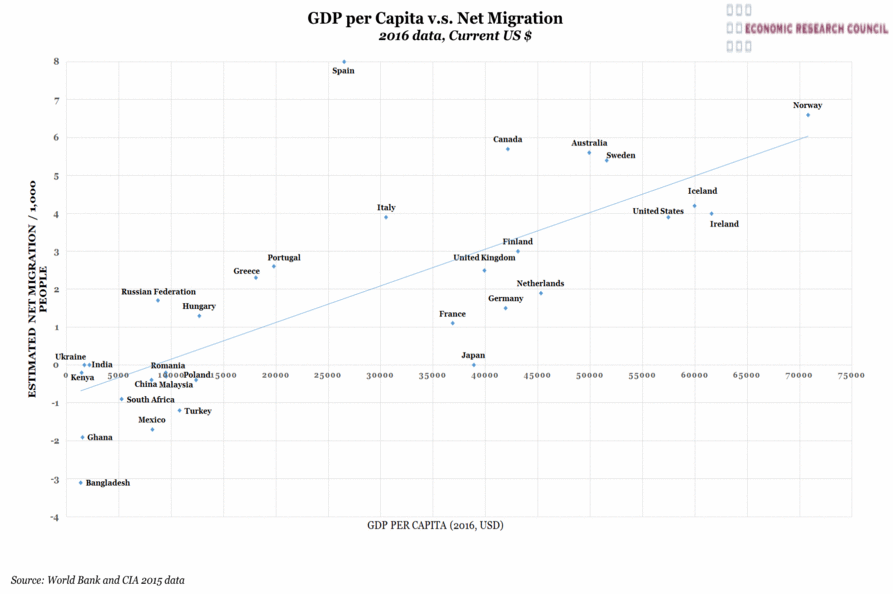
GDP per Capita v.s. Net Migration
Summary: 
This chart plots 31 countries according to the level of GDP and net migration relative to their populations. The trend line shows that countries with higher GDP per capita are typically experiencing higher rates of net migration per 1000 population. Norway sits high on both metrics, due to a range of factors. With a small population and relatively strong economy, Norway has successfully exploited its own natural resources and carefully managed the proceeds via a sizeable sovereign wealth fund. These factors, coupled with high tax rates, enable Norway to boast one of the most progressive and generous welfare systems in western Europe. The top right of this chart also houses other Northern European countries Sweden, and Iceland. These countries have medium to strong economies and social services, as well as low populations. Another in the top right is Ireland, which experienced its first year of positive net migration since 2009, perhaps a product of the tax breaks and grants being issued by the government to attract companies.
 
There is a selection of primarily European nations, alongside Japan, Australia and Canada in the centre of this chart with GDP per capita between $25,000 and $50,000, each with positive net migrations. This is excluding Japan, where net migration is zero. Japanese net migration is an interesting case likely due to a historically stringent entry policy. The next closest country to have net migration as low as Japan is Poland. However when considering GDP per capita, this is over three times lower in Poland (Japan GDP per capita is $38,894 versus Poland’s which is $12,372). Japan’s history of isolationism has caused immigration to be seen as culturally taboo, with few politicians prepared to risk political capital on the issue. 
In 2016, non-Japanese citizens made up only 1.4% of Japan’s total workforce, whereas according to the IMF, most advanced economies operate at over 5%. Critics believe this reluctance to relax immigration policy is detrimental to Japan’s economy, as its ageing population and low birth rate mean that many business owners are struggling to fill jobs. However, PM Shinzo Abe has made it clear that he will not open the country up to permanent residency for unskilled labourers. 
Spain has the highest net migration rate, as well as the lowest GDP out of these countries, with an estimated 8 people moving there per 1,000 residents, despite an unemployment level that is very high, particularly among the young.  Spain’s high net migration is possibly related to its proximity to the Mediterranean, a route via which many migrants, refugees and asylum seekers attempt to gain access to Europe. It may also reflect its historical colonial reach and the dominance of its language, something that engenders both a cultural link and eases the potential difficulties of integration for prospective migrants.
 
Of the countries with GDPs per capita less than $25,000, only four of the 16 countries featured have positive net migrations. The remainder, primarily countries of Africa, Eastern Europe and Asia, are a tightly clustered group with GDP per capita of less than $12,500 and net migrations at or below zero.
 
What does the chart show? The chart shows the estimated net migration per 1,000 people in 31 countries measured on the y-axis. Measured against the y-axis is the GDP per capita of these countries. Both of these figures are obtained from 2016 and GDP per capita is in US dollars. The trend line shows a positive relationship between these two metrics.
 
Why is the chart interesting? Immigration remains one of the most divisive and controversial issues in recent European elections. Increased pressure from the refugee crisis in North Africa and the Middle East has driven changes to the immigration policies of many nations. One example is Norway, where in 2016 the government implemented stricter border checks, and beginning the deportation of asylum seekers arriving from a ‘safe third country’, as well as the offer of financial incentives for migrants to return to their homes. This meant that in the first four months of 2016, Norway had accepted the lowest number of asylum seekers since 1997.  
Other European countries have taken yet more hard-line approaches towards those seeking asylum, particularly those in Central Europe, such as Hungary and Poland. Hungary’s populist PM Viktor Orbán has led the charge, although the European Commission has begun legal action against 3 of the Visegrad nations over their immigration policies which the Commission claims contravene a relocation plan forced through by the western EU powers, demanding that member states accommodate their share of 120,000 refugees. For comparison, Hungary granted asylum to 425 refugees, whereas Germany took in 280,000 asylum seekers.
Although the ability of a state to accommodate and support new citizens no doubt plays a role in the attraction of migrants and refugees, research shows there is often a complex interplay of a myriad factors in these decisions. A whole range of factors exist, each having contrasting implications on decisions including: migrants’ linguistic ability, pre-existing family ties and/or established communities, perceptions of opportunity vs racism and former colonial ties.


UPCOMING EVENT
The ERC in partnership with Deloitte Real Estate present
Your Property: Boom, Bust or Beyond your means?
A Debate on the Future of Housing
Thursday 21st September, 18:30 - 21:00
Kindly Hosted by Deloitte Real Estate,
2 New Street Square, EC4A 3BZ
Book your ticket here.
ABOUT THE SPEAKERS
 James Murray  -Deputy Mayor for Housing and Residential Development
Chris Baldwin -Partner, Deloitte Real Estate
Melanie Leech -Chief Executive, British Property Federation
Simon Harding-Roots -Executive Director of Major Projects, Grosvenor
Michelle Hannah -Associate Director, Cast Construction Consultancy
Are the increasingly competitive and innovative commercial real estate sector, historically low interest rates and an unattractive bond market all combining to nudge the UK away from being an owner-occupied-dominated market? The private rented sector (PRS) continues to expand with pace in the UK as novel solutions to the UK housing crisis are sought: is long term renting the solution?  Will innovations such as modularisation or 3D printing revolutionise construction? Large-scale PRS has long underpinned many housing markets internationally. Recent research by a range of parties has shown what has long been suspected: the millennial generation, blighted by both stagnating wages and rising house prices, now take decades longer than their parents’ generation to save for a deposit. Are the big hitters in UK PRS poised to offer a swathe of alternatives?
From establishing ground breaking new models, to the conversion of non-residential accommodation into homes, PRS is increasingly being integrated into housing strategy. Private developers, investors, local authorities, housing associations and contractors’ interests appear to be converging in schemes of all varieties and sizes across the capital. Will this spread to the rest of the UK? How and by whom is this funded? Our panel will discuss the merits of bank finance, equity investment and Government funding schemes, including the Build to Rent Fund, alongside institutional and private equity investment from the UK, Middle East and Far East. These shifts in market practice have consequences that reach beyond planning and construction: will the letting and management industries keep up as funders seek to extract the most value from an investment? 
Full ERC members are eligible for a free ticket, login with your details to reserve your ticket.
Non-members can purchase a ticket for £25 via the Eventbrite website, with student tickets costing just £10 each.
Please note, the event is of smaller capacity this year and we have a limited number of free tickets for members available. 
 A limited number of Early Bird tickets are available for £15 each.
 
 
OTHER EVENTS
'Northern Rock 10 years on: Is UK Banking sound?'
Professor Kevin Dowd
University of Durham
Thursday 14th September, 18:30 - 20:00
Book your ticket here.
 
ABOUT THE SPEAKER  
Professor Kevin Dowd is a Senior Fellow with the Cobden Centre and a long-standing free market economist whose main work has been on free banking and unregulated monetary systems. Over the years, he has written extensively on the history and theory of free banking, the mechanics of monetary systems without the state and the failings of central banking and financial regulation. He will be discussing his report into the inadequacies of stress testing methods for banks, which received significant coverage in the summer of 2016.
 
Full ERC members are eligible for a free ticket, login with your details to reserve your ticket.
Non-members can purchase a ticket for £20 via the Eventbrite website, with student tickets costing just £10 each.

If you are interested in joining the ERC and attending this and other similar events for free, please click here for more information.
For more information on this and future events visit the ERC website: www.ercouncil.org
If you are interested in becoming a member of the ERC: click here
or contact the Economic Research Council:
info@ercouncil.org
Economic Research Council, 5 Albany Courtyard, London, W1J 0HF
Telephone : 0203 793 7159

 
All these events follow this format:
 
VENUE: ROYAL OVERSEAS LEAGUE
Overseas House, Park Place, St. James's Street, London SW1A 1LR 
6.30 pm Drinks and Networking
7.00 pm Event start
7.30 pm Q&A
8.00 pm Finish

Every place includes a complimentary glass of wine or soft drink.


Dr Graham Gudgin
Centre For Business Research
University of Cambridge
Tuesday 3rd October, 18:30 - 20:00
Book your ticket here.
ABOUT THE SPEAKER
 Dr Graham Gudgin is currently Research Associate at the Centre For Business Research at the University of Cambridge and part-time Senior Economic Advisor with Oxford Economics. He is working on a new Keynesian model of the UK economy with colleagues in Cambridge and elsewhere. He was seconded as Special Adviser to the Northern Ireland First Minister on economic policy from November 1998 -2002. Prior to this, he was the Director of the Northern Ireland Economic Research Centre, the office of which he held since the Centre was established in 1985.
Before coming to Northern Ireland he was a Senior Research Officer in the Department of Applied Economics, University of Cambridge and Economics Fellow of Selwyn College, Cambridge. He has also been advisor to the House of Commons NI Affairs Committee, a member of the Labour Party Commission on the Future of Regional Policy in England, a member of the CBI Corporate affairs Committee in Northern Ireland and a member of the Executive Committee of the Economic and Social Research Institute (ESRI) in Dublin. He was a member of the NIERC Board from 2002-04, and until 2005, a member of the Board of the Economic Research Institute of Northern Ireland (ERINI).
 
Full ERC members are eligible for a free ticket, login with your details to reserve your ticket.
Non-members can purchase a ticket for £20 via the Eventbrite website, with student tickets costing just £10 each.
A limited number of Early Bird tickets are available for £15 each.
 
 
Central Banks' Engagement with Society
Andrew Haldane
Chief Economist, Bank of England
Thursday 5th October, 18:30 - 20:00
Book your ticket here.
 
ABOUT THE SPEAKER
Andrew G Haldane  is the Chief Economist at the Bank of England. He is also Executive Director for Monetary Analysis, Research and Statistics, and a member of their Monetary Policy Committee. Andrew  has responsibility for research and statistics across the Bank.
Andrew has an Honorary Doctorate from the Open University, is Honorary Professor at the University of Nottingham, a Visiting Fellow at Nuffield College, Oxford, a member of the Economic Council of the Royal Economic Society, a Fellow of the Academy of Social Sciences and a Member of the Research and Policy Committee at Nesta. Andrew is Chairman and co-founder of Pro Bono Economics, a charity that matches volunteer economists with charitable projects.
Andrew has written extensively on domestic and international monetary and financial policy issues and has published over 150 articles and four books. In 2014, TIME magazine named him one of the 100 most influential people in the world.
 
*Please note this event will be held under Chatham House rule and will be off the record.*
 
Full ERC members are eligible for a free ticket, login with your details to reserve your ticket.
Non-members can purchase a ticket for £20 via the Eventbrite website, with student tickets costing just £10 each.


Dame Margaret Hodge
Tuesday 7th November, 18:30 - 20:00
Book your ticket here.
ABOUT THE SPEAKER
Dame Margaret  has spent nearly 40 years in public life in London and the last 22 years of her life representing Barking and Dagenham as the Member of Parliament. In 2015 she released her first book ‘Called to Account, How Corporate Bad Behaviour and Government Waste Combine to Cost us Millions’.
The book is about her time as Chair of the Public Accounts Committee. After five years following the taxpayers’ pound, Dame Margaret has written about the 'unconscionable amounts of waste and inefficiency' she observed, in particular on watching 'too many big companies, aided by advisers, banks and lawyers get away without paying their fair share of tax'.
Dame Margaret will share her stories from the frontline and give you her take on the lessons that should be learnt for the future so that all taxpayers get better value for money.
 
Full ERC members are eligible for a free ticket, login with your details to reserve your ticket.
Non-members can purchase a ticket for £20 via the Eventbrite website, with student tickets costing just £10 each.
A limited number of Early Bird tickets are available for £15 each.
SAVE THE DATE
Monday 4th December, 18:30 - 21:30
The Clash of the Titans 
 
SPEAKERS TBA
The seventh annual Clash of the Titans  event is currently scheduled to be held at the auditorium at PWC, More London, Riverside, SE1 2RT. More details coming soon! 
 
Dame Minouche Shafik
Wednesday 28th February, 18:30 - 20:00
Book your ticket here.
ABOUT THE SPEAKER
Dame Minouche will be Director of the London School of Economics from September 2017. She was Deputy Governor for Markets and Banking at the Bank of England, where she had responsibility for the Bank’s balance sheet and its interaction with financial markets. She is a member of the Monetary Policy Committee, the Financial Policy Committee and the Board of the Prudential Regulation Authority. Prior to joining the Bank, she was Deputy Managing Director of the International Monetary Fund from 2011-2014 where she was responsible for policy and programmes in Europe and the Middle East. Prior to that she was Permanent Secretary of the UK’s Department for International Development. She has held academic appointments at the Wharton Business School of the University of Pennsylvania and the Economics Department at Georgetown University and published on a variety of economic topics.
 
Full ERC members are eligible for a free ticket, login with your details to reserve your ticket.
Non-members can purchase a ticket for £20 via the Eventbrite website, with student tickets costing just £10 each.
A limited number of Early Bird tickets are available for £15 each.
'Platform Capitalism' with Nick Srnicek
Tuesday 24th April, 18:30 - 20:00
Book your ticket here.
 
ABOUT THE SPEAKER
Nick Srnicek  is currently a faculty member at King's College London and author of 'Platform Capitlism'. 
What unites Google and Facebook, Apple and Microsoft, Siemens and GE, Uber and Airbnb? Across a wide range  of sectors, these firms  are transforming themselves into platforms: businesses that provide the hardware and software foundation for others to operate on. This transformation signals a major shift in how capitalist firms operate and how they interact with the rest of the economy: the emergence of  ‘platform capitalism’.
Nick Srnicek critically examines these new business forms, tracing their genesis from the long downturn of the 1970s  to the boom and bust of the 1990s and the aftershocks of the 2008 crisis. He will show how the foundations of the economy are rapidly being carved up among a small number of monopolistic platforms, and how the platform introduces new tendencies within capitalism that pose significant challenges to any vision of a post-capitalist future. This book will be essential reading for anyone who wants to understand how the most powerful tech companies of our time are transforming the global economy.
 
Full ERC members are eligible for a free ticket, login with your details to reserve your ticket.
Non-members can purchase a ticket for £20 via the Eventbrite website, with student tickets costing just £10 each.
A limited number of Early Bird tickets are available for £15 each.

If you are interested in joining the ERC and attending this and other similar events for free, please click here for more information.

For more information on this and future events visit the ERC website: www.ercouncil.org

If you are interested in becoming a member of the ERC: click here
or contact the Economic Research Council:
info@ercouncil.org
Economic Research Council, 5 Albany Courtyard, London, W1J 0HF
Telephone : 0203 793 7159