| Pure Water Products |
|
February, 2026
|
|
|
Water Treatment Issues and Current Water News |
In this bleak Winter Occasional, the second for 2026, you'll hear about the Pure Water Gazette's archived treasury of articles, learn what people call us about, where leaked city water goes, an optional pump-mounting system for AerMax, how often filter cartridges should be changed, the effect of road salt on water quality, a simple ORP test you can do without a meter, a questionable government decision to encourage more Glyphosate production, lead problems with New Orleans tap water, Texas' lawsuit against Dow Chemical, how cities fight corrosion in metal pipes, learn what keeps bedbugs awake at night, DBP content of tap water vs. bottled water, the resistance of states to easing PFAs standards, how the government's planned concentration camps will affect area water and sanitation, and, as always, there is much, much more.
|
Water and Environmental Issues |
Water Treatment, Advanced
The Pure Water Gazette website has been archiving information about water treatment for about three decades. Since we add regularly and almost never discard, the Gazette website is now bulging with many hundreds of informative and useful articles about water issues and how to deal with them. Best of all, there are no intrusive pop-ups or other distractions from the subject at hand. Even more importantly, information-rich articles don't disappear. You can depend on them to be there for future reference.
The Pure Water Gazette is a non-commercial site. Its function is to provide information, not sell products. The Gazette website is designed to be useful and informative, not beautiful. It is arranged into several broad categories. Below are the main topics from the site's sidebar index. Each of the main categories leads to articles added to the site since 2012.
-
- A few clicks on the links above will give an indication of the extensiveness of the Gazette's content. In this issue of the Occasional we're going to include a few articles from a single section, Water Treatment, Advanced/ . Water Treatment, Advanced contains scores of entries focused on topics of general interest to those interested in water treatment, from general information about product categories and treatment of various contaminants to some very specific information.
Last Month's Occasional featured reprints of a couple of pieces from the Water Treatment 101 categoy Here are some typical articles from Water Treatment, Advanced.
Talking About Water Treatment on the Phone

What People Call Us About
by Gene Franks, Pure Water Products
When we say phone sales at Pure Water Products, we don’t mean
telemarketing or cold calling. All phone work here is incoming. When
the phone rings, we answer it and do our best to help the caller,
whether he or she wants to buy something, has a complaint, needs help
installing or trouble-shooting a product, or just wants information. The
only people we call are people who have asked us to call them.
Phone work is the hardest and scariest part of our business, because
when the phone rings it can be anyone with any kind of question or
problem. People who answer the phone learn quickly that you can’t know
everything and that when you don’t know the answer to a question the
best thing to do is say that you don’t know and offer to get the
information and call or email back. We say “I don’t know” a lot.
Here are some examples of things we get most questions about–not in order of frequency.
- Removing chloramines from city water.
- The kinds of plastics tubing and filter housings are made of, and don’t we have any made of glass or stainless steel.
- Removing iron, manganese, and/or hydrogen sulfide from well water.
- Removing fluoride and arsenic from water.
- Removing the newer contaminants like GenX.
- Adding minerals to reverse osmosis water.
- What are reverse osmosis tanks made of.
- Something the caller just heard on the news.
- Raising pH of well water and or reverse osmosis water.
- Salt-free “softeners.”
- Spot-free car washing (my own least favorite topic).
- Sizing everything: whole house city water filters, iron filters, water softeners, retention tanks, and a lot more.
- Troubleshooting undersink reverse osmosis. Most frequent question:
Why isn’t my RO unit making enough water? And, how often should I change
the membrane?
- Pressure drop questions about whole house filters.
- Country of origin of products. (There is much interest now in “made
in USA” products, and they’re getting harder and harder to find.
“Assembled in USA” is often offered as a substitute.)
- Help in identifying and buying replacement parts.

No, sir, I haven’t seen the video
that proves that you can’t live past age 37 without a machine that
makes alkaline water. Could you send me a link?
We’re proud that we answer the phone six
days a week during Texas business hours and usually a couple of hours
after. If you’ve tried calling other internet water treatment sources
you know that we’re the exception to the usual. And people also tell us
that we’re exceptional in that you can get information from us without a
sales pitch.
This is a hard business and we aren’t
perfect, but we do our best. Keep in mind that there isn’t a college
course about how to answer questions about water treatment, so the staff
who answer our phones learn to talk on the phone by talking on the
phone. By winging it. It’s like learning to swim by jumping out of the
boat. Also keep in mind that our phone sales people are mainly occupied
with office management, website design and maintenance, building
products, managing inventory, keeping records, packing packages, and a
lot more. When you call, you’re actually talking with someone involved
in the business, not a phone bank person who only knows how to take
orders.
So be patient with us. Not a single one of us has a degree in phone sales.
The Loss of Water in City Water Systems: Where does the water go?
Every municipal water system leaks. Billions of gallons of water are lost every day from U.S. drinking water systems.
The city of Joliet, Illinois recently raised its water rates but was also forced to enter into a serious discussion about where 1/3 of its water goes. A full 33 percent of the water produced by the city for sale is not being sold and for the most part is unaccounted for. What’s worse, the amount or “lost” water is increasing every year. “Acceptable” water loss for cities is around 8%. Leaks account for most of this. A certain amount of leakage is inevitable, and it’s hard to find leaks in pipes that are 10 feet underground. Big leaks, like main breaks, can be estimated and thus “accounted for.” Also, the city can keep estimated records on water used for firefighting and street cleaning.
Inaccurate meters also account for a lot of the lost water. Meters, especially old ones, sometimes underestimate usage and the water that doesn’t get billed makes up part of the city’s lost water total. It isn’t unusual for some customers to get free water simply because of glitches in the billing system. What they get is, to the city, “lost” water.
Finding lost water is much harder than one might think. The city of Joliet hired a consulting firm that took a hard look and concluded that it did not know where the unbilled water was going. What they did conclude, however, was that the city was spending way too little to maintain it’s water lines.
The city of Joliet is not an extreme case. It is not uncommon to hear of water utilities that only bill for 50% or less of the water that they treat and pump to distribution. Studies have estimated that as much as 5.9 billion gallons per day of water is lost to leakage, poor accounting and other unbilled consumption in the United States. This is more than enough water to supply the ten largest cities of the United States.
Optional Mounting Bracket for AerMax Now Available
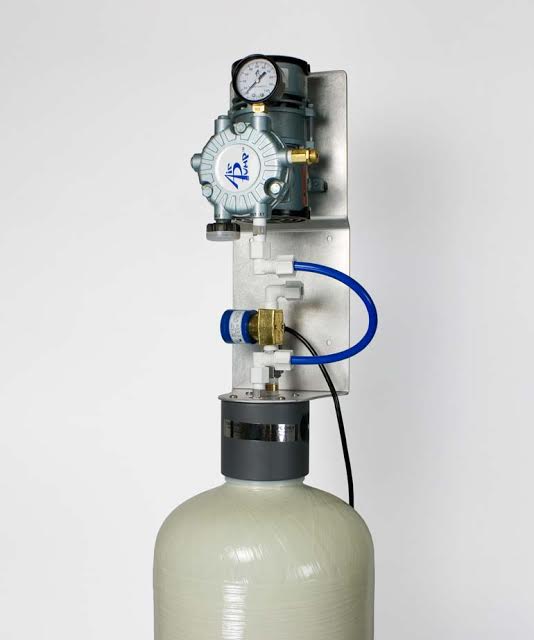
Our new AerMax installation kit mounts the air pump on the tank itself.
The traditional AerMax that we’ve sold for many years now comes with an optional installation kit. With the traditional AerMax unit, the air pump is wall mounted beside the treatment tank. The new optional installation system, pictured above, allows the air pump to be installeed on top of the tank itself, providing a more compact, vibration-free mounting. The vertical mount system is now available, as is a timer control that makes installation much easier than previously. Please call 940 382 2814 for details.
How Often Should Carbon Filter Cartridges Be Changed?
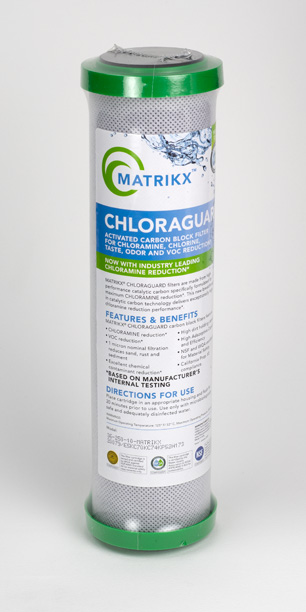
MatriKX Chloraguard Filter Cartridge, 2.5″ X 9.75″ — Standard Drinking Water Size
The simple and probably the best answer for residential applications is that carbon filter cartridges should be changed at least once a year. The more complicated answer is that it all depends on what you expect of the cartridge, how much you know about your water, and how willing you are to monitor such things as the amount of water used and the flow rate.
Carbon filters are a very versatile tool that can be applied to many different problems. What they do best and easiest is remove chlorine and improve taste and odor. But they are also the most practical treatment for many more difficult problems, like chemicals in general (see how many times carbon appears as the treatment of choice in this contaminant removal chart), and very hard to treat items like VOCs and PFAS.
Below is the manufacturer’s lifespan recommendation for the high quality coconut shell carbon block filter pictured above.
- Chlorine: 45,000 @ 1 gpm,
- Chloramine: 4,000 @ 0.5 gpm,
- PFAS: 3,500 @ 0.5 gpm,
- VOC: 750 @ 0.5 gpm.
Note that if your requirement is only the removal of chlorine from drinking water the cartridge should last until you die of old age. However, if your city uses chloramine rather than chlorine as its disinfectant, it will last only about 1/10 as long, and you’ll have to be sure to run the water half as fast. Running the cartridge at “chlorine speed” will greatly reduce its service life as well as its effectiveness when treating chloramine or difficult contaminants like PFAS and VOCs.
In most cases the once-a year-rule works well and assures excellent performance with most contaminants. If more than a couple of people are using the water and VOCs are a known issue, changing the cartridge twice a year is a good idea.
And then, of course, there are variables to be considered like multi-cartridge filters, position of the cartridge within the unit (a reverse osmosis pre-filter treats much more and much dirtier water than a reverse osmosis post filter), water temperature, pH, etc. But, for simplicity, the once-a-year cartridge change works pretty well.
What Happens to All the Salt We Dump On the Roads?
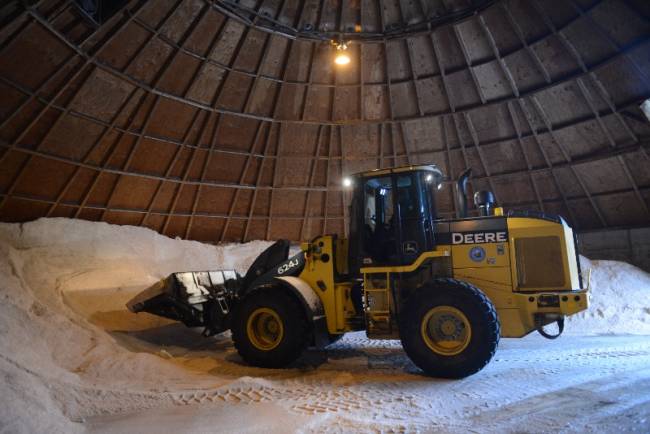
In the U.S., road crews scatter about 137 pounds of salt per person annually to melt ice. Where does it go after that?
by Joseph Stromberg
As much of the country endures from the heavy snowfall and bitter cold that has marked the start of 2014, municipalities in 26 states will rely on a crucial tool in clearing their roads: salt.
Because the freezing point of salty water is a lower temperature than pure water, scattering some salt atop ice or snow can help accelerate the melting process, opening up the roads to traffic that much sooner. It’s estimated that more than 22 million tons of salt are scattered on the roads of the U.S. annually—about 137 pounds of salt for every American.
But all that salt has to go somewhere. After it dissolves—and is split into sodium and chloride ions—it gets carried away via runoff and deposited into both surface water (streams, lakes and rivers) and the groundwater under our feet.
Consider how easily salt can corrode your car. Unsurprisingly, it’s also a problem for the surrounding environment—so much that in 2004, Canada categorized road salt as a toxin and placed new guidelines on its use. And as more and more of the U.S. becomes urbanized and suburbanized, and as a greater number of roads criss-cross the landscape, the mounting piles of salt we dump on them may be getting to be a bigger problem than ever.
Data from long-term studies of watersheds bear this out. A group of scientists that tracked salt levels from 1952 to 1998 in the Mohawk River in Upstate New York, for instance, found that concentrations of sodium and chloride increased by 130 and 243 percent, respectively, with road salting the primary reason as the surround area became more developed. More recently, a study of a stream in southeastern New York State that was monitored from 1986 to 2005 found a similar pattern, with significant annual increases and road salting to blame for an estimated 91 percent of sodium chloride in the watershed.
Because it’s transported more easily than sodium, chloride is the greater concern, and in total, an estimated 40 percent of the country’s urban streams have chloride levels that exceed safe guidelines for aquatic life, largely because of road salt.
This chloride can occasionally impact human water use, mostly because some penetrates into the groundwater we tap for drinking purposes.
Water utilities most frequently report complaints of salty drinking water during the winter, when chloride concentrations are likely to exceed 250 parts per million (ppm), our tastebuds’ threshold for detecting it. This is an especially big issue for people on salt restrictive diets. Overall, though, road salt-laced drinking water isn’t a widespread problem: A 2009 USGS study found that fewer than 2 percent of the drinking wells sampled had chloride levels that surpassed federal standards.
Road salt pollution is generally a bigger issue for the surrounding environment and the organisms that live in it. It’s estimated that chloride concentrations above 800 ppm are harmful to most freshwater aquatic organisms—because these high levels interfere with how animals regulate the uptake of salt into their bodies—and for short periods after a snow melt, wetlands nearby highways can surpass these levels. A range of studies has found that chloride from road salt can negatively impact the survival rates of crustaceans, amphibians such as salamanders and frogs, fish, plants and other organisms.
There’s even some evidence that it could hasten invasions of non-native plant species—in one marsh by the Massachusetts Turnpike, a study found that it aided the spread of salt-tolerant invasives.
On a broader scale, elevated salt concentrations can reduce water circulation in lakes and ponds (because salt affects water’s density), preventing oxygen from reaching bottom layers of water. It can also interfere with a body of water’s natural chemistry, reducing the overall nutrient load. On a smaller scale, highly concentrated road salt can dehydrate and kill trees and plants growing next to roadways, creating desert conditions because the plants have so much more difficulty absorbing water. In some cases, dried salt crystals can attract deer and moose to busy roads, increasing their chance of becoming roadkill.
How can we avoid killing trees and making roadkill of deer while de-icing the roads? Recently, in some areas, transportation departments have begun pursuing strategies to reduce salt use. Salting before a storm, instead of after, can prevent snow and ice from binding to the asphalt, making the post-storm cleanup a little bit easier and allowing road crews to use less salt overall. Mixing the salt with slight amounts of water allows it to spread more, and blending in sand or gravel lets it to stick more easily and improve traction for cars.
Elsewhere, municipalities are trying out alternate de-icing compounds. Over the past few years, beet juice, sugarcane molasses and cheese brine, among other substances, have been mixed in with salt to reduce the overall chloride load on the environment. These don’t eliminate the need for conventional salt, but they could play a role in cutting down just how much we dump on the roads.
A final article from Water Treatment, Advanced, that may help you make a decision about how to remove iron or odor from you well water.
Testing for ORP with Potassium Permanganate
Editor’s Note: The instructions below, which we’ve modified a bit, were prepared by the original manufacturer of Filox-R iron removal media. The purpose is to provide a quick and easy way to determine if your water can be treated by standard manganese dioxide-based iron filter media like Filox or Katalox without the use of additional oxidizers like chlorine, air, ozone, hydrogen peroxide or potassium permanganate.
Oxidation Reduction Potential (ORP) can be the most important factor to take into consideration in certain waters. Highly reducing waters may cause premature exhaustion or even destruction of the media bed.
Precautions can be taken prior to installation that can prevent ORP problems. Use one of the screening tests and follow the instructions below if the subject water has reducing properties that will require additional oxidants.
The Simple Test
Mix 1.75 ounces (50 grams) water with 0.75 ounces (22 grams) of potassium permanganate crystals. Then take 2 drops of the mixture and stir into a fresh ¼ gallon (1 liter) sample of the subject water. Let the subject water stand for 15 minutes. If the pink color remains, Filox-R can be installed without additional oxidants. If the pink color disappears, additional oxidants will be needed for Filox-R to function properly.
The ORP Test with a Meter
Note: Must use a calibrated ORP meter. Any reading that is above a negative 170 millivolts indicates that Filox-R can be used effectively without additional oxidants. Any reading falling below a negative 170 millivolts indicates that additional oxidants will be required.
The amount of oxidant required for proper installation can be determined by measuring the amount of oxidant added to a specific volume of subject water until the solution remains pink or the meter reads at negative 170 millivolts or above. An extrapolation can then be made to determine the correct feed rate for the oxidant with respect to the subject water flow rate. Once installed, sample the solution after the injector and mixer and repeat the above test to confirm that the feed rate is correct.
Final Note: The article is included to illustrate that deciding "scientifically" if your well water can be treated without an oxidizer is usually beyond the capabilities of the homeowner. The best approach is usually either to add a filter without an oxidizer to see if it works with the idea of adding an oxidizer like air or chlorine if needed, or, better, assume that an oxidizer will be needed and install accordingly. The second option will greatly increase your chances of success.
|
Water News
Water News for February of 2026

Water News For February 2026
Boil Water Alerts
Boil water alerts resulting from cold weather and aging infrastructure were too numerous to report.
A Bad Week for Clean Water and Public Health: How President Trump’s Glyphosate Executive Order and the 2026 Farm Bill Threaten Us All
On Feb. 18, President Trump signed an executive order titled Promoting the National Defense by Ensuring an Adequate Supply of Elemental Phosphorus and Glyphosate-Based Herbicides. Using the Defense Production Act, the order declares glyphosate and elemental phosphorus “critical” to national security and U.S. agriculture.
At first glance, this may sound like a supply chain measure. But in reality, it puts chemical industry profits above public health and clean water.
Why President Trump’s Executive Order on Glyphosate is Dangerous:
Instead of addressing decades of independent research by experts linking glyphosate — a widely used herbicide — to cancer, liver damage, endocrine disruption, and other serious health effects, the executive order pushes for more production.
Glyphosate and other pesticides already pollute our water. Studies have shown these toxic chemicals are widespread in streams and rivers. Despite this, the executive order doubles down, prioritizing the chemical industry’s interests over community safety.
Even more alarming, the order grants legal immunity to chemical producers following federal directives. Communities harmed by contamination could find it even harder to hold chemical companies accountable. And, the U.S. Department of Agriculture (USDA) is now directed to prioritize chemical production even if it increases exposure risks. Waterkeeper
Lead in New Orleans Water
Lead was detected in 7 of 10 New Orleans homes amid delayed pipe replacement The city’s residents are at risk of lead poisoning from their tap water because of piping that is long overdue for replacement. US News
Texas Sues Dow Chemical for “habitual non-compliance” with wastewater regulations: Is the state actually doing the notorious polluter a favor?
Texas attorney general Ken Paxton (widely known as an enemy of environmental regulation and friend to big business) is believed by many to have filed the suit to shield the company from a soon-to-be-filed suit by a local environmental group which would result in much harsher penalties and have greater chance of success. Houston Public Media.
Orthophosphate Treatment Added to Protect Against Leaching of Lead from Water Pipes
Kalamazoo MI is changing the corrosion prevention additives it has used since 1956 in an effort to assure its customers the best protection possible against lead. The protective lining reduces direct contact between water and metal surfaces, lowering the risk of metals, like lead, leaching into drinking water from older pipes. m.live.com
Bed Bugs’ Greatest Fear: Water and Wet Surfaces
Bed bugs have extremely flat bodies and small respiratory openings called spiracles on their belly sides. “If they physically contact a body of water, they’ll get stuck to its surface, blocking their respiratory openings.” Due to its strong adhesive power, water could be very dangerous from a bed bug’s perspective. So, it’s not surprising to learn that they’re extremely averse to moisture.” UC Riverside News
Study Finds Lower Levels of DBPs (by-products of chlorination) in bottled water than in tap water
A new study found that bottled water contains lower levels of disinfection byproducts (DBPs) than chloraminated tap water, averaging less than half the amount found in typical U.S. tap samples. Researchers detected DBPs—including trihalomethanes and haloacetic acids—in all 10 bottled water brands tested, though levels remained relatively low. Spring and groundwater brands tended to have fewer DBPs than purified bottled waters, making them the better choice for minimizing chemical byproducts. Food and Wine.
States Are Resisting the Trump Administration’s Efforts to Ease PFAS Regulations Established During the Previous Administration
States are locking in stricter limits on “forever chemicals” in drinking water while the Trump administration’s stated plan to soften those rules remains stalled. EPA said it would delay and partially rescind a landmark drinking water regulation for the synthetic chemicals that had been set by the Biden administration. The plan, announced last spring in a press release, was to formally propose changes last fall and finalize them this spring. Now, the agency that has lost thousands of staff under President Donald Trump is behind schedule. EPA has encouraged states to hold off on adopting the Biden-era limits for the substances that taint the tap water of over 100 million Americans. E&ENewsInfrastructure and Water Availability Crises Will Be Inevitable with the Establishment of Government’s Plan for Massive Concentration Facilities
The federal government has provided few specifics on the impacts ICE’s plans could have on rural communities where huge warehouses are being purchased to convert to concentration facilities for prisoners. Here’s an article that takes a look at how little planning has been devoted to what will be a massive problem, especially for small communities whose water and sanitation infrastructure are not capable of supporting the addition of massive prison warehouses. Spotlight.
|
|
Places to visit for additional information:
|
|
|
|
|
|