| Pure Water Products |
|
June, 2026
|
|
|
Water is chiefest of all things, for streaming
Therefrom all life and existence came.
Pindar's First Olympian Ode |
|
Water Treatment Issues and Current Water News |
| In this start-of-summer Occasional, you'll be thrilled by a rundown of reverse osmosis shutoff issues, find out how to get microplastics out of your drinking water, learn how to install filters in parallel to enhance performance and service flow, plus you'll hear about ultrafiltration and why you probably don't want it for whole house treatment, microbial contamination and how to deal with it, find out about chlorine burns and the president's sorrowful pool fiasco, then you'll learn now plants along the Colorado River are hogging water, hear a scary drought warning from the UN and another scary drought warning from the Governor of Colorado, find out once and for always if it's really true that all of the planet's water has been peed at least once, hear about Paraquot's association with Parkinson's Disease, an unexpected link between unsafe water and hunger, and as always, there is much, much more. |
|
Water and Environmental Issues |
More from the Pure Water Gazette Bulging Article Archive
The Pure Water Gazette website has been archiving information about water treatment for about three decades. Since we add regularly and almost never discard, the Gazette website is now bulging with many hundreds of informative and useful articles about water issues and how to deal with them. Best of all, there are no intrusive pop-up ads or other distractions from the subject at hand. Even more importantly, information-rich articles don't disappear. You can depend on them to be there for future reference.
The Pure Water Gazette is a non-commercial site. Its function is to provide information, not sell products. The site does not take orders or ask you for information. The Gazette website is designed to be useful and informative, not beautiful. It is arranged into several broad categories. Below are the main topics from the site's sidebar index. Each of the main categories leads to articles added to the site since 2012.
-
- A few clicks on the links above will give an indication of the extensiveness of the Gazette's content. In this issue of the Occasional we're going to include some miscellaneous articles from the Gazette.
This Issue of the Occasional
The article that follows appeared in the Pure Water Gazette in January of 2024. It addresses a frequently misunderstood issue with undersink reverse osmosis units: what's happening when you hear water running to drain. The article is archived in the Gazette's "Reverse Osmosis" category, and this issue will include a couple more articles from the same section.
Reverse Osmosis Shutoff Problems
Here is a typical customer question regarding an undersink reverse osmosis unit that doesn’t seem to be shutting off properly.
In the past week or so we’ve noticed a dramatic uptick — or trickle — of the filter. That is, we’ve been hearing sometimes for a couple hours at a time, for a week every day, what I’m calling the usual but much less frequent “back flow” into the drain pipe that happens during filtration under normal conditions. Whereas it used to be heard only once a month — in other words, so infrequently that we almost didn’t notice it.
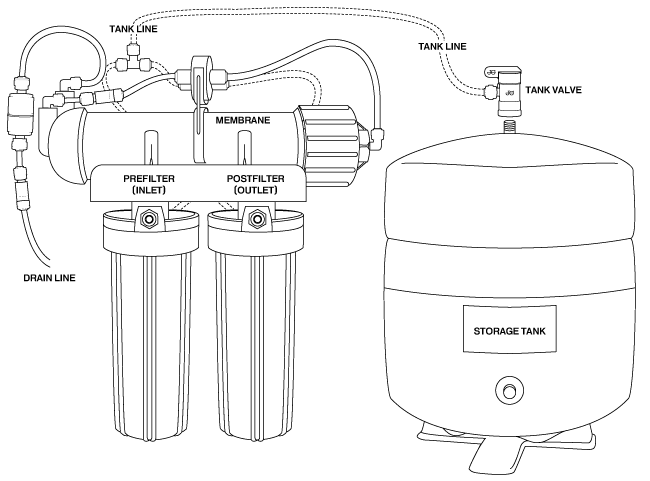
The “backflow” that the RO owner describes is actually the unit’s normal flow to drain. Whether you hear it or not, there is always a trickle of water running to the drain while the unit is filling the storage tank. The drain water’s function is to carry away the impurities that have been rejected by the RO membrane. The trickle to drain happens when the unit is making water to fill the tank. When the tank is full, it stops. Drain water (also called brine or reject water) gets to the undersink drain pipe via the "drain line" on the extreme left of the picture. The larger object in the drain line, by the way, is a flow restrictor which controls the amount of water that goes through the drain line. The smaller object is a one-way valve called a check valve that lets water flow to the drain but prevents it from backing up into the RO unit if the drain should stop up.
RO Units Don’t Follow Human Logic
There are a number of reasons why you start hearing water run into the drainpipe when you have not heard it before. The most common are a change in water pressure or a change in temperature, causing the water to fall a bit differently into the drain pipe. When drain water slides down the wall of the pipe, you don’t hear it, but if the pressure is a bit stronger it can fall into a small pool of water that has gathered in the pipe and you’ll hear it fall. (If the drain saddle is installed on a horizonal rather than a vertical pipe, you will hardly ever hear the drain flow.)
If it sometimes takes much longer than you would expect to fill the tank, that’s usually because the unit’s production was shut off prematurely with the tank only partially full. The next time the unit begins making water, it will take longer than you expect to refill the storage tank. Here’s a common situation. The unit is filling the tank when an event like a toilet flush or a shower lowers incoming pressure and the production stops because the shutoff system thinks that the tank is full. (Yes, I know, RO units don’t think.) The way that the shutoff system determines the amount of water in the tank is by monitoring the pressure inside the tank and comparing it to the pressure of the tap water going into the unit. The unit fills the tank until the pressure in the tank equals about 2/3 of the pressure of the inlet water. If the inlet pressure goes down (as happens when a toilet is flushed), the production of water to fill the tank can be interrupted. The next time there is a demand for water (e.g., the RO faucet is opened), the pressure in the storage tank goes down, production starts. In this case it will take a lot longer to top off the tank than you would expect.
To Determine If There Is a Problem
The first thing to do is to determine if the shutoff system is working.
Probably the easiest way to determine if the system is working is before going to bed to run enough water through the unit to start production, then check it the next morning. If it has shut off during the night everything is probably working fine.
A quicker way is to turn off the valve on top of the storage tank (off is with the valve handle at right angles with the tube), then open the countertop RO faucet. The water should run at a uniform trickle or small stream. Next, turn off the faucet. Water should stop running to drain within 3 or 4 minutes. If it stops production and keeps it off, the shutoff system is working fine. Turning off the tank valve simulates a full tank.
If water continues to run with the tank valve closed, the unit needs attention. The most likely parts that need replacement are the hydraulic shutoff valve (the small part mounted above the membrane housing that has 4 tubes) or, less likely, the check valve (one way valve) in the permeate tube that leaves the membrane (not the one in the drain line). It is the small cigar-shaped item in the short tube that connects the left end of the membrane housing with the shutoff valve.
Red Flag
If the water you hear in the drain line sounds more like a rushing river than a gentle trickle and it never stops, turn off the inlet water to the unit and leave it off until a repair is made. The offending part is the flow restrictor. That’s the larger of the two cigar-shaped items in the drain tube.
To read this article on the Gazette website, go here.
Residential Removal of Microplastics from Water
Avoiding microplastics in the environment is becoming increasingly
difficult. Removing them from drinking water is relatively easy.
Standard treatments for drinking water like reverse osmosis and
carbon filtration do an excellent job on microplastics, so no special
equipment is needed.
Reverse osmosis, which filters out particles down to 0.001 microns,
is the best treatment, but standard carbon filtration also works very
well. Highest removal percentages with carbon filtration are obtained
with carbon block filters. The tighter the filter, the better the
result, but even small end-of-faucet filters and pitcher filters are
reasonably effective at removing microplastics. Changing cartridges
frequently is important.
Parallel Installation of Water Filters
The illustration above depicts a triple parallel installation that is used to increase the service capacity, the longevity, and the effectiveness of cartridge filters. As an example, if a home needs 15 gallons per minute of service flow for, say, chloramine reduction, the desired flow can be most easily obtained by installing three 5 gallon-per-minute carbon filters in parallel so that the flow splits and each 5-minute unit has to handle only 1/3 of the desired 15 total. Water passes through a single sediment filter on the left. The sediment filter will easily handle the 15-gpm flow,then each of the carbons have to handle only five. This is a practical, relatively inexpensive installation that is easy to maintain.
A Pure Water Gazette article features drawings of six arrangements with compact whole house filters including one that illustrates how to build your own by-pass system for the compact units.
Ultrafiltration: Between Conventional Filters and Reverse Osmosis
by Gene Franks
Author's Note: UF, ultrafiltration, seems like an ideal residential whole house water treatment process, but so far the expectation has not become a practical reality. There are UF units on the market, but so far these are expensive and problematic. For residential use, UF seems to be a strategy whose time is yet to come.
In water treatment, the term “ultrafiltration” is used to describe a filtration process that separates out particles down into the 0.1 to 0.001 micron range.
That’s extremely small when compared with conventional filtration, but it’s large when compared with nanofiltration and reverse osmosis. Ultrafiltration is tight enough to strain out pesky colloidal particles that conventional filters can’t hold, and it rejects both organic and inorganic large molecule substances. It cannot, however, remove ions and organics with low molecular weights (sodium, calcium, sulfate, for example), which are readily removed by reverse osmosis.
Molecular weight, in fact, is the yardstick by which ultrafiltration systems are usually measured. For example, an ultrafiltration membrane that removes dissolved solids with molecular weights of 10,000 is said to have a molecular weight cutoff of 10,000. Such a membrane has a nominal pore size of about 0.003 micron.
Compared with reverse osmosis, ultrafiltration membranes have extremely high flux rates. (Think of flux as the speed that the product water goes through the membrane.) They can also be operated at much lower pressure. As with reverse osmosis, temperature can have a great effect on performance, with lower temperature resulting in reduced flux rate.
Unlike conventional filters, ultrafiltration membranes do not trap and hold contaminants but like the reverse osmosis membranes they act as a barrier, holding contaminants until they are washed away. Ultrafiltration works in the same cross-flow separation method as reverse osmosis.
One great advantage of ultrafiltration membranes is that they can operate at pressures much lower than those required for reverse osmosis. In fact, UF systems usually operate at pressures below 100 psi, and 50 psi operation is common.
Testing Water for Microbial Contamination
Adapted in part from information from Viqua, a leading manufacturer of ultraviolet treatment equipment.
Scientists have long understood the link between unseen contaminants in water and illnesses. In the 1900s, filtration and treatment became mainstays for municipal water, and regulations for the quality of public drinking water systems were established. Health authorities consider the introduction of water chlorination to be perhaps the most significant advance in public health made in the 20th century.
If your water is supplied by a municipality, large or small, the water supply is tested routinely, at the source. However, many pipes buried underneath our roads and cities have been in place since the introduction of widespread water treatment and are long past the time when they should have been replaced. This aged and often crumbling infrastructure now poses its own risk, which is why it’s smart to test the water where it is used. Even with city water, microbial contamination can occur between the water treatment plant and your home.
But what if your water comes from a private water supply, such as a well, a lake, or even a rainwater tank? In these cases, no one is testing the water unless you are. It’s possible that your water was tested when the well was drilled or when the property was purchased, but microbial water quality changes over time and can be affected by extreme weather events, land-use changes, or a nearby failing septic system.
Many water contaminants cannot be seen or even tasted in water, so the only way to be sure of the quality of your water supply is to test it. Even if the presence of a particular contaminant is readily apparent, such as the red-colored stains left by iron on fixtures, getting the water tested will quantify the problem, making the best water treatment choice easier.
Private water system users are solely responsible for the quality of their water. Public health authorities recommend that private well owners test for bacteria and nitrates at least once a year. Other contaminants, such as hardness, iron, or radon, may only need to be tested once. This testing frequency depends on the prevalence of naturally occurring substances in the area’s groundwater. Probably if you have experienced one of the following events, you should have your water tested soon:
• The water’s color, taste, or odor changed.
• Someone in the family has a weak immune system from an illness, medical treatment, or age.
• Someone who drank your tap water had an unexplained gastrointestinal illness.
• You moved into a new home.
For well owners, water should be tested at the wellhead at least once a year. The test sample should be taken before any water treatment equipment. Well water should also be tested whenever any work is done on the well or whenever any need for water treatment is suspected. Any change in taste or odor is a sign that a test should be performed. A test should also be done at intervals to test the efficacy of installed equipment. Testing for hardness, for example, will tell you how well your water softener is working. Likewise, a bacteria test will tell you if any disinfection equipment you have in place is working properly.
Total Coliform Bacteria
The most important measurement result for bacteria testing is for Total Coliform Bacteria. Coliform bacteria occur naturally in soil and decaying vegetation. They are associated with the presence of human or animal fecal contamination. While many coliform organisms are completely harmless, some, like E. coli, can make people sick and even be deadly. The usual practice is to test for coliform and if coliform is present in significant numbers, test specifically for E. coli. Presence of E. coli is a definite indication that treatment is needed. Water with E. coli should not be consumed unless it is boiled or otherwise treated.
Treating Contaminated Water in the Home
There are several good strategies for treating microbes in water, but the most widely used for permanent residential whole house treatment are chlorination and ultraviolet. Of the two, ultraviolet (UV) is usually the easiest to apply and the most trouble-free to maintain.
Sources of more information about testing and treatment.
City and county governments usually can provide information and quick and inexpensive testing for bacteria.
There are many excellent professional water tests. Most mail-in tests available do not offer testing for bacteria. One excellent mail-in test is offered on our website. The NTL tests include bacteria along with comprehensive testing for most significant water contamination. National Testing Laboratory Test from Pure Water Products. If you are in a hurry for results, a local test for bacteria is bettter. Typical turn-around time on the NTL test is at least two weeks.
What Are Chlorine Burns? and Why Do People Hate
Them?
Once a year, usually in spring, water suppliers that normally disinfect their product with chloramine, a mixture of chlorine and ammonia, perform a cleaning procedure known as a "chlorine burn." The purpose is simply to clean out the pipes, ridding the distribution system of film and debris that has built up.
The clean-out is accomplished by simply switching disinfectants from chloramine to straight chlorine for a time, and usually upping the dosage a bit to speed things along. Compared with chlorine, chloramine is a rather weak disinfectant. Its weak performance allows sludge and scum, bacterial film, to build up in pipe walls and crevices. The yearly purge, or "burn," with straight chlorine, cleans things out.
Chloramine is substituted for chlorine as the regular disinfectant in an increasing number of city water systems. The switch from chlorine to chloramine has been going on over a number of years as suppliers seek ways to stay in compliance with EPA standards for DBPs, disinfection by-products, that are produced as a consequence of chlorination. Some DBPs are known carcinogens, and EPA requires suppliers to monitor them. Chloramine, a weaker disinfectant, does not produce DBPs.
Are chlorine burns a good idea? Good or bad, they are necessary, since without a periodic cleanout, buildup in pipes would create significant problems for the water distribution system. The practice does call into question, however, the wisdom of using chloramine rather than chlorine in the first place, since, as many argue, while in progress, the burn and subsequent purging of pipes creates elevated levels of disinfection by-products in the system and higher than normal chlorine discharge into lakes and streams. In other words, for a short time we get concentrated doses of disinfectants and byproducts, which may be worse than what we would have with chlorine as the regular disinfectant.
The moral: With a good carbon filtration system in your home, you won't even know when the burn takes place. The elevated chlorine levels, murky water, and dislodged sediment that your neighbors are complaining about, you won't even notice.
|
Water News
Water News for May of 2026
The Take-Our-Word-For-It Water News for June 2026
From
this point our Water News page will provide only an occasional source
link. Use a search engine to find information if you want to pursue the
topic.
Trump's Infamous Pool Fiasco
June's
most persistent water story was the embarrassing algae takeover and
alleged "vandalism" of the "blue" pool at the Lincoln Center. The
president paid millions for a no-bid pool repair deal that that turned
out badly.
Drought Paradox
US Targets Reservoirs
A
US attack on two water reservoirs in the Bemani area of Sirik in
southern Iran, located on the shores of the strait of Hormuz, left
20,000 people without drinking water, according to an Iranian water
utility company. Hormozgan province water and wastewater company, or
Abfa Hormozgan, said the reservoirs were “targeted and completely
destroyed” by US military fire. Targeting civilian water reservoirs is a
clear violation of standard rules of warfare followed by most of the
civilized world.
EPA vs. Wego Chemical Group
U.S. Environmental Protection Agency filed an "administrative complaint" against Wego
Chemical Group of Great Neck, N.Y., and related
companies, for violations of the Toxic Substances Control Act
(TSCA). The complaint details Wego’s years-long failure to
properly report its import and domestic distribution of chemical
substances. Since at least 2016, Wego has imported hundreds of millions
of pounds of toxic chemicals, mostly from China, without meeting basic
federal reporting requirements. The complaint also alleges that at
least one chemical Wego imported could not lawfully have been imported
at all.
According to The Guardian, Data Centers Are Water Hogs and It's Going to Get Worse
Scientists have determined that
the climate crisis, caused by the burning of fossil fuels, is worsening
the duration and intensity of droughts in the US.
But
a stampede of new data centers are adding extra demands via their hefty
energy and water requirements. Large datacenters, some the size of
small towns, can require up to 5m gallons of water a day, equivalent to
the water use of up to 50,000 people, in order to provide cooling to
arrays of humming networked computers.
Overall,
the multiplying datacenters across the US are set to demand as much
as 73bn gallons of water a year by 2028, up from about 17bn gallons in
2023. Each 100-word AI prompt uses up roughly one 500ml bottle
of water due to the cooling needs of datacenters, researchers
have estimated.
“The AI industry is
sprinting as fast as it can to gain market dominance, and the rest of us
have to deal with a great increase in water demand in places already in
drought,” said Christopher Dalbom, an expert in water resources law at
Tulane University.
“Even if there wasn’t
climate change, we’d be feeling the effects of droughts more acutely,
because water demand is going up and up, to feed more people and water
more lawns and crops. There isn’t enough water to go around. Now with
this explosion of datacenters, I think a crunch point is inevitable.”
Companies
such as Google, Meta, Microsoft and Amazon are pouring billions of
dollars into new datacenters, with developers often drawn to dry,
sparsely populated areas, due to the lower cost of land and generous tax
breaks. Arid climates are also thought to cause the least amount of
corrosion to equipment over time.
One of the
world’s largest datacenters, a complex twice the size of Manhattan, was
last month controversially approved in a Utah county that has been deep
in drought since summer last year. Meanwhile, Walla Walla county in
Washington, site of a planned Amazon datacenter, has also been
overwhelmingly in drought since July last year.
In
Texas, two of the largest new datacenters are arriving in counties
– Pecos county and Carson county – recently parched by drought.
Datacenters could account for 9% of Texas’s total water use by 2040,
researchers recently calculated, with the state’s water development
board forecasting Texas will have to deal with rising overall demand and
falling supply of water in the decades ahead.
The Un warns that ‘Severe’ stress on oceans as rate of sea level rise doubles in 10 years
The
world’s oceans are under “severe and accelerating” pressure from human
activities, with the rate of sea-level rise double that of a decade ago,
according to a damning assessment from the United Nations.
The
“intensifying” stressors, which include pollution and large-scale
industrial fishing, are cumulative, resulting in widespread
biodiversity loss and putting ocean systems under “severe strain”.
The
UN’s third World Ocean Assessment, which reflects the work of nearly
600 scientists from 86 countries, looked at the oceans’ health from
2021-25. The previous report, that covered up to 2018, found persistent
degradation of the marine environment.
Five
years on, scientists know more about the cumulative impacts of
anthropogenic pressures on the ocean, and the latest report shows just
how much of the damage has been done in the past few years. The
scientists’ key findings include:
Sea levels continue to rise at an increasing rate, from 2mm a year prior to 2015 to 4.3mm a year in 2023.
16% of the increase in global ocean heat since 1955 occurred after 2018.
The greatest relative warming has been observed in the Atlantic Ocean and the southern parts of the Indian and Pacific Oceans.
Large
gaps in knowledge persist – with only 27% of the ocean floor mapped by
2025, deep-sea ecosystems remain poorly understood.
Has All Water On Earth Been Peed at Least Once?
A LiveScience study says probably not.
If
you divide the weight of the world's water by 0.2 gigatonnes of pee
each day, it would take around 7 billion days, or about 19 million
years, "to pee out the whole ocean," one expert said. Given that the
asteroid that "smacked the Yucatan" and wiped out the nonavian dinosaurs
struck 66 million years ago, "even mammals have probably peed more than an ocean since we took over," he said.
David Kreamer,
a professor of hydrology at the University of Nevada, Las Vegas, agreed
that when "you go back in history to the dinosaurs and things like
that, that's a lot of pee." But he also said calculations that depend on
assumptions and generalizations have a large margin of error.
Instead,
when it comes to whether every last drop of water on Earth has been
peed at one time or another, Kreamer said the answer is no.
Paraquat and Parkinson's Disease
Though
it is banned in many nations, the herbicide Paraquat is widely used in
US agriculture. Paraquat is a valued killer of many weeds, but it is
also linked to the vast increase in Parkinson's cases. Paraquat is
effectively removed from drinking water with carbon block filtration and
reverse osmosis, but the real concern is the rise in Parkinson's among
farm workers. Parkinson's is the fastest growing neurological disorder
in the world.
Col0rado Governor Declared a Dire Drought Emergency
Colorado Governor Jared Polis declared a statewide drought emergency on June 4, 2026,
activating the highest tier of the state’s drought response plan after a
record-warm winter left snowpack near its lowest level in nearly four
decades. Days earlier, federal forecasters delivered an even starker
warning downstream: Lake Powell could fall below 3,490 feet — its “minimum power pool” — as early as August 2026,
the elevation at which Glen Canyon Dam can no longer reliably generate
electricity. Together, the two developments mark the moment the West’s
slow-motion water crisis stopped being a forecast and became an
emergency on the ground.
This is a distinct escalation from the
basin-wide Colorado River shortage and Arizona’s delivery
cuts WaterVerge covered earlier this spring, and it goes beyond
the Front Range drought restrictions already in place around Denver,
Erie, and Aurora. Colorado’s formal statewide declaration, and the
accelerated timeline on Lake Powell’s hydropower threshold, are both new
— and both raise the stakes for the roughly 40 million people who
depend on the Colorado River.
A global report reveals the link between unsafe water and hunger
A
landmark study spanning 121 countries has found that people without
access to clean drinking water are pointedly more likely to go hungry, a
link that holds even in wealthy nations and demands a fundamental
rethink of how the world tackles food and water policy.
The
connection between unsafe water and hunger may seem intuitive, yet for
decades policymakers and humanitarian organisations have treated them as
separate problems, solved by separate ministries, funded through
separate budgets, and measured by separate metrics. A major new
study published in Nature Food challenges that siloed approach with some of the most comprehensive global evidence yet assembled.
|
|
Places to visit for additional information:
|
|
|
|
|
|