


Avoiding microplastics in the environment is becoming increasingly difficult. Removing them from drinking water is relatively easy. Along with PFAS, microplastics are what residential water users most often ask about.
Standard treatments for drinking water like reverse osmosis and carbon filtration do an excellent job on microplastics. No special equipment is needed.
Reverse osmosis, which filters out particles down to 0.001 microns, is the best treatment, but standard carbon filtration also works very well. Highest removal percentages with carbon filtration are obtained with carbon block filters. The tighter the filter, the better the result, but even small end-of-faucet filters and pitcher filters are reasonably effective at removing microplastics. Changing cartridges frequently is important.
Message in a Bottle–Communicating by Water
Introductory Note: Satirist Tiger Tom, a long-time contributor to the online Pure Water Gazette, has not appeared often in the Pure Water Occasional because he does not regularly write about water. He usually focuses on life's persistent, existential problems like his hatred of dogs, Christopher Columbus, and artificial Christmas trees. As a notable exception, in the piece below, Tiger Tom scolds us for abandoning one of mankind's oldest forms of communication, good old note-in-a-bottle-tossed- into-a- body-of-water messaging. Here we’re reprinting part of Tiger Tom’s piece, but you can read it all on the Pure Water Gazette website by taking the link at the bottom of the article.

Let’s Bring Back Bottle Messaging
by Tiger Tom
Gazette Social Critic Tiger Tom Speaks Out on the Lost Art of Message-in-a-Bottle Communication
One of the great forms of human communication, putting a written message into a bottle and tossing it into a body of water, has been on the decline in recent years and I, for one, would like to see it come back. That message-in-a-bottle communication has been eclipsed by smoke signals, pony express, telephones, email, text-messaging and other such fads is understandable to a degree, since these methods have a few advantages. But I feel bottle tossing has redeeming qualities that we should reconsider. I'm doing all I can to make bottle messaging great again.
The origins of bottle messaging are obscure, the only thing certain being that the practice did not develop before the invention of bottles that were light enough to float. Messaging with stone bottles never caught on. The first glass bottles were produced around 1500 B.C., and it’s hard to understand how someone didn’t immediately launch a bottle message; but it is generally believed that the first known messages in bottles were released around 310 BC by the Ancient Greek philosopher Theophrastus as part of an experiment to show that the Mediterranean Sea was formed by the inflowing Atlantic Ocean, known at the time as the Peloponnesian Ocean.
Bottle messaging was widely used by the time of Columbus, who tossed a bottled message addressed to Queen Isabel into the ocean when he feared his ship might not make it through a storm. The message has not surfaced to this day. Finding it would be a big event and the message would certainly fetch big bucks on Amazon.
In the 16th century, bottle messages were used by the English navy and others to send strategic information to government officials; these were viewed as so important that Queen Elizabeth decreed the death penalty for unauthorized un-corking of bottled messages. Hacking of personal messages was taken seriously then as now.
One thing that held bottle messaging back in earlier times was the high cost of bottles. It wasn’t until 1903 that the first automatic glass blowing machine was invented and glass bottles became ubiquitous and cheap. Before that, bottles were expensive and only the well-off could afford bottle messaging, even when shipwrecked or otherwise in dire straits.
Who, I’m sure you’re asking, holds the record for the oldest tossed-bottle message in existence? Since Theophrastus’ and Columbus’ offerings are still out there, the record goes to Richard Platz, who on a nature trail along the German Baltic Coast wrote a message on a postcard, put it in a beer bottle, corked it, and pitched it into the Baltic. That was in 1913. The message was found by fishermen 97 years later. The message, which wasn’t profound or in any way important in itself, leading to no buried treasure and revealing no long-forgotten secret, somehow survived world wars, innumerable storms, and rocks thrown by boys for a century.
End Note: This is a truncated version of Tiger Tom’s article. Read the rest on the Gazette’s website. The article appeared in 2014 and ended on a prophetic note: “Finally, just think how much saner our world would be if politicians gave up social media
and posted their random ravings via bottles in the sea.”
There are a dozen or so more Tiger Tom articles on the Pure Water Gazette website. For readers interested in water treatment, I recommend the article called "Bacteria Rights." In it Tiger Tom raises ethical concerns about ultraviolet water treatment.
How Air Gap Faucets Work
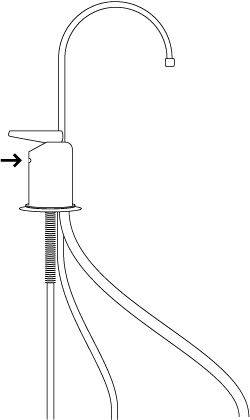
Air gap faucets are used with undersink reverse osmosis units. They are never used with filters because with filters there is no drain connection and the air gap is not needed.
The purpose of the air gap faucet is not only to deliver drinking water from the RO unit, as all faucets do, but also to provide an “air gap” for the RO unit’s drain system.
An “air gap” is a siphon break to assure that drain water cannot flow backward from the household drain system into the reverse osmosis unit.
Note in the picture above that the tubes are of different diameters. The smaller tubes are 1/4″ and the larger tube is 3/8″.
The tube on the left in the picture delivers the “permeate” or purified water to the user via the tall spout when the faucet’s handle is pressed. The other two tubes are parts of the air gap drain systems.
Reverse osmosis units produce drain water called brine when they are in operation. This waste water comes up the small center tube in the picture and is released into a small open trough inside the base of the faucet. The drain water flows along the open trough until it falls through a hole into the top of the larger tube on the right in the picture. The large tube connects to the undersink drain pipe. Water falls by force of gravity down the large tube and into the undersink drain pipe.
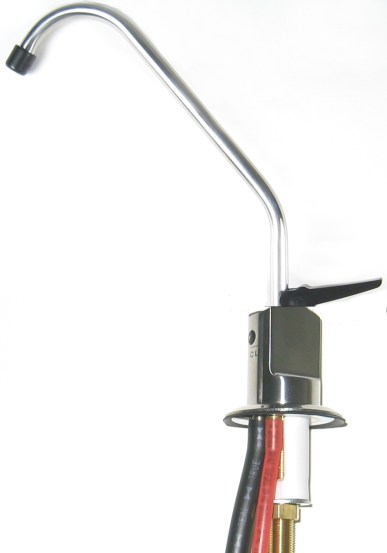
Classic Air Gap Design. The RO drain water goes up to the faucet in the red tube, then down to the sink’s drain pipe in the black. The permeate tube connects to the threaded metal stem. The hole in the faucet body serves as an overflow drain if the black tube is obstructed.
More about air gap faucets
If the air gap faucet leaks water through the hole in the faucet body onto the sink, it is usually because the drain line, the larger of the tubes, is stopped up. The drain hole, indicated with the arrow in the top picture, is an escape hole so that drain water can have a way out if the drain line stops up. The problem can usually be fixed by removing the drain line at the bottom end and clearing out the obstructions. Or, the obstruction may be in the drain saddle or the drain pipe itself.
Since the 3/8″ tube delivers water by force of gravity alone, any small obstruction (a small piece of food from the drain pipe, for example) can block it.
Since air gap faucets are often unpopular with homeowners because of noise and messes on the sink when the drain line blocks, some manufacturers provide reverse osmosis with standard faucets. A standard faucet has only the permeate line, the one that is attached to the threaded shaft. The RO drain line connects directly to the undersink drain.
Some RO builders use standard faucets but provide one or more one-way valves (called “check valves”) to guard against backflow from the drain.
Plumbing codes differ from place to place, but most still require the air gap faucet. It should be noted, however, that this is a provision of the plumbing code that is frequently overlooked.
Note: Pure Water Products’ reverse osmosis units are supplied with a high quality check valve in the drain line rather than the air gap faucet. Upon request we will supply the unit with an air gap faucet rather than the standard faucet. The link above goes to a very popular product that we call an “air gap adapter.” Its function is to allow the owner of virtually any undersink RO unit that has been installed with an air gap faucet easily to get rid of the air gap feature without replacing the faucet itself. It is an easy fix for an often very annoying problem. Air gap faucets are infamous for noisy gurgling and, worse, dumping drain water onto the kitchen cabinet if the drain is blocked.
Hydrogen Sulfide
Introductory Note: Along with iron, manganese, and hardness, hydrogen sulfide odor is among the most common well water problems. Using air as a pretreatment for filtration is often the easiest and least expensive way to deal with the rotten egg odor that can make water virtually unusable.
The “rotten egg” odor that people complain about in well water can come from many sources, but it is most commonly caused by “sulfur reducing” bacteria that give off a foul-smelling gas. The bacteria themselves are harmless–they don’t cause disease–but the gas they produce can cause horrible odors and smelly black staining in pipes and appliances.
In some parts of the country, most notably Florida, where hydrogen sulfide is common and very severe, the standard treatment is to spray the water into an open air tank, allow the noxious gas to escape into the atmosphere, then use a secondary pump to send the water from the tank into the home. Tanks of this type are expensive, need lots of space, and are subject to freezing in cooler climates. Therefore, another type of treatment known as “precipitation/filtration” is preferred in most areas.
With this method, an “oxidizer” causes the trapped hydrogen sulfide gas to “precipitate” to elemental sulfur, then the sulfur is trapped in a filter. It’s a two-step process. The filter is most often carbon. Filter carbon, especially a specialty carbon called “catalytic carbon,” can perform both steps–precipitation and filtration–but unless the amount of H2S (hydrogen sulfide) is small, the carbon wears out quickly and has to be replaced. However, when the carbon is helped by a more powerful “oxidizer,” on can last a very long time and the process can be very successful. Many “oxidizers” can cause the precipitation of the gas: air, chlorine, hydrogen peroxide, potassium permanganate, ozone, and more. For residential users, the most practical and the most easily maintained are aeration (air) and chlorination.
A full treatment system with chlorine looks like this–
1. A dry pellet chlorinator — a device that drops chlorine pellets into the well itself– followed by a carbon filter, or
2. A chemical feed pump, installed before the pressure tank, that feeds liquid chlorine (household bleach) into the water line. After the pressure tank, you must have a retention tank–usually 80 to 120 gallons–to give the chlorine time to work. After the retention tank, a carbon filter.
A full treatment system with aeration looks like this —
1. An “Aer-Max” system, which consists of a 10″ X 54″ treatment tank that is fed by a small air compressor. It is installed after the pressure tank, and it is followed by a carbon filter, or
2. A “single tank aerator” installed after the pressure tank. It is a backwashing filter with a special control valve that draws in air to “oxidize” the H2S so that it can be removed by the filter carbon in the bottom 2/3 of the tank.
Here are page links that show the various strategies. Many have installation diagrams.
Dry Pellet Chlorinator — http://www.purewaterproducts.com/dry-pellet-chlorinator
Chemical Feed Pump and accessories — http://www.purewaterproducts.com/chemical-feed-pumps
“Aer-Max” units.– http://www.purewaterproducts.com/aer-max-aeration-systems
Single Tank Aerators — https://www.purewaterproducts.com/single-tank-aerator
The carbon filter used in any of these system (other than the single tank aerator) can be either a “backwashing” tank-style filter or a carbon block filter. If iron is present in the water, a backwashing filter must be used because a carbon block filter would be clogged quickly with iron.
Catalytic carbon is the carbon of choice with hydrogen sulfide, but any good carbon filter will work after proper oxidation. Other iron removal media, like Katalox and Filox, often work well with odors, but if odor is the main issue, carbon is usually the product of choice.
Here are some places on our website to look for carbon filters —
Carbon block filters — https://www.purewaterproducts.com/whole-house-filters-compact
Often the hard part of designing these filters is choosing and sizing the carbon filters. Do not hesitate to call or email us for help.
Bee Sharper Puts the Numbers of Water Treatment into Context

Editor’s Note. Water contaminants are usually measured in parts per million, which is the same thing as milligrams per liter. Some, like lead and arsenic, are measured in parts per billion, or micrograms per liter. To put these tiny amounts into context, here’s a BB Sharper comparison. (Note that Bee initially made these calculations ten years ago, so the numbers might be off a billion seconds or so here or there.)
Year it was one billion seconds ago: 1959.
Year it was one billion minutes ago: c. AD 110.
Year it was one billion hours ago: BC 110,000.
Year it was one billion days ago: BC 2,640.000.
Parts per million represented by one drop in a bathtub full of water — 2.
Parts per million represented by one second in 12.5 days — 1.
Number of micrograms per litre (μg/L) represented by one part per billion — 1.
Number of micrograms per litre represented by one drop in 250 bathtubs full of water — 1.
Number of parts per billion represented by one second in 32 years — 1.
Note: Certain water contaminants are now regularly measured in parts per trillion (ppt), especially PFAS (per- and polyfluoroalkyl substances), which are known as “forever chemicals” due to their persistence in the environment and human body. There are 1000 billions in a trillion, a fact that makes the PFAS content of a gallon of water unimaginably small and the $40 trillion US national debt unimaginably large.
Water News for August 2026

Plan for Colorado River Water Crisis Finally Unveiled by US Government
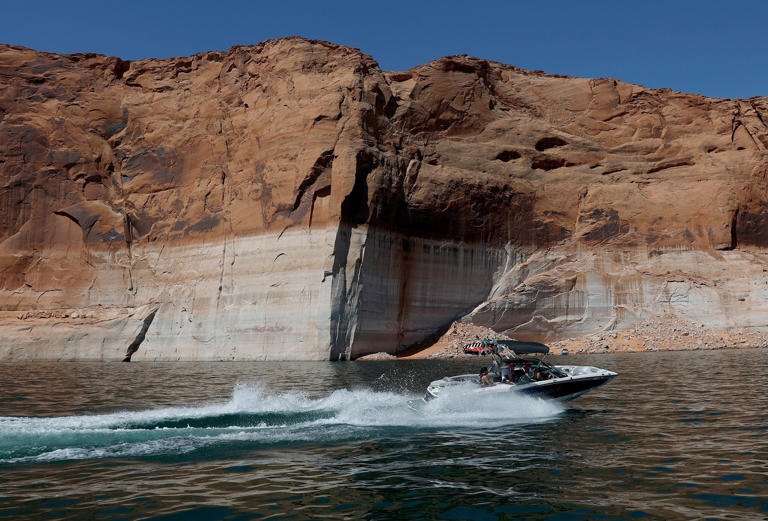
Bathtub Ring on the Stone Wall Grows Larger on Lake Powell
Federal government plan outlines cuts of roughly 40% to California, Arizona and Nevada but the fix is likely to be only temporary. The fight over dividing up the diminishing water of the Colorado River may be the the most contentious water story of our time.
The US government released its anxiously awaited plan for how to manage the Colorado River crisis on July 31, which includes the potential for harsh cuts in water supplied to California, Arizona and Nevada.Under the proposal, the so-called lower basin states stand to lose up to 3m acre-feet (3.7bn kiloliters) a year – enough water annually to serve more than 25 million people and roughly 40% of their collective total. The so-called upper basin states – Colorado, Utah, New Mexico and Wyoming – were spared from mandates restricting their supply. The Colorado River supplies roughly 40 million people in seven states, two countries and dozens of tribes, and also irrigates 5.5m acres (2.2 hectares) of farmland. The federal government has limited jurisdiction over state-based water policy but is responsible for managing the dams at Lake Powell and Lake Mead, the two key reservoirs that lower basin supplies flow through. (The Guardian)
Lake Mead, the largest reservoir in the United States, has fallen to a record low — yet another sign that the Colorado River system is spiraling further into crisis.
Water levels in Lake Mead dropped to 1,040.5 feet, below the previous record low of 1,040.58 feet set in July 2022, according to data published by the US Bureau of Reclamation. The lake is now lower than it’s ever been since it was created nine decades ago. (CNN)
Border Wall Construction Is Robbing Water From Ranchers
Construction crews building a border wall in New Mexico were ordered to stop drilling new wells after ranchers said that pumping groundwater to produce concrete could threaten their livestock amid a severe drought. (The Guardian.)
Cyber Attacks on Water and Wastewater Facilities
On July 30, the Environmental Protection Agency (EPA) and Federal Bureau of Intelligence (FBI) released a joint statement warning about cyberattacks on water utilities across the country. So far, there have been 12 cyberattacks reported across the country that have targeted water and wastewater treatment facilities.
“After remotely accessing internet-facing devices, the actors changed the IP addresses and passwords, resulting in a loss of monitoring and control functionality,” the FBI reported.
Reports suggest that Iran is the prime suspect in these attacks, but there is no confirmed involvement to date. The FBI is also urging utilities to protect themselves by taking actions like disconnecting systems from the internet when possible and familiarizing operators with manual controls in the case of compromised automated systems.
The agencies also reaffirmed the necessity of complex passwords for security and proper firewall configurations to prevent unauthorized devices from connecting to internal systems. (WC&P)
Record Rainfall in China
More than a million people had to be evacuated in China because of record rainfall resulting from Typhoon Dolphin. (The Guardian)
The EPA Finally Enters the Fluoride Debate
The following is from an EPA press release: "Today, U.S. Environmental Protection Agency (EPA) announced the next step in its review of public health risks linked to fluoride in drinking water: the release of the Protocol for Developing the Fluoride Human Health Toxicity Assessment. This marks a significant milestone in the agency’s expedited assessment of fluoride under the Safe Drinking Water Act (SDWA), a priority set by EPA Administrator Lee Zeldin as part of the Trump Administration’s commitment to Make America Healthy Again, while following gold standard science.
“Every American should be able to count on safe and healthy drinking water, plain and simple. In light of new science and real concerns from the public, the Trump EPA is working in lockstep with HHS to expedite our review of fluoride under the Safe Drinking Water Act,” said EPA Administrator Lee Zeldin. “Today’s important milestone means we are another step closer to completing this assessment years ahead of schedule. Our new action outlines specifically how EPA’s assessment will be conducted and advances our commitment to transparency and gold standard science.”
“Parents deserve the truth about fluoride in drinking water—not assumptions, not politics, but rigorous science,” said U.S. Department of Health and Human Services Secretary Robert F. Kennedy, Jr. "That is why HHS is working side by side with EPA to ensure this assessment focuses on the health risks that matter most for children, including neurodevelopmental effects and dental fluorosis. By conducting a rigorous dose-response analysis and making every step of the process transparent, we will give states, communities, and families the scientific foundation they need to make informed decisions about fluoride in drinking water.”
Earlier this year, EPA released its Preliminary Assessment Plan and Literature Survey for public comment. The agency’s new Protocol for Developing the Fluoride Human Health Toxicity Assessment reflects public input received on that plan. The Protocol is an essential part of developing the human health assessment; it is a road map that transparently describes how EPA will conduct the assessment while applying gold standard science.
The agency will use this Protocol to develop the draft fluoride human health toxicity assessment, which once completed will be available for public comment. EPA will use systematic review practices that are consistent with gold standard science and SDWA requirements, draw on expertise from the U.S. Department of Health and Human Services (HHS), and will not prejudge any outcomes of the assessment. When final, the assessment will inform potential revisions to federal drinking water regulations. It will also help states and local leaders make informed decisions about fluoridating drinking water.
The significance: After decades of limiting itself to setting an MCL standard for Fluoride in water, the EPA is now going to weigh in on the wisdom of adding fluoride intentionally to drinking water. It's about time!
Ocean Conservancy Removes 1.3 million Plastic Bottles from Beaches in a Single Day
More than 1.3m plastic bottles were collected from beaches, rivers and waterways last year during the world’s largest single-day volunteer ocean cleanup. About 630,000 people took part in the International Coastal Cleanup in 2025, removing almost 13.9m pieces of rubbish from more than 15,000 miles of coastline and waterways.
Plastic bottles were the most commonly recorded item, while more than 1.2m cigarette butts were litter-picked. Volunteers picked up 885,000 plastic bottle caps, 581,000 plastic shopping bags and more than 1m other plastic bags and food containers.
The annual cleanup is organized by the NGO Ocean Conservancy. Its director of plastics policy, Dr Anja Brandon, said: “There’s really no excuse for this – plastic bottles are among the most recyclable items out there, which tells us two important truths: one is that we are making too much plastic, and two is that a lot of our waste isn’t getting where it needs to go.” (Guardian)
Massive Flood and Mudslides in Nepal
The death toll from catastrophic flash floods and mudslides in Nepal rose to at least 675 on a late August Saturday, as nearly 2,500 people remained missing in the country, including around 90 Americans.
More than 7,500 people have been rescued, according to Nepal’s National Disaster Risk Reduction and Management Authority, which consolidates information from Nepal Police, Nepal Army and Armed Police Force. More than 90,000 people have been affected by the disaster, according to Nepal Red Cross.
Rescuers have struggled to reach devastated communities along the Nepal-Tibet border, with the scale of the disaster coming into view four days after the torrent of water, ice and debris swept through Himalayan valleys, destroying homes, bridges and other infrastructure.
As families wait for news about their relatives, damaged roads, power outages and fears of further flooding have hampered rescue efforts.
Of those missing in Nepal, 589 are foreign nationals, according to the disaster agency. The Nepal Tourism Board said 261 foreign nationals have been rescued.
China has separately reported seven deaths and 554 people missing in its Tibet region, including hundreds of foreigners. It is unclear how much overlap there is between the Chinese and Nepali missing-person counts.
