|
PRESS RELEASE – May 19, 2026
Chinese 3D-printing giant gives artist a 10-year ban over Tiananmen artwork
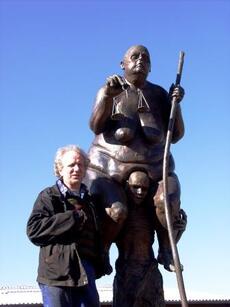
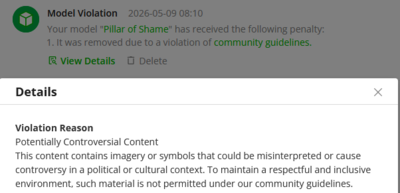
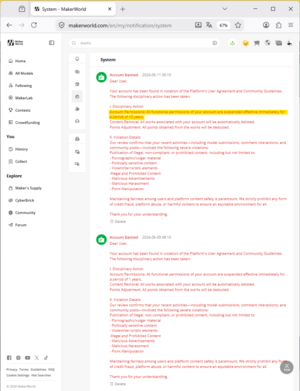
The Chinese 3D-printing platform MakerWorld / Bambu Lab has, without warning, given artist Jens Galschiøt a 10-year exclusion from the platform for sharing 3D-print models of the world-famous artwork “The Pillar of Shame” — a memorial to the Tiananmen Massacre in Beijing in 1989.
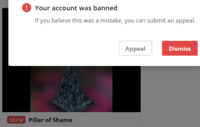 The case should raise serious concern within maker, tech, and open-source communities because it indicates that Chinese political censorship is now actively being enforced on some of the world’s largest global platforms for 3D-printing and digital maker communities. The 3D model has been available on the platform for years, so it seems Chinas is tightening the grip. The case should raise serious concern within maker, tech, and open-source communities because it indicates that Chinese political censorship is now actively being enforced on some of the world’s largest global platforms for 3D-printing and digital maker communities. The 3D model has been available on the platform for years, so it seems Chinas is tightening the grip.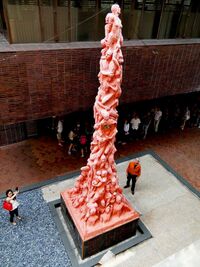 “It is deeply serious that an internationally recognized artwork and historical memorial to the victims of the Tiananmen Massacre is now being categorized as prohibited political content. This is political censorship disguised as community moderation,” says Jens Galschiøt. “It is deeply serious that an internationally recognized artwork and historical memorial to the victims of the Tiananmen Massacre is now being categorized as prohibited political content. This is political censorship disguised as community moderation,” says Jens Galschiøt.CHINESE CENSORSHIP DISGUISED AS MODERATION
Bambu Lab itself justifies the ban with the phrases: “Politically sensitive content” and “images or symbols that could be misinterpreted or cause controversy in a political or cultural context”.
But everything points toward the action having taken place under pressure from the Chinese government: The 3D figure is a scan of a 30-year-old world-famous sculpture. The artist uploaded the file several years ago, and it is also available on other major 3D platforms (eg. you find the Pillar of Shame on Thingiverse and Cults3D)
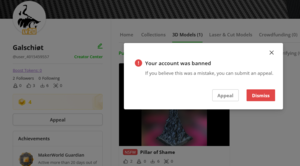
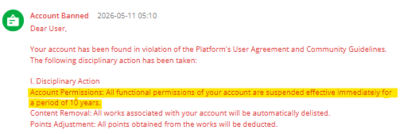 But without warning, the account was suddenly suspended — first for one year, and the following day changed to a total 10-year exclusion. All models were removed, all points deleted, and all account functions shut down. But without warning, the account was suddenly suspended — first for one year, and the following day changed to a total 10-year exclusion. All models were removed, all points deleted, and all account functions shut down.“When you hand out a 10-year exclusion for historical and political art, this is no longer ordinary moderation. This is political censorship,” says Jens Galschiøt, continuing: “and if you doubt China’s influence, just try searching for a 3D print of China’s leader Xi Jinping on MakerWorld.”
THE 3D-PRINTING COMMUNITY IS BEING CENSORED FROM CHINA
MakerWorld is today one of the world’s largest online communities for 3D-printing and functions as a central digital infrastructure for millions of hobby users, makers, educational institutions, and creative communities around the world.
 For many users, the platform is no longer simply a place to share files, but an integrated part of a cloud-based hardware ecosystem connected to printers, software, community functions, and digital distribution. For many users, the platform is no longer simply a place to share files, but an integrated part of a cloud-based hardware ecosystem connected to printers, software, community functions, and digital distribution.If users now risk a 10-year exclusion for sharing historical or political works considered sensitive to China, this sends a signal to the entire international maker community that Chinese political boundaries also apply on global digital platforms.
“This is a direct attack on freedom of expression in digital communities” says Jens Galschiøt “basically Chinas decides what you see and what you can upload on the platform. Sharing a 30-year-old historical sculpture or that you uploaded years ago may risking long-term exclusion.
WATCH YOUR DATA, AND WHAT YOU PRINT – CHINA MAY BE WATCHING
The case now raises a far more serious question for millions of users of Bambu Lab printers and the MakerWorld platform: If Chinese political interests already determine which models users are allowed to share and print, then what happens to personal and print data when people work through the MakerWorld platform or print using a Bambu Lab printer?
Bambu Lab printers are tightly connected to cloud services, user profiles, online synchronization, and digital platforms. Many makers today upload both models, print histories, and projects directly into the company’s systems as an integrated part of their workflow.
“The maker communities should wake up now and ask themselves how far the control actually reaches within the cloud-based systems we all use. What data is being collected? Who has access to it? Is it being shared with China?” says Jens Galschiøt.
ARTIST - "WE NEED TO ACT NOW"
Jens Galschiøt now calls on the international 3D-printing and maker community to take the case into their own hands by uploading “The Pillar of Shame” and other China-critical artworks to MakerWorld and similar platforms — and by protesting every attempt at political censorship.
“The maker movement was built on openness, decentralization and freedom to create. If political censorship is allowed to spread unchallenged into our digital communities, we will lose that freedom. The only way to defend open platforms is to use them, challenge them and refuse to be intimidated,” says Jens Galschiøt.
Contact
 Feel free to contact for questions, interviews, media etc.
BACKGROUND
THE DIGITALIZATION OF THE PILLAR OF SHAME
The sculpture “The Pillar of Shame” is an eight-meter-high memorial to the victims of the Tiananmen Massacre in Beijing in 1989. The sculpture was created by Jens Galschiøt in 1997 and stood for more than 24 years at the University of Hong Kong as an international symbol of the democracy movement and remembrance of the massacre.
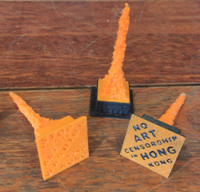
When China began taking control of Hong Kong in 2021 and decided to remove the sculpture, activists and digital pioneers from the democracy movement and Lady Liberty Hong Kong began hand-scanning the entire artwork to ensure its survival in digital form.
The completed 3D scans were subsequently released freely on the internet, and the artist waived his copyright to the work so that anyone could 3D-print it. The message was simple:
“They removed one sculpture — but got a thousand back.”
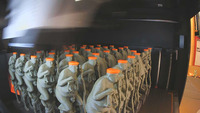
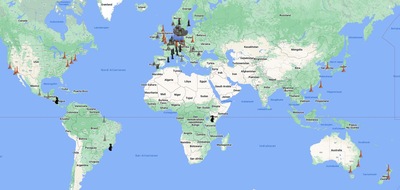
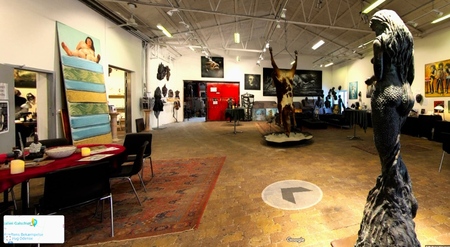
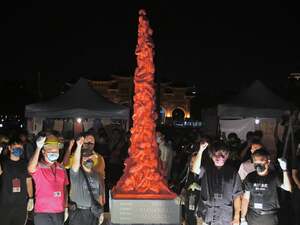 Since then, digital versions of “The Pillar of Shame” have been printed and distributed all over the world as street art, art projects, and democracy statements. The sculptures have been exhibited in Paris, London, Berlin, Brussels, Taipei, Mexico City, and at the European Parliament. Since then, digital versions of “The Pillar of Shame” have been printed and distributed all over the world as street art, art projects, and democracy statements. The sculptures have been exhibited in Paris, London, Berlin, Brussels, Taipei, Mexico City, and at the European Parliament.Across the world, Hong Kong’s diaspora uses the sculpture as a symbol of freedom, and it continues to be shared and printed internationally. At Jens Galschiøt’s gallery, new 3D-printed versions of the work are continuously.
Photo: 3D Printed Pillar of Shame in Taiwan
Photos, media and links- copyright free:
 Feel free to use all text and photos from this press release and links bellow.
 3D Platforms where the Pillar of Shame was NOT censored by China
Thingiverse 3D
Cults3D
Printables
Apart from the Pillar of Shame, artist Jens Galschiøt has been scanning and uploading a number of his sculptures.
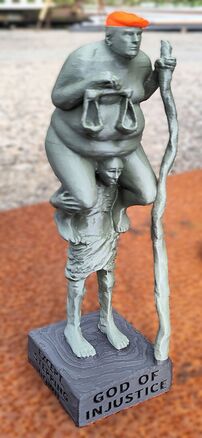
In November he handed out 6,000 3D statues of the US President Donald Trump in Brazil as a protest against his destruction of the climate negotiations at COP30. More about that project.
|
||
|
||
|
******************************************
******************************************
Subscrition and unsubscription of informations from Jens Galschiøt
If you want to be unsubscribed from this infolist, then click here: Unsubscribe
If you want to update your name, e-mail etc. on this list, click here: Change Profile
If you want to subscribe this infolist, then click here: Subscribe to Galschiøts infoliste
|