| |
|
Tip of
the Week
Did
you know....
Never begin a call to a Note
Holder with, "How are you
today?" It is a dead giveaway
that you are going to try and
sell or convince them of
something.
Product Highlight
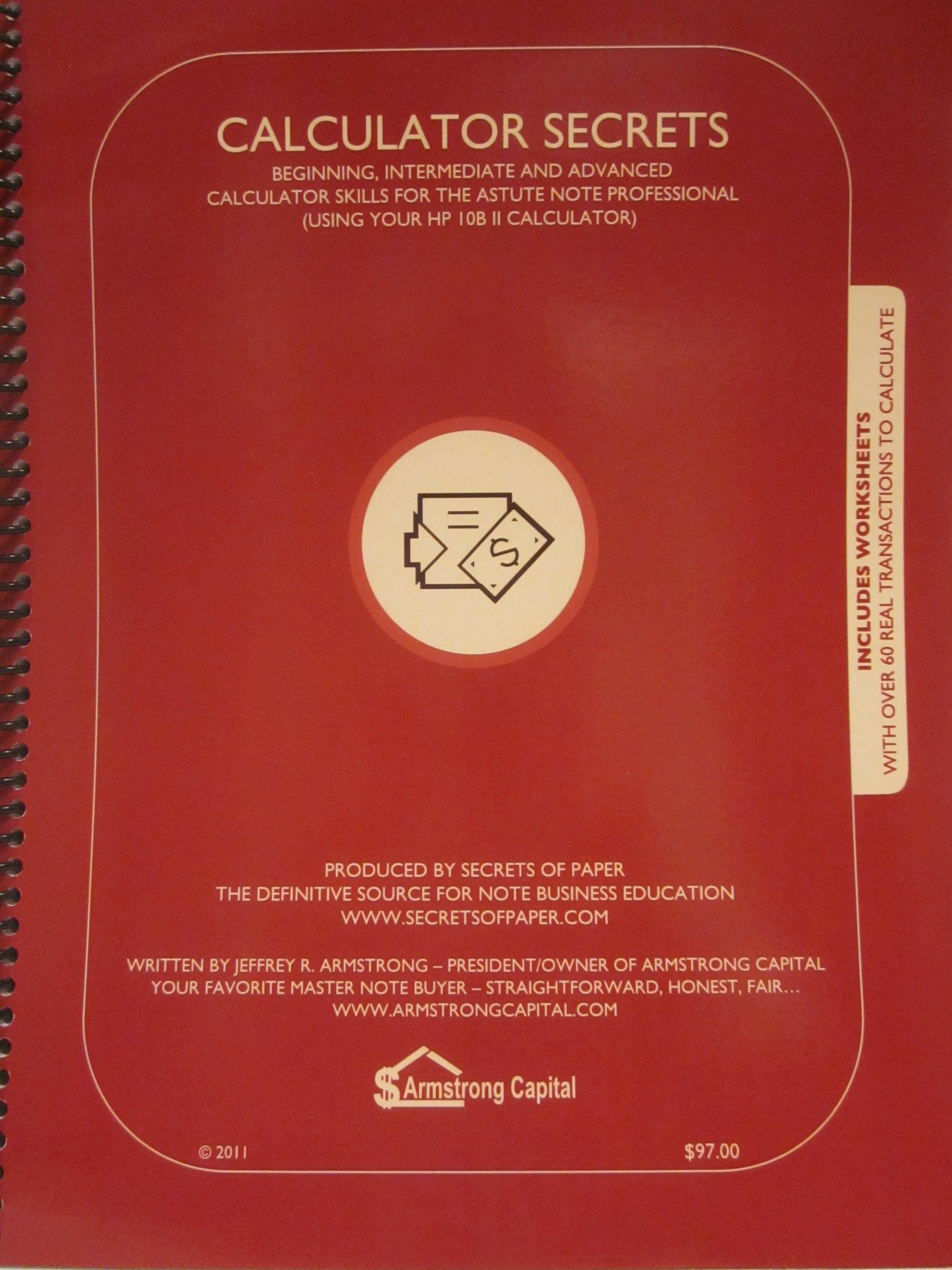
Whether you have never used
an HP10BII calculator before
or if you use a different
calculator
Calculator Secrets will
walk you through the process
of calculating the term,
payment amount, remaining
balance, balloon amount,
interest rate, yield and
much, much more. You will
work through Beginning,
Intermediate and finally
Advanced calculations by
following a simple step by
step process and each new
thing you learn will be
followed by actual
worksheets of real life
transactions for you to
practice on (answers
included).
By the time you are finished
with this book you will be a
calculator wizard!
Click for
more info and to order TODAY!
When you order in March you will also receive FREE the E-Book Supplement with 60
more transactions to practice your calculations!
|
 |
Upcoming Events
2013
Chicago, IL
Secrets of Paper
April 26-27, 2013
Las
Vegas, NV
Paper Source
Note Symposium
2013
Los
Angeles, CA
Secrets of Paper
October 24-27, 2013
Las
Vegas, NV
Noteworthy Convention
Watch for Exclusive
Fred
Pryor CareerTrack seminars
facilitated by Jeff,
details
coming soon!
Ask Jeff to come and
speak
or teach
to your group or
at
your event!
Coming Soon
Exclusive
Note-able Membership
with Videos, Training Tools
and Support! |
Quote
of the Week
“Get
action. Seize the moment. Man was never intended to become an oyster.”
― Theodore Roosevelt
Learn to invest in
and broker notes... the
Secrets of Paper 201 Home Study Course is
Your Launching
Pad to Success in the Note Business!
Always includes
SOP 101 audios - Introduction to the Note Business PLUS when you order SOP 201 in March you will also
receive the "Art of Target Marketing for Note Holders"
5 part video
series
(regularly $99) for FREE!
 President's
Corner President's
CornerLast week we started to examine exactly what we are looking
for, what our funding sources do purchase, what we can help people with AND what
we don’t do. Once people know that
you have access to millions of dollars to buy notes they will be contacting you
for every conceivable real estate related cash need you can think of. Last month
we looked at Second Position Notes, Non Performing Notes, Simultaneous
Transactions and Loans and whether or not we can help people with them or not
and if so how.
Hopefully you have a clearer view of what our primary job is
in our industry, the purchase and sale of Seller
Financed Notes. We purchase existing seller financed first position notes
secured by real estate on the secondary market.
These are called these “Purchase Money Mortgages.”
To further explain, we buy existing first position notes secured by real
estate that were created when the seller of a property carried back a note to
facilitate the sale of the property. An
existing note is one that the seller has already received at least one payment
on it. This is 99% of my business, the purchase and brokering of existing first
position seller financed notes secured by real estate on the secondary market.
So why is it that in our little niche that our investors and
funding sources only buy the Seller Carryback notes that are these “Purchase
Money Mortgages”? Well,
it has to do with the differences between negotiable instruments and
contracts and the definitions of being a “good faith purchaser” and a
“holder in due course”. Following
is an explanation and court case that explains it more clearly:
“…Negotiable
instruments – checks, bank notes, and so on – are promises to pay or orders
with an implied promise to pay, and are thus contracts. But they differ from
contracts in two important ways. First is the idea of “merger.” Normally, a
contract right is an abstraction that is located nowhere in particular but
belongs to a party to the contract or to a person to whom that party has
assigned that right. Possessing a copy of a normal contract has nothing to do
with who has rights under that contract. But in a negotiable instrument, the
contract right is “merged” into the document. Assignment of that right takes
place simply by transferring the document (in the case of a bearer instrument)
or by indorsing (signing) and transferring it.
The second big way negotiable instruments differ from contracts is the
“good faith purchaser” or “holder in due course” rule which is
illustrated by Miller v.
Race. In a normal sale of goods under common law, the new
owner’s title to the goods is at risk to the contractual defenses of a prior
owner. For example:
Alice
is Dr. Barb’s patient and is feeling ill. Barb says to Alice, “sell me your
Mercedes for $100 and you’ll feel a lot better.”
Alice
complies, but then later realizes she was snookered. Meanwhile, Barb sells the
car to Chuck, who knows nothing of how Barb acquired it, for $50,000. Under
contract law, Chuck can get no greater title to the car than Barb had. But the
contract is void for undue
influence, so Barb doesn’t have legal title to the
car. Ergo, Chuck does not, either.
Alice
can sue Chuck to get her car back. Chuck must then sue Barb for his $50,000, an
expensive and often-futile thing to do.
Contract defenses are invoked so commonly that any downstream owner of a
good is at significant title risk under common law. This risk could make things
very bad for paper money, which to work efficiently should change hands dozens
of times or more. Thus, Miller v.
Race has long been celebrated as an advance that made bank
notes under the common law a more efficient form of money. Miller
helped create for promissory notes under common law (including, crucially, bank
notes) what is now known as the “good faith purchaser” or “holder in due
course” rule. Summarized, this rule says that a holder in due course who
obtained the instrument for value, in good faith, and without notice of any
upstream claims or defenses, is entitled to enforce the promise to pay in that
instrument regardless of most kinds of such claims or defenses.
The good faith purchaser rule can cause its own problems. For example,
when you sign a promissory note to get a mortgage, these days the bank usually
sells that note to an aggregator, who bundle up these mortgage notes in packages
and sell them to investors. In most states if you make your mortgage payments to
Bank A, who has meanwhile sold the mortgage to Bank B (and perhaps not told
you), Bank B can bill you for that same payment and foreclose on your house if
you don't pay. You have to pay Bank B and then beg, plead, or sue Bank A to get
your money back.
Today, the differences between negotiable instrument law and contract law
are sufficient that negotiable instruments and sale of goods are in different
and largely distinct sections of the
U.S.
Uniform Commercial Code….”
I hope that
explanation helps you understand better of why we only buy Purchase Money
Mortgages, because when we do we are a “holder in due course”.
Next week we will talk about more of the basics of a Seller Carryback
note and the different documents that we are actually purchasing when we buy a
seller financed real estate secured note.
Remember, Success Demands
Action!
Keep on marketing, it’s going to
work! TWITA!
|
Feature Article
The Truth About Direct Mail
|
Direct Mail, used by the
most successful note
brokers, can be extremely
lucrative as a marketing
tactic. You simply have to
avoid the common mistakes
that can lead to waste.
Direct mail has two major
drawbacks: It can be
expensive and difficult to
carry out without misstep.
However, if a direct mail
marketing campaign is
implemented correctly, it
can be very lucrative. To
succeed, you simply have to
know where the pitfalls
might be, do your homework,
and be persistent.
Read More... |
|
Question of
the Week
Q – Hey Jeff:
I currently have a business note
I would like to submit for
pricing. What criteria is
required for a business note
quote? Thanks!
~ Joel G.
A
– Hi Joel!
Thanks for the email! Unlike
property, notes on Businesses do
have minimum requirements. If a
business note does not AT LEAST
meet the following requirements,
don’t spin your wheels.
- AT LEAST 30%+ CASH
Down Payment
- prefer 12% Interest
Rate or higher
- Fully Amortized
- No Balloons (if
there is a balloon we will only
buy the payments up to the
balloon)
- Minimum 720 Buyer
Credit Score
- Personally Signed
for / Guaranteed
- Minimum 6 Months of
Seasoning
If the business note you found
DOES meet the above criteria I
will email you our Business Note
Worksheet for you to fill out as
completely and legibly as
possible and return to me for
pricing options.
Hope this helps!
~ Jeff
|
|
So you want to invest in or broker notes?
Been trying for awhile with
limited or no results?
Check out the most talked about, current and innovative educational tools,
training, mentoring, assistance and support services in the industry! Updated
for 2012, click here to start growing your note business today!
|
|
If you have missed any of our
Newsletters click here for our
Archived Monthly Newsletters!
|
If you have a note business question you would like to see answered in this
newsletter just
email Jeff!
|
|


|
|
|