| Pure Water Products |
|
July, 2026
|
|
|
Water is chiefest of all things, for streaming
Therefrom all life and existence came.
Pindar's First Olympian Ode |
|
Water Treatment Issues and Current Water News |
|
In this hot summer Occasional you'll thrill to contributions by B. Sharper and Emily McBroom and be awed by details about desalination, the TDS of sea water, and RO membrane pore size. You'll hear about removing PFAS from water in your home, how to sanitize an undersink RO unit or water filter and how to fend off microbes that lurk in water. Learn about the ever increasing woes for Lake Powell, now at 1/4 full and draining, and the EPA's frightening lowering of PFAS standards for cities. Hear how we're saying hello to microplastics and the microbes that love them and adios to whitefish and the Aral sea. You'll learn that, like data centers, border walls are big water gluttons, and, as always, there is much, much more.
|
|
Water and Environmental Issues |
More from the Pure Water Gazette Bulging Article Archive
The Pure Water Gazette website has been archiving information about water treatment for about three decades. Since we add regularly and almost never discard, the Gazette website is now bulging with many hundreds of informative and useful articles about water issues and how to deal with them. Best of all, there are no intrusive pop-up ads or other distractions from the subject at hand. Even more importantly, information-rich articles don't disappear. You can depend on them to be there for future reference.
The Pure Water Gazette is a non-commercial site. Its function is to provide information, not sell products. The site does not take orders or ask you for information. The Gazette website is designed to be useful and informative, not beautiful. It is arranged into several broad categories. Below are the main topics from the site's sidebar index. Each of the main categories leads to articles added to the site since 2012.
-
- A few clicks on the links above will give an indication of the extensiveness of the Gazette's content. In this issue of the Occasional we're going to include some miscellaneous articles from the Gazette.
This Issue of the Occasional
For a number of years a leading contributor to the Pure Water Gazette was B. Sharper. The online Gazette has almost three dozen of Ms. Sharper's short articles about water and other environmental topics. B., who sometimes signs as Bee, sometimes as Bea, sometimes as Bea B., sometimes as B.B., always writes in the difficult Harper's Index numerical style.
The piece below was posted in the Gazette in November of 2014. You can find more Bee B. Sharper here.
Getting Drinking Water from the Sea
by B. Sharper
Pure Water Gazette numerical wizard Bee Sharper rolls out some numbers on the production of fresh water by sea water desalination.
Approximate number of desalination plants in the world as of 2013 — 17,200.
Daily production capacity of these plants in gallons — 23 billion.
Percentage of these plants that make potable water from sea water — 59%.
Percentage that make potable water from brackish water — 22%.
Percentage that make potable water from river water and wastewater — 9%.
Total dissolved solids (TDS) count of the saltiest of sea waters (e. g,.the Arabian Gulf) — 50,000 mg/L.
Total dissolved solids (TDS) count of most ocean water — 35,000 mg/L.
Typical chloride content of sea water — 19,000 mg/L.
Typical calcium content of sea water — 400 mg/L.
Typical sodium content of sea water — 10,500 mg/L.
Typical number of viruses present in one drop of sea water — 1,000,000.
Nominal pore size of a reverse osmosis membrane used for desalination — 0.0001 to 0.001 microns.
Nominal pore size of a nanofiltration membrane — 0.001 microns.
Psi equivalent of one bar of pressure — 14.5.
Pressure required to treat sea water by reverse osmosis desalination — 55 to 70 bars (800 psi to 1000 psi).
Pressure required to treat brackish water by reverse osmosis desalination — 15 to 35 bars (220 psi to 500 psi).
Percentage of salts, organics, and microbes that are removed from sea water by high pressure reverse osmosis — 99%+.
Estimated per gallon cost of producing fresh water by desalination with reverse osmosis –1/2 cent.
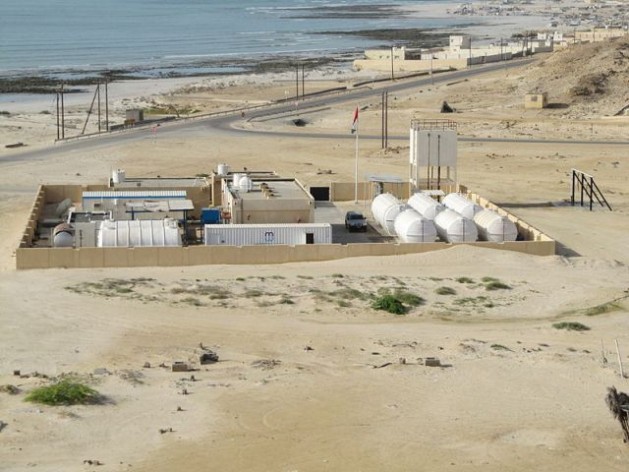
Desalination plant at Al Khaluf in Oman
More From the Pure Water Gazette
Emily McBroom has contributed several excellent articles to the Pure Water Gazette. The following is a piece that she and I wrote in 2019 about PFAS removal from residential water. At the time a lot had been written about large projects to remove PFAS from municipal water supplies, but treatment strategies for residential users had not been widely studied. --Gene Franks.
A Common Sense Approach to Residential PFAS Treatment
by Emily McBroom and Gene Franks
Most of the information now [in 2019] about how to remove PFAS from water focuses on the gigantic carbon filters made to treat the millions of gallons of water per day required by cities. Also mentioned are the very small residential drinking water filters, mainly carbon filters, that have received NSF certification for PFAS removal from drinking water.There is a lot of confusion about the residential applications that fall between the gigantic and the tiny.
Here are some things to consider about residential applications for PFAS reduction.
- Consensus is that three treatment strategies work with PFAS: carbon filtration, reverse osmosis, and ion exchange. Of these, carbon (GAC) filtration seems most practical for municipalities. GAC and reverse osmosis both work well for residential users, with reverse osmosis an easy first choice for drinking water. One agency tested eleven separate undersink reverse osmosis units and found that they all removed PFAS well. Several pretty small and unassuming carbon filters have gained NSF certification for PFAS reduction.
- Those who recommend treatment equipment for residential applications almost always make an unfounded assumption that homes must use point of entry equipment, treating all the water going into the home. We find no convincing information to indicate that PFAS in water is anything other than an ingestion issue. According to the CDC’s Agency for Toxic Substances Disease Registry: “Studies have shown that only a small amount of PFAS can get into your body through your skin. Therefore, showering and bathing in water containing PFAS should not increase exposure. Washing dishes in water containing PFAS should not increase exposure.”
- For point of entry treatment, we found that almost all recommended treatments are simply scaled-down versions of the strategies developed for municipalities. Usually there is no rationale stated that would justify the sizing recommendation. Recommended sizes range from extra large to even larger. We found EBCT (Empty Bed Contact Time) recommendations for PFAS ranging from 6 to 16. Ten is a common recommendation. Using an EBCT of ten, to provide a modest service flow of five gallons per minute for a residential whole house filter for PFAS one would need almost 7 cubic feet of granular carbon. That’s a 21″ X 72″ carbon tank, or three or four 12″ X 52″ tanks installed in series, or five 10″ X 54″ tanks installed in series. One authority recommends “at least 200 pounds of GAC” for residential whole house treatment–a 7 cubic-foot filter array. That’s a lot of equipment to assure PFAS-free water for flushing toilets. The most commonly suggested point of entry system is for two 12″ X 52″ GAC filters installed in series, without regard to family size. This would provide an EBCT of 6 at 5 gpm.
- No one offers information about PFAS performance for whole house sized carbon block filters, although carbon block units might offer the most practical PFAS whole house option.
The Obvious Conclusions
Our advice to consumers is get an undersink RO unit. If you don’t want reverse osmosis, get a high quality undersink or countertop carbon drinking water filter with an ample amount of carbon, and service it regularly. Ignore PFAS as a point of entry treatment issue, but don’t drink water from the bathtub. Treat your drinking water well, and add a whole house carbon filter if you want to, but you don’t have to get a box-car sized filter that competes with the city water department because if your drinking water is taken care of, a little PFAS in the shower water won’t matter.
Gazette comment from 2026: A reasonably sized whole house carbon filter will provide excellent water for bathing and general household purposes, but don't expect it to provide PFAS-free drinking water. The main purpose of whole house residential filtration is to remove chemicals like chlorine and chloramine used as disinfectants and to make the water more aesthetically pleasing. Since the article above was written the basic coconut shell carbon block filters that we feature in our drinking water units have been tested and rated as very effective for PFAS reduction.
Parallel Installation of Water Filters

The illustration above depicts a triple parallel installation that is used to increase the service capacity, the longevity, and the effectiveness of cartridge filters. As an example, if a home needs 15 gallons per minute of service flow for, say, chloramine reduction, the desired flow can be most easily obtained by installing three 5 gallon-per-minute carbon filters in parallel so that the flow splits and each 5-minute unit has to handle only 1/3 of the desired 15 total. Water passes through a single sediment filter on the left. The sediment filter will easily handle the 15-gpm flow,then each of the carbons have to handle only five. This is a practical, relatively inexpensive installation that is easy to maintain. (Be aware that the three-filter array is a large home arrangement. Most homes do fine with one or two carbon block filters.)
A Pure Water Gazette article features drawings of six arrangements with compact whole house filters including one that illustrates how to build your own by-pass system for the compact units.
How To Sanitize a Standard Undersink Reverse Osmosis Unit (according to AI)
Gazette Introductory Note: After four decades in water treatment I still don't have a clear answer to questions about when and how to "sanitize" a reverse osmosis unit. Or better, should you bother to sanitize a reverse osmosis unit? When do I, personally, sanitize my home RO unit? Almost never. The mysterious process of "sanitizing," I'm convinced, arises more from dealers' need for a substantial service fee than from the RO unit's need to be purged of microbes.More of that at another time.
Assuming you do want to sanitize your RO unit, how do you go about it? The main complications are the storage tank and especially the membrane. I asked AI how to sanitize an undersink RO unit and I was impressed by a really good answer. I made some comments. Here's the resulting piece that appeared in the Pure Water Gazette in December, 2023.--Gene Franks.
The very direct instructions created by an AI search are printed in bold type below. They work great for our standard Black and White reverse osmosis units. They require some elaboration and modification if you have an RO unit with disposable cartridge housings (like our Q Series units), one or more disposable inline filters (like our “Economy” RO unit), or an encapsulated membrane (like any of our units with the 50/50 GRO membrane upgrade). The AI instructions are in bold. See my comments in standard type below the AI instructions:
- Turn off the cold water supply connected to the RO system.
- Drain out the old tank of water through the dispensing faucet.
- Remove all pre-filters (stages 1, 2, and 3) from their housings. Also, remove the membrane from its housing.
- Scrub the inside of the housings with dish water and rinse thoroughly.
- Add bleach into the housing of filter stage 1.
- Install all empty housings and turn on the water supply.
- Open the RO faucet until water comes out.
My comments’ numbers refer to the topic number in the AI instructions.
- On the Black and White unit, turn off the blue handled inline valve that feeds the Black housing.
- If it doesn’t drain completely, now would be a good time to add some air to drive all of the water out. This isn’t absolutely necessary to sanitize the unit, but you’ll do a much better job if the tank is healthy. See Pure Water Gazette . Reverse Osmosis Tanks Cannot Live Without Air
- Remove the cartridges from the 2 or 3 vertical housings and the membrane from the horizontal housing.
- This step is optional. Unnecessary if the unit is running on reasonably clean water.
- About 3 tablespoons of household bleach is more than enough.
- Turn the valve half way on and let the water fill the unit fairly slowly.
- After you can smell bleach coming from the faucet, turn the water off and let the unit sit for a few minutes with bleach in it. (The longer you wait, the more thorough the job of sanitation will be.)
When sanitation is complete, turn off the inlet valve, open the faucet and let all the water drain from the storage tank. When the tank is empty, you can reinstall the filters and membrane (or replace them with new ones). When everything is back in place, open the inlet, open the tank valve and close the faucet. Let the RO unit fill the tank, open the faucet and let the tank drain, then close the faucet and the unit is back in service. When there is enough water in the storage tank, you can go back to using the RO unit as usual.
An Easier Way that Cleans Everything but the Membrane
- Turn off the water, remove the filter cartridges, drain the storage tank.
- Remove the black tube that goes into the In port of the shutoff valve. Remove from the tank tee the white tube that connects it to the shutoff valve. Plug the black tube you just removed from shutoff valve directly into the tank tee.
- Add bleach to the black housing, turn on water part way and let the unit fill slowly.
- When the tank is almost full (judging by the reduced flow of water into the tank), turn the inlet water off, run water from the faucet until you smell bleach, then close the faucet and let the unit sit for at least an hour.
- With inlet water off, open the faucet and let the tank drain completely.
- Reinstall filters and put the unit back in service. When the storage tank if full, open the faucet and let the tank empty completely to rinse the unit.
Sanitizing an Undersink Filter
Sanitizing an RO unit is complicated because of the membrane and storage tank. A filter system is relatively easy to sanitize after an event such as a boil water alert.
- Turn off the inlet water, open the faucet, remove the filter cartridges.
- Put a couple of spoonfuls of household bleach into the inlet housing and put both housings back on without cartridges.
- Turn on the inlet water and run water through the unit until you smell bleach coming out of the faucet.
- Turn off the faucet and let it sit for an hour.
- Turn off the water, open the faucet, replace the old cartridges with new ones.
- Turn on the water, let the new filters rinse for four or five minutes, and close the faucet. You are now back in service.
|
A Fool’s Errand
by Gene Franks
Sizing and setting up a backwashing filter for iron and/or manganese treatment is largely a guessing game. The more that’s known about the water being treated, the more accurate the guess can be, but in the end, it’s still a guess. There are simply too many factors that influence backwash and service flow requirements for a “one size fits all” sizing chart to work for everyone.
Manufacturers of iron/manganese products like Katalox and Filox-R pass the sizing decisions on to the user of the product by providing only vague, generalized sizing information. The new Katalox literature states the service flow capacity of the medium as 4 to 12 gallons per minute per square foot. (That is, square feet of surface area of the media bed. A 10″ diameter tank, for example, has a surface area of 0.54 square feet, while a 13″ tank has an area of about 0.92 square feet,) With Katalox, therefore, the manufacturer is saying that if you use a 10″ tank you can treat a maximum service flow to your home of up to somewhere between 2 and 6.5 gallons per minute. The exact service flow capacity for the individual home depends on such factors as whether you are treating iron, manganese, or a combination of the two, if there are other competing contaminants in the water (like hydrogen sulfide), the pH of the water, the oxygen content of the water, and pre-treatment provided.
With backwash rate requirement, the big unknown (to most users) is the water temperature. Cold water backwashes a filter much more efficiently than warm water, so less backwash water is needed if the water is cold. Filox’s manufacturer states the backwash requirement between 16 and 23.5 gpm per square foot, depending on the water temperature–in other words, between 8.5 (cold water) and 12.5 gpm (warm water) for a 10″ filter tank. Other important variables, like the total contaminant content, enter the equation as an educated guess. Obviously, a more vigorous backwash is required to clean a media bed if the iron content of the treated water is 10 parts per million as opposed to one ppm. The type of tank used also matters. We use Vortech tanks for most filters and assume, based on manufacturer’s data, that Vortech tanks increase backwash efficiency by at least 20%.
With that in mind, here’s how we are revising our Katalox recommendations. The numbers are simply a guess based on the average of the high and low figures given by the manufacturer. For example, Katalox recommends a minimum backwash rate of 10 to 12 gpm/ft2, so we used 11 gpm/ft2.
| Tank Diameter in Inches |
Maximum Service Flow–GPM |
Minimum Backwash Rate — GPM – With Vortech Mineral Tank |
Minimum Backwash Rate — GPM – With Standard Mineral Tank |
| 9 |
4 |
4 |
5 |
| 10 |
5 |
5 |
6 |
| 12 |
6 |
7 |
9 |
| 13 |
7 |
8 |
10 |
Charts like this are not a guarantee of performance. They should be used as a starting place. If your contaminant content is high, decrease the maximum service flow accordingly. If you are planning a filtration project, we can’t guarantee a perfect outcome, but we can help you make an educated guess at sizing. The more information you can provide about the water, the better the chance of a good outcome.
Testing Water for Microbial Contamination
Adapted in part from information from Viqua, a leading manufacturer of ultraviolet treatment equipment.
Scientists have long understood the link between unseen contaminants in water and illnesses. In the 1900s, filtration and treatment became mainstays for municipal water, and regulations for the quality of public drinking water systems were established. Health authorities consider the introduction of water chlorination to be perhaps the most significant advance in public health made in the 20th century.
If your water is supplied by a municipality, large or small, the water supply is tested routinely, at the source. However, many pipes buried underneath our roads and cities have been in place since the introduction of widespread water treatment and are long past the time when they should have been replaced. This aged and often crumbling infrastructure now poses its own risk, which is why it’s smart to test the water where it is used. Even with city water, microbial contamination can occur between the water treatment plant and your home.
But what if your water comes from a private water supply, such as a well, a lake, or even a rainwater tank? In these cases, no one is testing the water unless you are. It’s possible that your water was tested when the well was drilled or when the property was purchased, but microbial water quality changes over time and can be affected by extreme weather events, land-use changes, or a nearby failing septic system.
Many water contaminants cannot be seen or even tasted in water, so the only way to be sure of the quality of your water supply is to test it. Even if the presence of a particular contaminant is readily apparent, such as the red-colored stains left by iron on fixtures, getting the water tested will quantify the problem, making the best water treatment choice easier.
Private water system users are solely responsible for the quality of their water. Public health authorities recommend that private well owners test for bacteria and nitrates at least once a year. Other contaminants, such as hardness, iron, or radon, may only need to be tested once. This testing frequency depends on the prevalence of naturally occurring substances in the area’s groundwater. Probably if you have experienced one of the following events, you should have your water tested soon:
• The water’s color, taste, or odor changed.
• Someone in the family has a weak immune system from an illness, medical treatment, or age.
• Someone who drank your tap water had an unexplained gastrointestinal illness.
• You moved into a new home.
For well owners, water should be tested at the wellhead at least once a year. The test sample should be taken before any water treatment equipment. Well water should also be tested whenever any work is done on the well or whenever any need for water treatment is suspected. Any change in taste or odor is a sign that a test should be performed. A test should also be done at intervals to test the efficacy of installed equipment. Testing for hardness, for example, will tell you how well your water softener is working. Likewise, a bacteria test will tell you if any disinfection equipment you have in place is working properly.
Total Coliform Bacteria
The most important measurement result for bacteria testing is for Total Coliform Bacteria. Coliform bacteria occur naturally in soil and decaying vegetation. They are associated with the presence of human or animal fecal contamination. While many coliform organisms are completely harmless, some, like E. coli, can make people sick and even be deadly. The usual practice is to test for coliform and if coliform is present in significant numbers, test specifically for E. coli. Presence of E. coli is a definite indication that treatment is needed. Water with E. coli should not be consumed unless it is boiled or otherwise treated.
Treating Contaminated Water in the Home
There are several good strategies for treating microbes in water, but the most widely used for permanent residential whole house treatment are chlorination and ultraviolet. Of the two, ultraviolet (UV) is usually the easiest to apply and the most trouble-free to maintain.
Sources of more information about testing and treatment.
City and county governments usually can provide information and quick and inexpensive testing for bacteria.
There are many excellent professional water tests. Most mail-in tests available do not offer testing for bacteria. One excellent mail-in test is offered on our website. The NTL tests include bacteria along with comprehensive testing for most significant water contamination. National Testing Laboratory Test from Pure Water Products. If you are in a hurry for results, a local test for bacteria is bettter. Typical turn-around time on the NTL test is at least two weeks.
|
Water News
Water News for July, 2026
4th of July Special: Fireworks are Powerful Contaminants of Water
Three recent studies published in American Chemical Society (ACS) journals examined what fireworks leave behind, from discarded debris and airborne particles to chemical compounds released into the atmosphere. Fireworks debris alters water chemistry. Once fireworks burn out, they leave behind more than ash. Spent firecrackers scatter residue that contains partially burned fuel, metal salts, additives, and pieces of charred packaging. (Science Daily)
New Orleans is Sinking Faster Than Predicted
A new study has shown that New Orleans is sinking due to the climate crisis and that it has already hit a “point of no return.”
Water Quality Association States Opposition to Trump EPA’s Loosening of PFAS Standard
WQA issued comments opposing rescinding requirements for PFHxS, PFNA, GenX and certain PFAS mixtures without a scientifically supported basis. The comments emphasized that reversing the rules could create inconsistent treatment requirements, regulatory uncertainty and a patchwork of state standards that complicates communication and limits equal protection for consumers nationwide.
WQA remained neutral on extending the PFOA and PFOS compliance deadline but highlighted that the industry already offers certified point-of-use and point-of-entry treatment products capable of meeting or exceeding current requirements. These technologies provide an immediate, practical and cost-effective option for reducing PFAS exposure while supporting public health. (WQA Press Release)
The Dire Predictions for Lake Powel Get Even Worse
Experts say the critical reservoir system is careening toward a breaking point as the US west’s climate warms and dries. Lake Powell, US’s second-largest reservoir, threatens to plunge to unprecedentedly low levels this year after a historically bleak snowpack failed to raise its water level, scientists and water experts have said, adding renewed urgency to stalled talks over how to conserve a water source depended on by tens of millions of people in the US south-west. (The Guardian)
Whitefish Disappearing Rapidly from the Great Lakes
The Great Lakes’ most emblematic fish is rapidly becoming history because of “. . . the proliferation of quagga and zebra mussels, which now carpet entire lakebeds for hundreds of miles in any direction.” (The Guardian)
Backlash Against Data Centers Growing
The is a growing nationwide backlash against the construction of resource-hungry datacenters, which opponents say place unbearable demands on local water and energy supplies. According to Data Center Map, the US has almost 4,500 datacenters, some consuming up to 300,000 gallons of water each day, equivalent to the demands of about 1,000 households. (The Guardian)
Nanoplastics in Water Don’t Just Contaminate the Environment: They Sustain the Growth of Harmful Bacteria
Tiny plastic particles in drinking water may be doing more than contaminating the environment. New research suggests nanoplastics can actually help harmful bacteria survive by strengthening the slimy biofilms they form inside water systems. These tougher biofilms become more resistant to disinfectants, making them harder to remove and potentially increasing public health risks. (Virginia Tech)
The San Carlos Reservoir Has Almost Vanished
A historic lack of snow in the Gila River watershed has left Arizona’s San Carlos Reservoir less than 1% full, triggering a massive fish kill and an indefinite closure. Despite the bleak conditions, heavy summer rains could help the reservoir rebound. (Science Daily)
Building a Wall Requires Water–A Lot of It
Residents of southern New Mexico are complaining about water shortages caused by border wall building activities recently resumed by the Trump administration. Wells are going dry because of extensive pumping to support wall construction. New Mexico has strong protective laws that require permitting to draw groundwater, but the federal government has declared itself immune to regulation and is pumping vast amounts of water in arid regions without a state permit. (NPR)
Overuse of Water Fuels Climate Change: Here’s How
The Aral Sea Today after the Soviet Union diverted the flow of rivers to irrigate cotton farms
The Aral Sea sits between Kazakhstan and Uzbekistan and was once the fourth-largest inland body of water on Earth. For the past 60 years, though, humans have bled it nearly dry irrigating cotton crops, leaving behind a salty plain the size of Ireland. Its loss has long been seen as an ecological and humanitarian problem, but new research shows that it has also been a significant driver of climate change.
Over the years, carbon collects at the bottom of lakes. If the water dries up, carbon in the dry lakebed becomes a source of atmospheric pollution. Only recently have scientists begun to understand the significance of the release of carbon from dried lake beds as a driver of climate change. In fact, the figure is staggering. Between 1960 and 2022, scientists found, the Aral Sea had pumped a remarkable 748 million metric tons of carbon dioxide into the atmosphere. That’s three times the annual emissions of Spain. Read the full story in Grist.
Citizens Rally to Save Fish in Overheated River
Along the Odet River in Brittany, volunteers are catching hundreds of trout and young salmon – not for sport but to save them. Fish being moved to oxygenated flowing water further downstream as water levels drop across the country. (The Guardian)
A New Study Finds that Almost All North Texas Waterways Are Now Polluted with Microplastics
Microplastics, according to the National Oceanic and Atmospheric Administration, are small pieces of plastic less than 5 millimeters long that come from sources such as larger debris that degrades down, or microbeads found in certain health beauty products like body wash.
Researchers and local volunteers sampled water from 77 North Texas waterways, including the Trinity River, White Rock Lake and Mountain Creek Lake. According to the findings: “The overwhelming majority of sites contained plastic fibers.”
The report says microplastics can be a threat to the health of wildlife and humans. “This is a serious physical hazard. These plastics can cause suffocation and gut blockage, and animals that ingest too much plastic can starve.” Denton Record-Chronicle.
|
|
Places to visit for additional information:
|
|
|
|
|
|