| Pure Water Products |
|
January, 2026
|
|
|
Water Treatment Issues and Current Water News |
In this wintery Occasional, the first for 2026, you'll hear about the rich trove of information to be found on the Pure Water Gazette website, the Gazette's Water Treatment 101 category, reverse osmosis tanks, the correct change interval for replaceable water filter cartridges, how to convert Fleck AIO units for service as standard backwashing filters, the superiority of standard-sized water filters over uniquely sized (proprietary) units, the very sad unreported news about water in the USA, huge seaweed mats in the oceans and algae blooms in Lake Erie, Water Bankruptcy, the role of forests in protecting our drinking water, a giant bluefin tuna, and, as always, there is much, much more.
|
Water and Environmental Issues |
Water Treatment 101
The Pure Water Gazette website has been archiving information about water treatment for about three decades. Since we add regularly and almost never discard, the Gazette website is now bulging with many hundreds of informative and useful articles about water issues and how to deal with them. Best of all, there are no intrusive pop-ups or other distractions from the subject at hand. Even more importantly, information-rich articles don't disappear. You can depend on them to be there for future reference.
The Pure Water Gazette is a non-commercial site. Its function is to provide information, not sell products. The Gazette website is designed to be useful and informative, not beautiful. It is arranged into several broad categories. Below are the main topics from the site's sidebar index. Each of the main categories leads to articles added to the site since 2012.
-
- A few clicks on the links above will give an indication of the extensiveness of the Gazette's content. In this issue of the Occasional we're going to include a few articles from a single section, Water Treatment 101. Water Treatment 101 contains scores of entries focused on topics of general interest to those interested in water treatment, from general information about product categories and treatment of various contaminants to some very specific information about, for example, how to program Fleck 5600 and Clack AIO control valves or how to decide if your RO unit should have a standard or an air-gap faucet.
Here are some typical articles from Water Treatment 101.
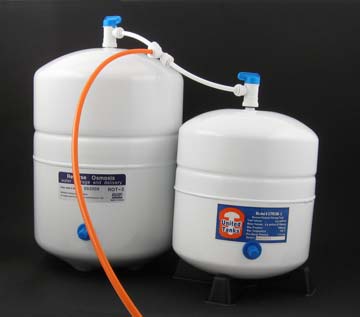
Should you worry about BPA in reverse osmosis tanks?
Because of the widely publicized presence of BPA in some plastic products, the public has developed a general suspicion of all plastics as a source of BPA. Actually, the plastic products that contain BPA are mainly the hard, shatter-resistant, usually clear water bottles as well as baby bottles and a few other plastic containers. You normally will not find BPA in plastics like polypropylene and polyethylene. BPA is not one of the materials used in preparing these plastics.
If a product is NSF certified (certified to ANSI/NSF standard 58), the certifying agency has scanned the product for BPA. If the product contains BPA, it will fail the extraction test and will not be certified.
The materials in high quality RO tanks that touch the water are stainless steel (the spout only), polypropylene (the liner in the chamber that holds the water), and butyl (the bladder that holds air and pushes the water out of the tank). The butyl (aka chlorobutyl) bladder material in high quality tanks is specially cured so that it will not put out bad tastes or contaminants.
There are lots of things that contaminate food and water that we should worry about, but reverse osmosis tanks aren’t one of them.
How Often Should Carbon Filter Cartridges Be Changed?
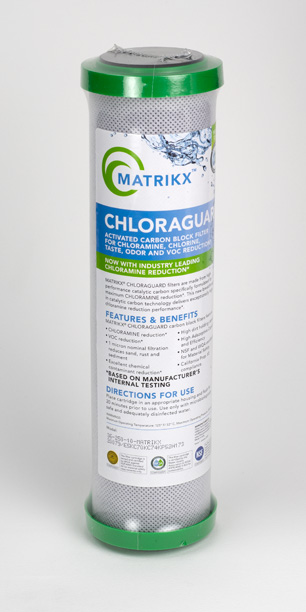
MatriKX Chloraguard Filter Cartridge, 2.5″ X 9.75″ — Standard Drinking Water Size
The simple and probably the best answer for residential applications is that carbon filter cartridges should be changed at least once a year. The more complicated answer is that it all depends on what you expect of the cartridge, how much you know about your water, and how willing you are to monitor such things as the amount of water used and the flow rate.
Carbon filters are a very versatile tool that can be applied to many different problems. What they do best and easiest is remove chlorine and improve taste and odor. But they are also the most practical treatment for many more difficult problems, like chemicals in general (see how many times carbon appears as the treatment of choice in this contaminant removal chart), and very hard to treat items like VOCs and PFAS.
Below is the manufacturer’s lifespan recommendation for the high quality coconut shell carbon block filter pictured above.
- Chlorine: 45,000 @ 1 gpm,
- Chloramine: 4,000 @ 0.5 gpm,
- PFAS: 3,500 @ 0.5 gpm,
- VOC: 750 @ 0.5 gpm.
Note that if your requirement is only the removal of chlorine from drinking water the cartridge should last until you die of old age. However, if your city uses chloramine rather than chlorine as its disinfectant, it will last only about 1/10 as long, and you’ll have to be sure to run the water half as fast. Running the cartridge at “chlorine speed” will greatly reduce its service life as well as its effectiveness when treating chloramine or difficult contaminants like PFAS and VOCs.
In most cases the once-a year-rule works well and assures excellent performance with most contaminants. If more than a couple of people are using the water and VOCs are a known issue, changing the cartridge twice a year is a good idea.
And then, of course, there are variables to be considered like multi-cartridge filters, position of the cartridge within the unit (a reverse osmosis pre-filter treats much more and much dirtier water than a reverse osmosis post filter), water temperature, pH, etc. But, for simplicity, the once-a-year cartridge change works pretty well.
Some of the articles in Water Treatment 101 are simply practical advice about maintaining a product you already own. Below is a good example. It offers a step-by-step explanation of what you need to do to re-program a Fleck AIO (air induction) filter to function as a standard, non-airation filter.
Turning Off Aeration: Converting an AIO Control to Standard Filter Operation
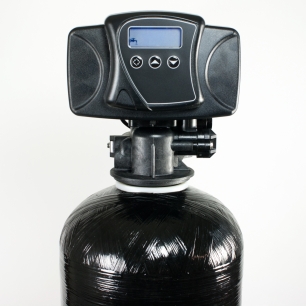
The instructions below are for turning off the aeration feature in Fleck 5600 and 2510 AIO filtration units so that the unit will operate as a standard filter.
To enter master programming–
Set the time of day to 12:01 PM (must be pm).
Press the extra cycle button to save the time.
Press the up and down buttons simultaneously and hold until the screen changes to a setting that says DG GAL (You are now in master programming mode.)
To scroll through the settings, push and release the extra cycle button.
Scroll through and do not change settings until you get to
DO 1 (DO, for Day Override, is the number of days until the unit regenerates.)
Change the 1 to any number you want for the regeneration interval. For example, if you want to regenerate every 4th day, change the number to 4. Push the Extra Cycle button to save and move on.
Scroll through until you get to BD 40 Change the 40 to 0 and continue. (Set BD to 0, not to OFF.)
When you get to RR, change the 1 to 2. (This gives you a 2 minute Rapid Rinse. Set to a higher number if you wish.)
Continue to scroll through until the screen returns to the time of day. Reset the time to the correct time of day.
Now the screen should alternate between the time of day and the DO number that you entered. The number displayed is the days before the next regeneration.
Call 888 382 3814 if you have a question.
The following is the most recent addition to the "Water Treatment 101" category.
Proprietary Water Filters vs. Standard Models
The most “standard” size in point of use drinking water filters uses 2.5″ x 9.75″ replaceable filter cartridges. Over the years the 2.5″ X 9.75″ cartridge (we call it Size 1) has dominated the industry. Virtually all cartridge makers offer cartridges in this size. Wide use encourages a competitive market, hence lower prices, and a big variety of products to choose from.
Not all filters are made in standard size, however. Some manufacturers create unique filter styles that can have advantages and disadvantages. One advantage is convenience in the form of easy-to-replace filter elements in which the housing itself is discarded. This means easier replacement but greater cost and limited choice in replacements.
A major disadvantage of buying a water filter with proprietary replacement parts is that you are dependent upon the manufacturer to stay in business and continue to supply replacement elements. Most basic drinking water filters are durable products that will last for years, but if the product disappears from the market after a couple of years your only option is to discard the unit and replace it. This happens often. In fact, it is a sales strategy of some makers who regularly discard proprietary filtration units to force replacement with “improved” (slightly different) units.
Below, for comparison, are examples of proprietary and standard filtration units. Both models shown are “simple” undersink filters–filters that treat all the cold water at the sink and dispense the filtered water through the cold-water side of the regular sink faucet. Simple undersink units are easy to install because no extra faucet for drinking water is needed. The principles in this article also apply to regular undersink filters that need their own faucet and to undersink reverse osmosis units.
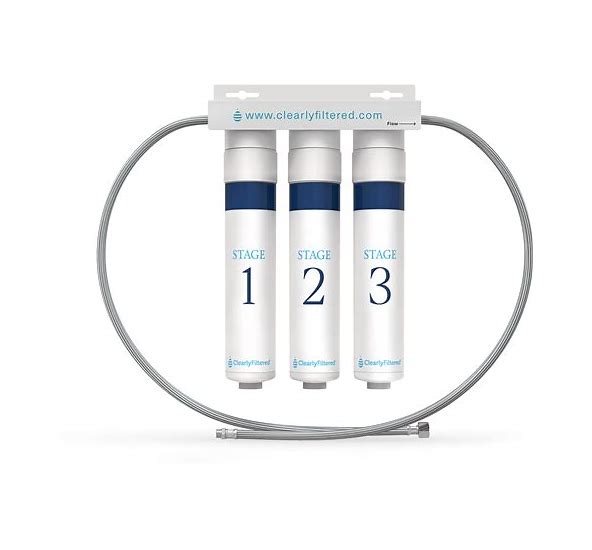
The unit pictured above is a respected proprietary unit which features regular city water treatment including fluoride removal. Although the manufacturer does not give specifics about the standard 3-filter replacement package, the expectation would be that one is a sediment cartridge, one a carbon block cartridge, and one a fluoride removal cartridge. The unit features easy-to-change disposable cartridges. Go here for more information and purchase details.
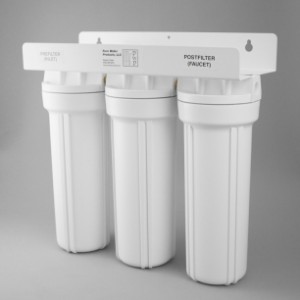
Pictured above is a Pure Water Products Standard Simple Undersink Filter. It is offered with many standard 2.5″ x 10″cartridges to select from, including several carbon block filters, several sediment cartridges, carbon block cartridges with lead removal and cyst removal built in, both coconut shell and standard carbons, fluoride and nitrate removal–in other words, a lot of treatment styles to choose from so that the final product can be tailored to the customer’s local water.
Comparative Chart
| Filter Model |
Proprietary 3-Stage Undersink Filter with unique replacement cartridges. |
Pure Water Products Simple Undersink 3-Stage Filter with standard-sized cartridges and housings. |
| Internet Price for the unit. |
$550 complete with one set of cartridges |
$90, without cartridges. The customer chooses cartridges from a large variety available, and the cartridge price is added to the $90 basic unit. A typical set of the very best city water cartridges would add $79. Optional installation kit is $16. Typical total price for everything would be about $185, shipping included. |
| Price of annual cartridge replacement |
$396 for standard setup with fluoride removal. |
$89 (with fluoride removal) ($66 without fluoride removal). Varies according to cartridges chosen from many available. |
| Cartridge availability |
Must buy from manufacturer or reseller of manufacturer’s product. |
Readily available from Pure Water Products or almost anyone who sells a water filter. Uses any standard 2.5″ X 10″ cartridges. Any cartridge on this page will fit the unit. |
| Parts availability |
Filter housing caps and o rings might be hard to find. |
All parts are standard size and readily available from Pure Water Products or many other water treatment suppliers. The sump o rings, for example, are a widely available part–easy to find, easy to replace.
|
|
Water News
Water News for January of 2026

Water news for January of 2026
The Big News in Water Is that The Real News Isn’t Being Reported
The big news in water is that the EPA is no longer prioritizing public heath, as it was created to do, but is quickly being converted to serve the interests of big business. The Natural Resources Defense Council has identified 66 environmental rollbacks in the first year of the second Trump presidency.
Most of the news about water has been about EPA program cancellation.
After a tumultuous year under the Trump administration, the Environmental Protection Agency (EPA) has adopted a new, almost unrecognizable guise – one that tears up environmental rules and cheerleads for coal, gas-guzzling cars and artificial intelligence.
When Donald Trump took power, it was widely anticipated the EPA would loosen pollution rules from sources such as cars, trucks and power plants, as part of a longstanding back and forth between administrations over how strict such standards should be.
But in recent weeks, critics say the EPA has gone far further by in effect seeking to jettison its raison d’etre, forged since its foundation in 1970, as an environmental regulator. The EPA is poised to remove its own ability to act on the climate crisis and has, separately, unveiled a new monetary worth assigned to human lives when setting air pollution regulations. The current new value? Zero.
“The EPA was designed to protect public health and the environment and did a remarkably effective job of that,” said William Reilly, who was EPA administrator under a previous Republican president, George HW Bush.
“That record is now at risk and we will see the degradation of air quality in major cities. The administration seems to conceive the purpose of the agency as solely promoting business, which has never been the agency’s mission. That’s revolutionary – it’s not been seen before.”
A vivid illustration of this, Reilly said, was when the EPA asked businesses last year to simply email a request to be exempt from air pollution rules. “The notion you could be excused from a black letter law just by asking for it was startling to me,” he said. “I thought it was a spoof. But it did happen.”
After returning to the White House, Trump vowed to “unleash” oil and gas drilling and the burgeoning AI industry by sweeping away environmental regulations that the president says only serve a “globalist climate agenda” and a “scam” clean energy sector.
The EPA under its current administrator, Lee Zeldin, has zealously followed this lead – initiating 66 environmental rollbacks in the first year, according to a tally compiled by green group Natural Resources Defense Council (NRDC).
This list includes paring back limits on pollutants such as mercury and soot coming from cars and power plants, cancelling grants for renewables and aid for communities blighted by toxins, squashing clean water protections and deleting mentions of the climate crisis from the EPA website. For the full account: The Guardian.
Scientists warn of alarming growth of huge mats of seaweed in the oceans
Scientists have warned of a potential “regime shift” in the oceans, as the rapid growth of huge mats of seaweed appears to be driven by global heating and excessive enrichment of waters from farming runoff and other pollutants.
Over the past two decades, seaweed blooms have expanded by a staggering 13.4% a year in the tropical Atlantic and western Pacific, with the most dramatic increases occurring after 2008, according to researchers at the University of South Florida.
A harmful algae bloom in Lake Erie
Scientists warn of an ecosystem out of balance because of lethal algae blooms that could darken the waters below, changing their ecology and geochemistry, and also accelerate climate breakdown. The Guardian
A single bluefin tuna was sold for $3.2 million
A Pacific bluefin tuna the size and weight of a grizzly bear sold for a whopping $3.2 million at auction last week inside a popular Japanese fish market. Smithsonian.
With Rainfall Far Below Average, Water Scarcity in Northwestern Turkey has Reached a Critical Point
Water scarcity in northwestern Turkey has reached a critical point after the Kadıköy Dam, a key drinking water source for the town of Keşan, effectively ran dry, according to Daily Sabah. Authorities suspended all water withdrawals after reservoir levels dropped below what is known as “dead storage,” and intensifying droughts linked to rising temperatures are pushing vital water systems to the brink. The Kadıköy Dam supplies drinking water to Keşan. The reservoir, designed to hold 56 million cubic meters of water, has dropped to below 1% capacity. Prolonged drought, extreme summer heat and increased evaporation have driven the decline. According to the Turkish government, rainfall was 26% below the long-term average last year. Yahoo News.
“The World Is Entering a Situation of Water Bankruptcy. Water May Soon Be More Valuable than Gold”
What is water bankruptcy?
We are using up water sources faster than they can be replenished, essentially putting us in water debt. In “many basins and aquifers, long-term water use has exceeded renewable inflows and safe depletion limits,” said a report by the United Nations. Other water sources, including rivers, lakes, wetlands, soils and glaciers, have been “damaged beyond realistic prospects of full recovery.”
Like financial bankruptcy, water bankruptcy happens gradually. We “pull a little more groundwater during dry years. We use bigger pumps and deeper wells. We transfer water from one basin to another. We drain wetlands and straighten rivers to make space for farms and cities,” said Kaveh Madani, the director of the UN University’s Institute for Water, Environment and Health and author of the report. After that, the costs begin to pile up. “Lakes shrink year after year. Wells need to go deeper. Rivers that once flowed year-round turn seasonal. Salty water creeps into aquifers near the coast. The ground itself starts to sink.” The Week.
Forest Service Research Underlines the Importance of Forests for Drinking Water Quality
Across the United States, forests play a major role in protecting our drinking water supply. A U.S. Forest Service analysis found that 89% of public surface drinking water supplies receive at least some surface water from forested lands. That means forests help filter the drinking water of roughly 150 million Americans. Some western cities, like Portland, Oregon, receive up to 90% of their drinking water from nearby national forests.
In other words, preserving forests helps keep our water clean and reliable. Environment America
|
|
Places to visit for additional information:
|
|
|
|
|
|