Footloose Is Over in New York. The Music Fight Isn't.
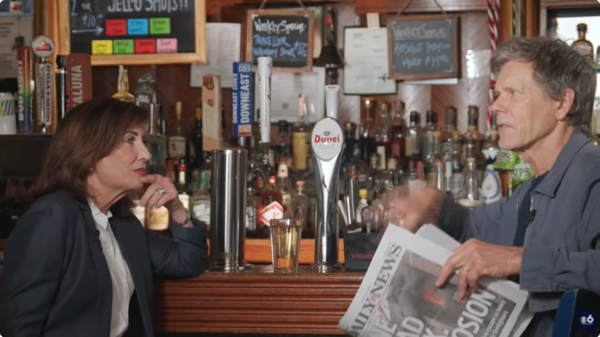
When Governor Kathy Hochul wanted New Yorkers to know that the state had stopped policing dancing, she brought in Kevin Bacon. The casting was not subtle, and that was the point. The star of Footloose announcing the end of New York's own footloose laws is the kind of moment our community has waited three decades for.
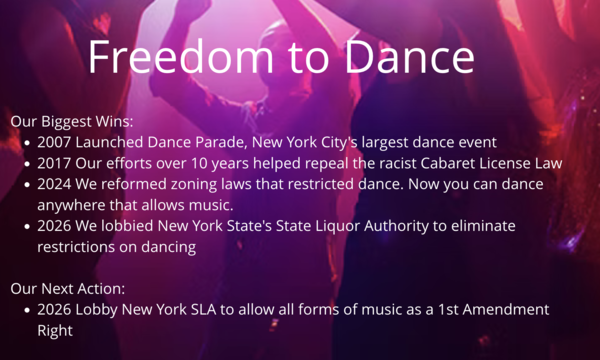
Getting there took a fight most New Yorkers never saw. When the State Liquor Authority proposed to fix the problem by creating a dancing license, Dance Parade wrote a policy paper arguing that a license is not a repeal, and sent it to the Chair of the SLA and to state legislators. The New York City Hospitality Alliance carried that argument into Albany. The license idea was dropped, and the requirement came off the books entirely.
The fight is not over. New York no longer regulates whether you can dance. It still regulates what music can be played and how it is played, which Dance Parade maintains is regulatory overreach that suppresses culture. Here is what changed, who made it happen, and what we need from you next.
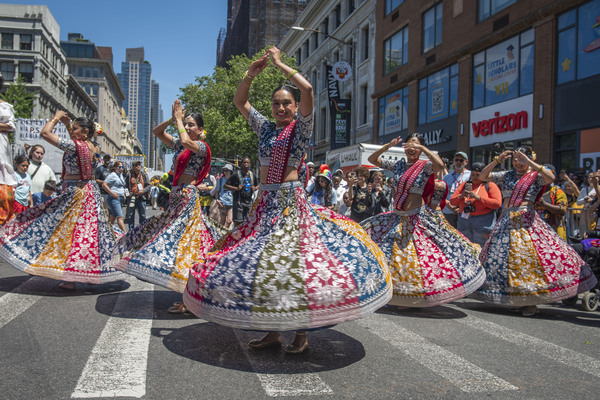
Reba Browne Dance Company performs at Dance Parade 2026 on May 16, 2026. (Photo: Wenping Li)
What the State Liquor Authority gave up
For years, bars and restaurants holding a liquor license in New York had to declare whether dancing would happen on their premises. That declaration sat in the venue's "method of operation", and a venue that let people dance without having declared it was exposed to enforcement. In practice, most venues never asked. Requesting dancing marked an establishment as immoral and turned a routine liquor license into a contested hearing before a community board, so owners left it off the application and then spent years telling paying customers to sit down.
When the State Liquor Authority looked at fixing the problem, its first proposal was a dancing license. At the request of the New York City Hospitality Alliance, Dance Parade submitted a policy position written on behalf of the people who actually dance: flamenco dancers in tapas bars, immigrants finding joy in Caribbean soca, Argentine tango couples, flamboyant voguers and ballroom dancers, and everyone who just wants to groove to a track with funky beats. The five-page paper went to the Chair of the SLA and to state legislators, and it made one argument: a license is the wrong fix. It would only rebuild the same gatekeeping that New York City just spent decades dismantling, with a new name and a new fee.
The SLA dropped the licensing idea. Instead, Governor Hochul announced a policy change: Bars and restaurants no longer need to specify any interest in dancing at all. The requirement is gone rather than renamed.
Major credit for that outcome goes to the New York City Hospitality Alliance, and in particular to Andrew Rigie and Rob Bookman, who led the lobbying effort in Albany. Their relationships across state government, and the work of their lobbyist, are what moved the NYS legislators and effectively changed SLA policy. Dance Parade has made the public case for twenty years. The Alliance turned it into policy. That is a rare outcome in regulatory advocacy, and it belongs to everyone who danced in the Annual Dance Parade and Festival, testified, signed a petition, and showed up.
|
Three decades of pressure
This did not start in 2026, and it did not start with Dance Parade. New York City's Cabaret Law dated to 1926 and made it illegal for more than three people to dance in an unlicensed venue. What turned it into a weapon was the Giuliani administration, which revived it in the 1990s and used it to fine and shut down dance venues across the city. Enforcement fell hardest on Black, Latino and LGBTQ communities. Dance Parade was founded in 2007 as the pushback.
The law rested on a distinction that makes no sense to anyone who dances. Dance performed on a stage counted as expression and was protected by the First Amendment. Social dancing, the kind that happens in a merengue club or at a house music party, was treated as something the city could license, restrict and police.
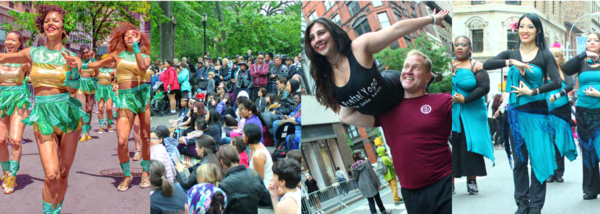
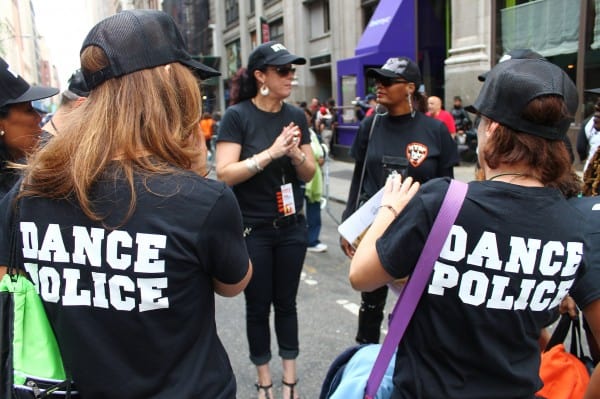
"We built a parade to make that line impossible to defend" says Greg Miller, Executive Director of the non-profit that produces Dance Parade New York and provides dance residencies to dozens of schools and community centers. "We bring more than 100 styles of social dance into the street each year on the third Saturday in May and send out the NYDP, our own Dance Police, to ticket bystanders for failing to dance."
Dance Parade's Dance Police (NYDP) giving out "No Movement Violations" to those not dancing.
The city repealed the Cabaret Law in October 2017 after a campaign that ran through our parade route and into City Hall. Bedford + Bowery covered the coalition behind it, which stretched from the Mayor's office to Duke Ellington's family. Mercedes Ellington kicked off historic testimony in then Council Member Rafael Espinal's 2017 hearing to repeal the cabaret law.
A law with a racist history
New York's dance laws were never enforced evenly, and the record of who they were used against is not ambiguous. From 1940 to 1967, any performer who wanted to work a New York club that served alcohol needed a cabaret card, issued and policed by the NYPD. You were fingerprinted and investigated. An arrest, not a conviction, could cost you the card, and losing it meant losing the right to work in your own city.
|
|
|
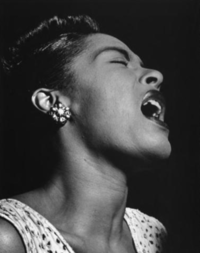
Billie Holiday lost her cabaret card after a 1947 narcotics conviction and never got it back. For the last twelve years of her life she could sell out Carnegie Hall, which the law did not reach, but she could not sing in a New York nightclub. Thelonious Monk lost his in 1951 after taking the fall for a friend, and spent roughly six years locked out of the rooms that had made him. Charlie Parker lost his. Miles Davis had his taken after police beat him outside Birdland in 1959, on a night he was headlining there.
|
Billie Holiday, Downbeat, New York, c. 1947. Photo: William P. Gottlieb, Library of Congress
These were not marginal figures. They were the artists who made New York the capital of American music, and the city's answer to them was to decide, one by one, who had permission to perform. The cards were discretionary, the discretion sat with the police, and the weight of it fell on Black musicians.
Dance Parade exists because of this history. For twenty years we have said in public what the city spent decades refusing to admit: that rules about dancing and music in New York have always been rules about who gets to gather, and which neighborhoods get policed for it. The Cabaret Law outlived every musician named above.
"The NYC Cabaret Law stayed on the books until 2017, NYC zoning reform took six years after that and the State Liquor Authority's dancing restriction outlived it by another nine years," says Jerry Goldman, dancer, attorney and Board Chair of Dance Parade New York.
Rooting out what those laws left behind is the work, and it is why we are not treating what remains as a technicality. The through line is simple. Every time one restriction falls, another one is still standing. Which brings us to the music.
|
The next fight: Let the Music Play New York
New York no longer regulates whether you can dance in a bar. It still regulates the kind of music a venue may play and the way it is played. Method of operation conditions continue to limit live music and DJs at licensed venues across the state. A room where people are now free to dance can still be restricted in what it is allowed to play, who is allowed to play it, and how. For small venues, which is to say most of the places where New York's music actually gets made, those conditions decide what is economically possible.
Let the Music Play New York is our campaign to end them. We are building it with the Hospitality Alliance and with partners across the music industry, on the theory that the industry should stand together rather than let each venue negotiate alone.
Nearly 5,000 New Yorkers have signed the petition already. The legislative push comes in early 2027, and the number of names on that petition is what gets us in the room in Albany.
Where this work has been happening this Summer
In June, the Queer Nightlife Community Center in East New York hosted “The Future of Nightlife in New York,” a town hall with the Mamdani administration. City officials included Deputy Mayor for Economic Justice Julie Su, Cultural Affairs Commissioner Diya Vij, Office of Nightlife Executive Director Jeffrey Garcia, and Media and Entertainment Commissioner Rafael Espinal. They came to talk about safety, resources for the people who work these spaces, and what the city can actually do to help nightlife thrive.
In July, Tara Duvivier, club historian and zoning expert, convened “This Used to Be a Club” event at The Pratt Institute, fostering a conversation about nightlife and the spaces New York has lost. Jeffrey Garcia attended and described the range of programs his office runs to preserve nightlife while keeping peace with neighbors. Greg Miller joined DJ Disciple on a panel about the culture we are trying to protect and nourish.
In August, Ali Coleman screened his film Ali's Story at the Ki Smith Gallery in Manhattan's Lower East Side and led a panel of his own, featuring Pratt's Tara Duvivier, Dance Parade's Greg Miller, archivist Armando X (Raw Club Archives) and filmmaker Ben Sinclair, who is making "Movement", a documentary about nightlife advocacy. Ali himself has continued the fight far longer than this summer: his House Coalition float has participated in Dance Parade for twenty consecutive years, through the Cabaret Law, the repeal, the zoning fights, and now this.
Through November, Dance Parade's LOOK UP short is on view in Venice. Curator Rachel D. Vancelette asked artists one question: what does “look up” mean to you? Our answer, a one-minute piece on reverence, played on the billboards of Times Square before being selected for Palazzo Mora, at the 2026 Venice Biennale, the world’s oldest international art exhibition.
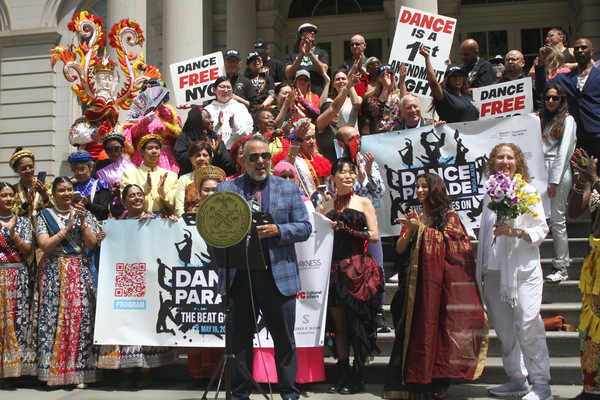
Jeffrey Garcia (Office of Nightlife Executive Director) speaks at a Dance Parade press conference at New York City Hall on May 13, 2026. (Photo: Josef Pinlac)
Read more
Our full advocacy history, policy positions, and press archive live at LegalizeDance.org.
Dance One, Dance All
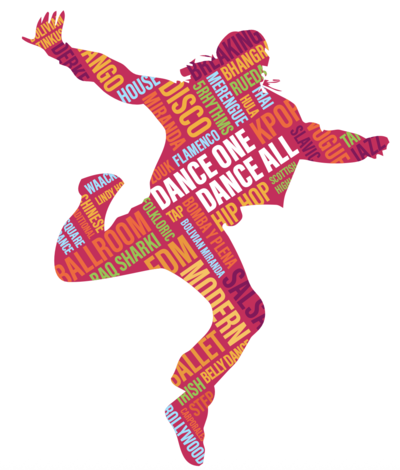
Registration opens for The 21st Annual Dance Parade and Festival November 15th. Join the city's biggest dance event that steps off Saturday, May 15, 2027, under the theme "Dance One, Dance All." More than 160 dance organizations and over 100 styles, on the streets of Manhattan, because that right had to be fought for and still does.
|
Spread the joy of Dance Parade:
|
|
|
|  | |