| Pure Water Products |
|
May, 2026
|
|
|
Water is chiefest of all things, for streaming
Therefrom all life and existence came.
Pindar's First Olympian Ode |
|
Water Treatment Issues and Current Water News |
In this merry month of May Occasional you'll hear (as you have already heard several times in recent Occasionals) about the Pure Water Gazette's water treatment archive, the downside of chemical additives used by city water departments to fight scale buildup, the scary buildup of phosphorus in our water caused by human activities, the discovery of the importance of hand washing, how filter carbon works and the difference between absorption and adsorption, news about microplastics and nanoplastics including the amount of plastics found in bottled water, the alarming oxygen loss in our rivers, the concerning rate at which ocean ice is melting, a squid with eyes the size of a large pizza, the problems of migratory fish, water shortage in Kabul, a new tool for measuring and predicting drought, and as always, there is much, much more.
|
Water and Environmental Issues |
More from the Pure Water Gazette Bulging Article Archive
The Pure Water Gazette website has been archiving information about water treatment for about three decades. Since we add regularly and almost never discard, the Gazette website is now bulging with many hundreds of informative and useful articles about water issues and how to deal with them. Best of all, there are no intrusive pop-up ads or other distractions from the subject at hand. Even more importantly, information-rich articles don't disappear. You can depend on them to be there for future reference.
The Pure Water Gazette is a non-commercial site. Its function is to provide information, not sell products. The site does not take orders or ask you for information. The Gazette website is designed to be useful and informative, not beautiful. It is arranged into several broad categories. Below are the main topics from the site's sidebar index. Each of the main categories leads to articles added to the site since 2012.
-
- A few clicks on the links above will give an indication of the extensiveness of the Gazette's content. In this issue of the Occasional we're going to include some miscellaneous articles from the Gazette.
The article below appeared in the Pure Water Gazette in August of 2018. It addresses a familiar problem in water treatment: when you treat one problem, you often create another. And perhaps another and another.
Chemicals that keep drinking water flowing may also cause fouling
by Yun Shen et al
Research from The University of Illinois at Urbana-Champaign
Summary: Many city drinking water systems add softening agents to keep plumbing free of pipe-clogging mineral buildup. According to new research, these additives may amplify the risk of pathogen release into drinking water by weakening the grip that bacteria — like those responsible for Legionnaires’ disease — have on pipe interiors.
Many city drinking water systems add softening agents to keep plumbing free of pipe-clogging mineral buildup. According to new research, these additives may amplify the risk of pathogen release into drinking water by weakening the grip that bacteria — like those responsible for Legionnaires’ disease — have on pipe interiors.
Biofilms, which are similar to the films that grow on the glass of fish tanks, are present in almost all plumbing systems and anchor themselves to mineral scale buildups in pipes. They are teeming with harmless microbial life and incidents of waterborne illness are rare.
“The groundwater that supplies many cities may be high in magnesium and calcium,” said Helen Nguyen, a professor of civil engineering and co-author of the study. “When combined with other elements, they can form thick deposits of mineral scale that clog up engineered water systems. Because of this, water treatment plants add chemicals called polyphosphates to dissolve the minerals to keep the scale buildup under control.”
A recent study by co-author and civil and environmental engineering professor Wen-Tso Liu has shown that even with the addition of antimicrobial agents by water companies, the bacteria that grow on the mineral scale can reproduce to harmful levels in supplies that stagnate within indoor plumbing.
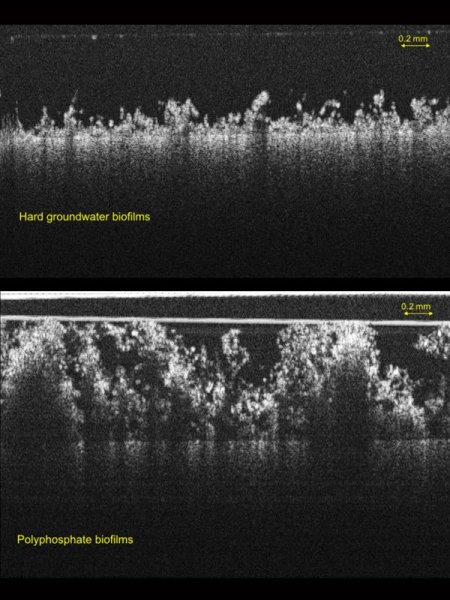
In a new study published in the journal Biofilms and Microbiomes, a team of University of Illinois engineers shows that the addition of anti-scalant chemicals cause the biofilms to grow thicker and become softer.
The team measured the thickness and stiffness of lab-grown biofilms using magnetomotive optical coherence elastography — a tool used to measure the strength of cancer tissues. The analytical method, developed by Stephen Boppart, a professor of electrical and computer engineering and study co-author, allowed the team to quantify the effect that polyphosphate has on the strength of biofilms.
To reproduce what happens in engineered plumbing systems, the team used PVC pipe and groundwater from the Champaign-Urbana area source to grow biofilms. They set up multiple scenarios with and without added polyphosphates. All scenarios produced biofilms, but the system that used polyphosphates grew a much thicker and softer biofilms than the others, the researchers said.
“Increased biofilm thickness means more bacteria, and the softening increases the chance that pieces will detach and foul the water supply under normal flow pressure,” Nguyen said. “Tap water is regulated by the Environmental Protection Agency up to the property line, not the tap. So, in buildings where water has been stagnating for a while, this could become a public health issue.”
A problem, according to researchers, is that some sort of anti-scalant chemical is required to maintain adequate water flow through pipes. “Of course, one solution could be to replace pipes once they become clogged with mineral buildup,” Nguyen said. “But that would be a very expensive endeavor for public utilities and property owners in a country as large as the United States.”
Nguyen believes that the most affordable and realistic solution will come through a better understanding of water chemistry, not by trying to kill all microbes, ripping out pipes or changing regulations.
“Before this work, we did not have a good understanding of the relationship between the water chemistry and microbiome that exists in plumbing. This work has given us initial insight and tools to help determine what chemicals will work best and at what concentration,” Nguyen said.
The team is moving ahead with related studies that look at ways to help physically remove biofilms while pipes remain in place and others that look at the effects of anti-corrosive chemicals on biofilms and water quality.
“We will not be able to control how long a drinking water user will allow water to stagnate, but we can work to understand how the chemicals we add to our water interact with biofilms.”
To read this article on the Gazette website, please go here.
Parallel Installation of Water Filters
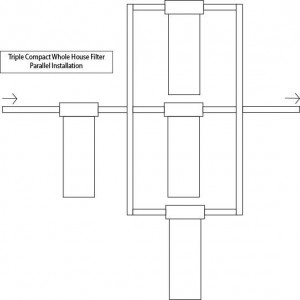
The illustration above depicts a triple parallel installation that is used to increase the service capacity, the longevity, and the effectiveness of cartridge filters. As an example, if a home needs 15 gallons per minute of service flow for, say, chloramine reduction, the desired flow can be most easily obtained by installing three 5 gallon-per-minute carbon filters in parallel so that the flow splits and each 5-minute unit has to handle only 1/3 of the desired 15 total. Water passes through a single sediment filter on the left. The sediment filter will easy handle the 15-gpm flow,then each of the carbons has to handle only five. This is a practical, relatively inexpensive installation that is easy to maintain.
A Pure Water Gazette article features drawings of six arrangements with compact whole house filters including one that illustrates how to build your own by-pass system for the compact units.
Can Earth’s Fresh Water Survive the Phosphorus Overload?
Man-made phosphorus pollution is reaching dangerously high levels in freshwater basins around the world, according to new research.
Phosphorus is a common component of mineral and manure fertilizers because it boosts crop yields. However, a large portion of phosphorus applied as fertilizer is not taken up by plants, and either builds up in the soil or washes into rivers, lakes and coastal seas, according to the study’s authors.
The results of a new study show global human activity emitted 1.62 million U.S. tons of phosphorus per year into the world’s major freshwater basins, four times greater than the weight of the Empire State Building.
The study also assessed whether human activity had surpassed the Earth’s ability to dilute and assimilate excess levels of phosphorus in fresh water bodies. The authors found phosphorus load exceeded the assimilation capacity of freshwater bodies in 38 percent of Earth’s land surface, an area housing 90 percent of the global human population. There is simply not enough fresh water in many areas to assimilate the phosphorus.
The study’s results indicate freshwater bodies in areas with high water pollution levels are likely to suffer from eutrophication, or an excess level of nutrients, due to high phosphorus levels. Eutrophication due to phosphorus pollution causes algal blooms, which can lead to the mortality of fish and plants due to lack of oxygen and light. It also reduces the use of the water for human purposes such as consumption and swimming.
Breaking down phosphorus load The authors of the new study examined agricultural activity to calculate the total amount of man-made phosphorus entering Earth’s surface water from 2002 to 2010. They gathered data on how much fertilizer is applied per crop in each country, and estimated domestic and industrial phosphorus production by looking at protein consumption per capita per country.
The largest contribution to the global Phosphorus load came from domestic sewage at 54 percent, followed by agriculture at 38 percent and industry at 8 percent.
The authors found the phosphorus load from agriculture grew by 27 percent over the study period, from 525 gigagrams (579,000 U.S. tons) in 2002 to 666 gigagrams (734,000 U.S. tons) in 2010.
About The American Geophysical Union The American Geophysical Union is dedicated to advancing the Earth and space sciences for the benefit of humanity through its scholarly publications, conferences, and outreach programs. AGU is a not-for-profit, professional, scientific organization representing 60,000 members in 137 countries.
Gazette’s Famous Water Pictures: Dr. Semmelweis Washing His Hands
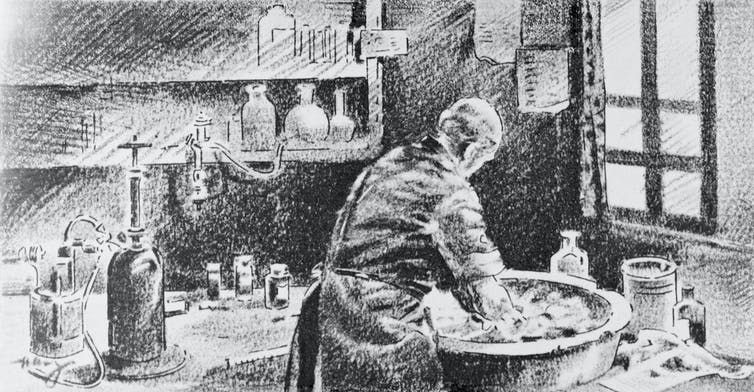
Dr. Ignaz Semmelweis washing his hands in chlorinated lime water before attending to patients.
History of Hand-Washing
The idea that “germs” that cause disease get on people’s hands and that they can be spread from person to person by unclean hands hasn’t been around that long. In fact, it was 19th-century Hungarian physician Ignaz Semmelweis who, after observational studies, first advanced the idea of “hand hygiene” in medical settings. Here’s how Semmelweis, working in an obstetrics ward in Vienna in the 19th century, made the connection between dirty hands and deadly infection.
Hand-Washing in the old days
While we certainly don’t know the name of the first guy to wash his hands, the history of hand-washing extends back to ancient times, when it was largely a religious practice. The Old Testament, the Talmud and the Quran all mention hand-washing in the context of ritual cleanliness, and it may be that ritual hand washing had some public health implications. During the Black Death of the 14th century, for instance, the Jews of Europe had a distinctly lower rate of death than others. Researchers believe that hand-washing prescribed by their religion probably served as protection during the epidemic.
Dr. Semmelweis
Hand-washing as a health care practice did not really surface until the mid-1800s, when a young Hungarian physician named Ignaz Semmelweis did an important observational study at Vienna General Hospital.
Semmelweis started working in obstetrics, a relatively new and not very prestigious area for physicians, in the Vienna Hospital in 1846. Obstetrics had to that time been dominated by midwifery and conventional doctors were trying to expand into the childbirth business.
The leading cause of maternal mortality in Europe at that time was puerperal fever–an infection, now thought to be caused by the streptococcus bacterium, that killed postpartum women. Prior to 1823, about 1 in 100 women died in childbirth at the Vienna Hospital. But after a policy change mandated that medical students and obstetricians perform autopsies in addition to their other duties, the mortality rate for new mothers suddenly jumped to 7.5%. When the hospital opened a second obstetrics division, staffed entirely by midwives, the older division, where Dr. Semmelweis worked, was quickly seen to have a much higher mortality rate than the new midwives’ division.
Semmelweis set out to investigate. He examined all the similarities and differences of the two divisions. The only significant difference was that male doctors and medical students worked in the first division and female midwives in the second.
What transmits disease?
At that time, the general belief was that bad odors called “miasma” transmitted disease. It would be two more decades at least before germ theory–the idea that microbes cause disease–took over as the accepted theory, the theory that persists until today.
Semmelweis reasoned that no midwives ever participated in autopsies or dissections, but students and physicians regularly went between autopsies and deliveries, rarely washing their hands in between. Realizing that chloride solution rid objects of their odors, Semmelweis ordered hand-washing across his department. Starting in May 1847, anyone entering the doctors’ obstetrical division had to wash his hands in a bowl of chloride solution. The incidence of puerperal fever and death dropped sharply by the end of the year.
Unfortunately, as in the case of his contemporary John Snow, who discovered that cholera was transmitted by polluted water and not miasma, Semmelweis’ work did not get him a place in history or even a promotion. In fact, he lost his job because his boss was envious of his success and got no recognition for the discovery during his lifetime.
Hand-washing has now, of course, become a part of the medical ritual, but it gets a definite bump of compliance whenever there is disease outbreak. Even in times of pandemic, though, we do not have a day on our calendar that honors Dr. Ignaz Semmelweis. There is no justice.
Start here
Adsorption of Water Contaminants: How Filter Carbon Works
According to the Wikipedia, “Adsorption is the adhesion of atoms, ions, or molecules from a gas, liquid, or dissolved solid to a surface. This process creates a film of the adsorbate on the surface of the adsorbent. This process differs from absorption, in which a fluid (the absorbate) permeates or is dissolved by a liquid or solid (the absorbent). Note that adsorption is a surface-based process while absorption involves the whole volume of the material.”
Explained more graphically:
This man has adsorbed a pie.
This man is absorbing a pie.
In water treatment, activated carbon is the main adsorbing agent. This is true because filter carbon has an amazing amount of surface area and a strong ability to attract and hold organic chemicals.
Most of the surface area of a particle of carbon is internal.
Enlargement of granular carbon shows countless pores that adsorb contaminants. The surface area of the pores is exceptional. A single pound of activated carbon has more surface area in its pores than 100 football fields.
Carbon’s amazing ability to adsorb organic chemicals varies according to the chemical in question and conditions of the water. In general, chemicals of high molecular weight and low solubility are most easily adsorbed. The lower the concentration of the chemical, the higher the adsorption rate by carbon. Also, the fewer the interfering organic compounds present in the water the better. The pH of the water is also significant, with acidic compounds being most readily adsorbed at low pH. And, as with most other aspects of water filtration, rate of flow of the water being treated is extremely important with carbon adsorption. The more residence time the better.
In regard to specific chemicals, one source lists dozens of common chemicals and ranks them according to the likelihood that they will be removed by carbon adsorption. Here are a few of the more common items from the list:
Very High Probability of Adsorption: Atrazine, Malathion, 1, 3-dichlorobenzene, DDT, Lindane.
High Probability of Adsorption: Toluene, styrene, benzene, carbon tetrachloride, vinyl acetate, phenol.
Moderate Probability of Adsorption: Chloroform, vinyl chloride, acetic acid.
Unlikely to be adsorbed by carbon: Isopropyl alcohol, dimethylformaldehyde, propylene.
It should be remembered that although carbon has great chemical reduction capacity because of its ability to attract and hold chemicals on its surface, it acts in other ways as well. Chlorine, for example, is reduced mainly by catalytic reaction with the carbon, not by the “grab and hold” process of adsorption.
|
Water News
Water News for May of 2026

Water News for May, 2026
For the first time, the EPA has flagged microplastics and pharmaceuticals as priority drinking water contaminants
America’s drinking water has carried microplastics and prescription drug residues for years. Washington is only now starting to officially care.
On April 2, 2026, EPA released its draft Sixth Contaminant Candidate List, designating microplastics and pharmaceuticals as priority contaminant groups under the Safe Drinking Water Act. Neither had previously held formal federal research status under drinking water law.
Science still has some catching up to do. No agreed-upon definition for microplastics in drinking water currently exists, and standardized testing protocols remain a work in progress. How quickly those gaps close will determine when utilities face hard compliance deadlines. — Water Treatment USA 2026.
Bottled water can contain hundreds of thousands of previously uncounted tiny plastic bits
A new microscopic technique zeroes in on the poorly explored world of nanoplastics, which can pass into blood, cells and your brain. In recent years, there has been rising concern that tiny particles known as microplastics are showing up basically everywhere on Earth, from polar ice to soil, drinking water and food. Formed when plastics break down into progressively smaller bits, these particles are being consumed by humans and other creatures, with unknown potential health and ecosystem effects.
One big focus of research is bottled water, which has been shown to contain tens of thousands of identifiable fragments in each container. Now, using newly refined technology, researchers have entered a whole new plastic world: the poorly known realm of nanoplastics, the spawn of microplastics that have broken down even further. For the first time, they counted and identified these minute particles in bottled water. They found that on average, a liter contained some 240,000 detectable plastic fragments — 10 to 100 times greater than previous estimates, which were based mainly on larger sizes.
Rivers Are Losing Oxygen at an Alarming Rate
Climate change is steadily stripping oxygen from rivers around the world, according to a new study published May 15 in Science Advances. Researchers found that this long-term oxygen decline is happening across most river systems, with tropical rivers emerging as the most vulnerable. The findings point to an urgent need for strategies aimed at slowing oxygen loss in freshwater ecosystems. A sweeping analysis found that nearly 80% of the world’s rivers have been steadily losing dissolved oxygen, with climate change identified as the main driver. Science Daily
Ocean Ice Is Melting Much Faster Than We Thought
In research focused on the Fimbulisen Ice Shelf in East Antarctica, scientists discovered that the shape of the underside of the ice shelf strongly affects how seawater circulates below it. Where deep channels exist beneath the ice, ocean currents can form small circulation patterns that keep warmer water trapped against the ice instead of allowing it to move away quickly. This concentrated warmth dramatically increases melting in those locations.
The researchers found that melting within these channels can increase dramatically. In other words, the structure of the ice shelf itself helps determine where heat collects and how much damage that heat can cause. In a word, ocean ice is melting much faster than we previously believed. Science Daily
Researchers Find Evidence of Fabled Giant Squid
Scientist working in the ocean off the western coast of Australia have used DNA to detect many ocean species that have not yet been observed by humans. Among these most notably is a fabled giant squid. “Giant squid are among the ocean’s most mysterious animals. They can grow longer than a school bus (10 to 13 meters), weigh between 150 and 275 kilograms, and possess the largest eyes in the animal kingdom, reaching up to 30 centimeters across, roughly the size of a large pizza.” Science Daily.Migratory Freshwater Fish Are in Rapid Decline
Some of the longest and most essential animal migrations on Earth take place beneath the surface of rivers. A major new report from the Convention on the Conservation of Migratory Species of Wild Animals (CMS), a United Nations environmental treaty, warns that many of these migrations are now rapidly breaking down. A sweeping global report finds that migratory freshwater fish are in steep decline, with populations down roughly 81% since 1970. These species depend on long, connected rivers, but dams and human pressures are cutting off their routes. Hundreds of species now need coordinated international protection. Experts say restoring river connectivity is critical to preventing further collapse. Science Daily.
Kabul, Capital of Afghanistan, Is Running Out of Water Rapidly
Kabul is rapidly running out of water. Its population relies mostly on groundwater extracted from wells. But the groundwater has been receding at an alarming rate, and some wells have to be dug as deep as 500 feet to reach it.
An April 2025 report by the aid group Mercy Corps said the level of Kabul’s aquifers had plunged by 25-30 meters (about 80-100 feet) over the past decade. Aquifers hold massive amounts of water deep under land surfaces. Water in them collects slowly over years as precipitation seeps in. Too much extraction from aquifers, or changes to the climate bringing less water, leads to depletion.
“Without large-scale changes to Kabul’s water management dynamics, the city faces an unprecedented humanitarian disaster within the coming decade, and likely much sooner,” it said.
Climate change, mostly caused by the burning of gasoline, oil and coal, has played its part. Repeated droughts have reduced snowfall, whose gradual melting can replenish groundwater. Instead, Kabul sees more sudden, heavy rainfall that leads to flooding but not enough of it reaches the aquifer. AP.
USGS Groundwater Drought Metrics
The U.S. Geological Survey Released a Pioneering Study of US Groundwater Levels a pioneering study analyzing groundwater levels across the conterminous U.S., providing tools to assess groundwater drought and inform water planning.
Nearly 27 million Americans, or 8% of the U.S. population, live in areas where water demand consistently approaches or exceeds naturally available water supply. Until now, accessing comprehensive water availability information required navigating fragmented datasets across multiple agencies. A new tool eliminates many of those barriers.
“While the United States has abundant water nationally, regional imbalances between supply and demand may create water challenges affecting millions of Americans,” said Shirley Leung, lead scientist. “This tool can help decision-makers understand whether challenges may stem from limited natural water supply, high demand, or both. This information is helpful for effective water planning.”
There are also water‑rich regions of the country where communities and water managers may use the tool to identify potential economic opportunities tied to their water supply, as well as to support long‑term planning to preserve and protect this vital resource. USGS.gov.
|
|
Places to visit for additional information:
|
|
|
|
|
|