Chiefest is water of all things,
For streaming therefrom
All life and existence came.
Pindar, 500 BC.
September 30, 2027 |
|
IN THIS ISSUE
How Does Your Water
Supply Get Treated?
Does PVC Piping Make Water Unsafe to Drink?
How Do Twin Tank Water Softeners Work?
What Is Causing the Rising Salt Levels in Lakes?
Current Water News
|
The Occasional is supported by
|
Places to visit on our websites:
Model 77: The World's Greatest $77 Water Filter
|
Write to the Pure Water Gazette or to Pure Water Products
|
|
|
In this action-packed issue |
You'll learn about water's journey between source and tap. Plus, the effect of PVC piping and road salt on the quality of our water. Pure Water Annie explains the pros and cons of the twin tank residential water softener. Also, a summary of the current water news. And, as always, there is much, much more. |
How Water Is Treated for Use in Homes
Water doesn't just come out of your faucet by magic.
If you live in a city . . .
your water comes to you in pipes from a municipal water supplier that gets water from lakes and rivers and sometimes wells, treats it to make it clear, odor-free, germ-free, non-corrosive, and generally palatable, then pumps it through a maze of pipes to your home. Some cities start with better water than others, and some cities are better at treating it than others.
As part of its treatment, the city water plant adds chlorine or a mixture of chlorine and ammonia called chloramine to the water to kill pathogens.You may not like the taste and odor of the disinfectants, but the chlorination of water is regarded, rightly, as one of our society's greatest public health achievements. The treatment plant also adds other chemicals to clarify the water and prevent corrosion in pipes. Some cities also add an industrial waste product called fluoride which is believed to prevent tooth decay. The practice of fluoridation is on the decline worldwide.
Between the city water plant and the home lie miles of pipe, some of it very old, made of a variety of materials and in varying states of repair. The water is affected a lot by pipe materials and by contaminants that can enter the water if the pipe leaks or is broken. The water that leaves the treatment plant is not the same water that enters the home. A lot of things happen to it along the way.
Most city water plants do a praiseworthy job of taking some pretty dirty raw water from a lake or river, getting the mud and sticks out of it, and turning it into water that is clear, tastes good, and won’t cause a cholera epidemic. They supply 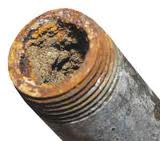 water that is of really high quality for hosing down driveways and flushing toilets. People who have watched a plumber cut open a pipe entering their home, however, usually don’t feel quite so good about drinking their tap water anymore, or even bathing in it.
The very decent water delivered by the city can be made excellent in the home, which is, after all, where the fine polishing of water should take place. Home treatment makes much more sense than trying to supply top quality drinking water for flushing toilets and mopping floors. Only a tiny percentage of the water that enters the home is used for drinking.
Point-of-entry treatment for city water most often consists of cartridge or tank-style activated carbon filters to remove disinfectants (chlorine or chloramine) for all the water that enters the home. If the water is “hard” (meaning that it has lots of calcium and magnesium in it), it can be treated with a conventional water softener or one of the newer “salt-free” alternatives. Treatment for hardness is mainly done to protect pipes and fixtures and to make water more aesthetically pleasing. Adding a point-of-entry ultraviolet (UV) unit to assure bacteria-free, cyst-free water for the whole home is becoming more popular, especially in light of the increasing number of “boil water” alerts.
For point-of-use treatment for the water that you’re going to drink, cook with, or make ice with, a variety of countertop and under-the-sink systems are available. These range from simple, very tight carbon filters that improve taste and odor and remove chemicals to more comprehensive treatments like steam distillers or reverse osmosis. The real king of point-of-use drinking water systems is reverse osmosis. A good undersink reverse osmosis unit can provide top quality drinking water for a moderate cost. RO, as it’s called, removes virtually anything one would want removed from water, including the more difficult contaminants like arsenic, lead, chromium 6, fluoride, chloramines, trihalomethanes, and a wide range of pesticides, herbicides, “pharmaceuticals,” and so-called “emerging contaminants."
If you live outside the city . . .
your water usually comes to you from a well on your own property. A well is essentially a hole in the ground with a pipe through which water in an underground pool is sucked up to the surface. It's like drinking from a glass with a drinking straw. Also, many non-city dwellers pull their water through pipes directly from a pond or stream and treat it themselves.
If you have a well or draw water from a lake or river, you are your own water treatment superintendent, so you need to pay attention to what you're about. The first thing you should do is get a good, comprehensive water test. This might cost you a couple of hundred dollars, but it will pay for itself easily in what you'll save by not purchasing unnecessary or inappropriate equipment. If the test shows that your water is perfect, the peace of mind you gain will more than pay for the test.
The reason the well test is needed is that you don't have the benefit of the testing that's done for you with city water. If there's arsenic in the city's water source, the city is obligated to take care of it and to tell you about it. If there's arsenic or feedlot contamination in your well, the only way you'll know is by having a good test done.
With private water sources there is a much greater chance that extreme treatment will be needed. Here are some of the common issues with well, river and pond water, along with a few of the ways they can be corrected. These are just some of the problems and some of the possible solutions.
Bacteria - pathogens like E. coli can be controlled by chlorination or ultraviolet treatment.
Iron and manganese - treated with iron filters that often require pre-treatment with aeration or chlorine. Also treated with conventional water softeners (not the salt-free alternative units).
Hardness - Treated with a water softener or a salt-free alternative TAC unit.
Hydrogen Sulfide (rotten egg odor) - treated by chlorination or aeration followed by filtration.
Arsenic, Chromium - reverse osmosis for drinking water. (Frequently left untreated for point of entry.)
Pesticide, Herbicide, general chemical contamination - Carbon filtration.
Tannins (tea colored water) - Ion exchange and carbon filtration.
Sand, Sediment - Backwashing or cartridge-style sediment filters. |
PVC pipe that meets current manufacturing standards and carries NSF/ANSI 61 certification is considered safe for drinking water by U.S. and international regulators. It’s the most widely used plastic pipe material in municipal water systems across North America. That said, the safety picture has some nuances worth understanding, particularly around the age of your pipes, chemical migration at very low levels, and long-term degradation.
What Makes PVC Approved for Drinking Water
The key standard in North America is NSF/ANSI/CAN 61, titled “Drinking Water System Components: Health Effects.” To earn this certification, manufacturers must submit their exact product formulas, including every ingredient and supplier. NSF then independently tests the pipes in its own laboratories, checking whether any chemicals migrate from the pipe wall into water at levels that could affect health. Those migration results are evaluated by toxicologists and peer-reviewed by an external health advisory board.
Certification isn’t a one-time event. Each certified production facility receives at least two unannounced inspections per year. The pipes are tested annually for compliance with NSF/ANSI 61 and at least twice a year specifically for residual vinyl chloride monomer, the chemical most associated with PVC safety concerns. If a manufacturer changes its formula in any way, it must report the change and potentially undergo additional testing before the certification continues. When phthalates or phthalate-based plasticizers appear in a product’s formulation, those products are tested separately for phthalate leaching.
Vinyl Chloride: The Primary Concern
Vinyl chloride is a known human carcinogen and the building block molecule used to make PVC. During manufacturing, trace amounts of unreacted vinyl chloride monomer can remain trapped in the finished pipe. Over time, small quantities can migrate into the water sitting inside the pipe.
The EPA sets a maximum contaminant level for vinyl chloride in drinking water at 0.002 mg/L (2 micrograms per liter), while its health goal is zero. The World Health Organization sets a stricter guideline value of 0.0003 mg/L (0.3 micrograms per liter), noting that “as vinyl chloride is a known human carcinogen, exposure to this compound should be avoided as far as practicable.”
How much vinyl chloride actually ends up in your water depends heavily on when the pipe was made. PVC pipe manufactured before 1977 has been found to leach vinyl chloride at concentrations as high as 14 micrograms per liter, well above the EPA limit. Modern manufacturing processes leave far less residual monomer in the pipe walls. Lab and field studies on newer pipes show vinyl chloride accumulation in the range of tens of nanograms per liter after a few days of water sitting still, and hundreds of nanograms per liter after two years. For context, a nanogram is one-thousandth of a microgram, so these levels fall well below both the EPA and WHO limits.
Heat and sunlight accelerate the process. Research on unplasticized PVC exposed to temperatures around 45°C (113°F) or direct sunlight found vinyl chloride levels reaching roughly 2 to 2.5 micrograms per liter over 14 to 30 days. That’s right at the EPA’s legal limit. This is why PVC water pipes are meant to be buried underground, not run along exterior walls or through areas with sustained high heat.
Pure Water Gazette note: Vinyl chloride is effectively removed by standard home water treatment with carbon filtration or reverse osmosis.
Phthalates and Other Additives
Rigid PVC (sometimes called uPVC) used in municipal water mains and most household plumbing does not require plasticizers to be flexible, so phthalate exposure from these pipes is minimal. Chlorinated PVC (CPVC), a related material common in hot water lines, is a different story. One EPA-referenced study found that CPVC pipe released significantly higher concentrations of several phthalates compared to PEX (cross-linked polyethylene) pipe. The highest measured phthalate from CPVC reached 18,400 nanograms per liter, while the same compound from PEX pipes peaked between 169 and 881 nanograms per liter depending on the type.
Lead stabilizers are another historical concern. In North America, lead-based heat stabilizers were phased out of PVC production starting in the 1970s. Modern PVC pipes use calcium-zinc or tin-based stabilizers instead. If your home has PVC plumbing installed before the early 1980s, the pipes may have been manufactured with lead-containing stabilizers, though the degree of lead migration into water from these older pipes varies.
Microplastics From Aging Pipes
A concern that has gained attention more recently is the release of tiny plastic particles from pipe walls as they age. Over years of service, the surface of PVC pipe develops pits and cracks at the microscopic level. Polymer chains break down, weakening the structure and making the surface increasingly rough and crumbly. This degradation produces particles in the micro and nanoplastic size range that can shed into the water flowing through the pipe.
The degree of degradation depends on how long the pipe has been in service and the conditions it faces. Research confirms that both PE and PVC pipes age relatively quickly in terms of surface integrity, and that aging pipes “should be considered a real and very important source” of microplastics and nanoplastics in drinking water. The long-term health effects of ingesting microplastics are still being studied, but the presence of these particles in drinking water is now recognized as a water quality issue worth monitoring.
How UV and Heat Affect PVC Over Time
PVC is not designed to withstand prolonged sun exposure. Ultraviolet light triggers a chemical reaction called dehydrochlorination, where chlorine atoms break free from the polymer chain and form hydrochloric acid. This process begins at the surface and works inward, making the pipe progressively more brittle. In testing, PVC lost about a third of its toughness after just 100 hours of UV exposure. After two weeks of outdoor weathering, fracture resistance dropped roughly 20 percent, reaching a 38 percent decline after one month.
The pipe doesn’t suddenly collapse, as its overall strength and stiffness remain relatively stable. But it becomes much more prone to cracking under stress. In hot climates where solar radiation is intense and summer temperatures exceed 50°C (122°F), exposed PVC and CPVC pipes can degrade significantly. This is one reason building codes require PVC water pipes to be installed underground or in protected indoor locations. If you notice any PVC plumbing in your home that sits in direct sunlight, such as near a window or in an uncovered outdoor run, that section is aging faster than it should be.
Practical Steps to Minimize Risk
If your home was built after the early 1980s and uses PVC or CPVC plumbing installed to code, the pipes generally fall within safe parameters for drinking water. A few practical habits can reduce your exposure to whatever trace chemicals do migrate from the pipe walls:
- Flush stagnant water. Vinyl chloride and other compounds accumulate when water sits motionless in the pipe. If water has been standing for several hours or overnight, let the cold tap run for 30 seconds to two minutes before drinking.
- Use cold water for cooking and drinking. Hot water dissolves contaminants from pipe walls more readily than cold water. This applies to all pipe materials, not just PVC.
- Keep PVC out of sunlight. Any PVC pipe exposed to UV light degrades faster and may release more chemicals. Ensure outdoor sections are shielded or replaced with UV-resistant materials.
- Know your pipe age. Homes with PVC plumbing from the 1970s or earlier may have pipes with higher residual vinyl chloride and possibly lead-based stabilizers. Testing your water or replacing very old PVC sections is reasonable if you’re concerned.
- Look for NSF 61 markings. When replacing plumbing or adding new lines, confirm that any PVC pipe you purchase carries the NSF/ANSI 61 certification stamp. This ensures the product has been independently tested for chemical migration into drinking water.
PVC remains one of the most affordable, durable, and widely accepted materials for water distribution. For modern, properly installed pipe, the measured chemical migration levels sit far below regulatory limits under normal conditions. The risks increase with pipe age, heat exposure, and stagnant water, all factors you can manage with straightforward precautions.
|
|
Twin Tank Softeners Are the Most Efficient Softeners Made
Pure Water Gazette water treatment wizard Pure Water Annie explains how twin-tank water softeners work. |
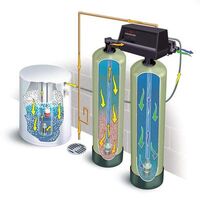
One of the most underrated “green” products available is the twin tank water softener. Although the initial cost is more, twin softeners can pay for themselves in water and salt savings. They also offer the satisfaction of being the most environmentally friendly of conventional water softeners.
A twin softener is essentially two identically-sized water softener resin tanks joined and controlled by a single softener valve. The control valve can be either a timer or a metered regeneration style, with a metered digital being strongly preferred for this type softener.
To dispel a common misconception about twin softening units, the two tanks work one at a time. That is, you don’t get double softening. A single softener tank is more than adequate to reduce the hardness of most residential water to virtual zero. The twin unit operates by keeping one of its tanks in reserve. When the capacity of tank one is reached, the control valve immediately puts tank two into service, so that there can never be a time when hard water is being sent to the home. Even when a tank is being regenerated, soft water is being delivered to the home. And, unlike the single tank unit, twin units use soft water for regeneration.
Since the switch from one tank to the other can be made at any time of the day or night, no “reserve” needs to be programmed into the softener. With conventional one-tank units, a certain amount of the tank’s capacity–usually about one day’s expected usage–is always held in reserve. This is accomplished by simply programming the softener to regenerate a day early. By conservative estimate, this “reserve” requirement is responsible for about 15% of the salt and water used by a single-tank softener. Simple arithmetic tells you that if a softener that regenerates once a week always regenerates one day early, in a year it will simply throw away 48 days worth of its softening capacity. And what is really being tossed away is water and salt.
Applications
Twin tank units are especially good for applications that require a long, uninterrupted supply of soft water. For example, if a softener is used to pretreat hard water for a large reverse osmosis unit, it is difficult to assure that the reverse osmosis unit will not demand water when the softener is regenerating. A twin tank unit solves this problem by providing a never ending supply of soft water.
One of our local customers is a yogurt store that needs to protect its expensive yogurt machines from scaling. Yogurt machines run around the clock and it would be very impractical to turn them off so that a conventional water softener can regenerate its resin bed. A twin softener is a perfect solution. It provides an endless supply of treated water with fully automatic operation with no need to maintain a “reserve.” |
Twin softeners are the most water and salt efficient softeners made. They regenerate less frequently because no "reserve" capacity has to be calculated. They have the added advantage of performing the regeneration with softened water, assuring a cleaner and more complete regeneration. Twin softeners are especially useful for applications requiring long service cycles that need an uninterrupted supply of soft water.
So, shouldn't everyone buy a twin-tank softener? Not necessarily. There are a few negatives to consider as well. They cost more initially, and if resin is replaced, you need twice as much resin. They take up more space. They're a little harder to work on and quite a bit harder to find parts for.
Editor's note: Pure Water Products offers 5600 single-tank softeners on its website but not twin-tank units. Please call or email for information about twin-tank units. |
Lakes are getting dangerously salty, and it’s our fault
by Mary Beth Griggs |
Salt. You might be happy to have it in your pasta water and your oceans, but in your friendly neighborhood freshwater lake, it’s an unwelcome intruder.
Unfortunately, salt is getting into lakes more and more frequently as humans move closer and closer to lakes, pouring increasing amounts of salt on the roads in the winter.
“Lakes are really good at showing long term environmental change,” says lead study author Hilary Dugan. Unlike rivers, which tend to show salt contamination in steep spikes, lakes show a steady change over time.
Many kinds of salt used on roads are chemically similar to table salt—NaCL—or sodium chloride. The presence of salt messes with water’s ability to freeze into a slippery, icy layer on the roads in winter. But when the weather warms, all that salt gets washed off the impervious road surfaces, sidewalks, and parking lots. It ends up accumulating in the soil, and eventually getting washed out by rain and snowmelt into surface waters like lakes and streams as sodium and chloride components.
Just like having too much salt is bad for you, too much chloride can be bad for the environment. It can kill off plants, and make waters less hospitable for native plants and algae.
Salt becomes noticeable in drinking water at about 300 milligrams per liter, or one teaspoon of salt in five gallons of water. That’s when you start tasting the difference, and it’s around that concentration that salt starts to put stress on freshwater plants and animals, which have adapted to live in extremely fresh water.
Road salt impacts the environment in other ways as well. While on the road, it can attract salt-loving animals like deer, increasing the possibility of both roadkill and traffic accidents.
Chloride can also make water more corrosive. In Flint, Michigan, researchers found that the chloride from road salt made the water in the Flint River so corrosive that when the city switched water sources, the water ate away at the lead pipes, creating the ongoing water crisis.
But water quality can be improved. Unlike phosphorus or other pollutants that can lurk in sediments in a lakebed for long periods of time, chlorides stay in the water column, and can gradually be flushed out of a lake as new water enters the lake. If you improve the water going into a lake you have the potential to freshen the lake.
Daunted by the rising price of salt, governments have already started to adopt more conservative salt-use measures, only using the amount necessary to ensure public safety. But homeowners can help cut back too. A single 12 oz coffee cup is all you need to salt a 20-foot length of driveway. And, ironically, the colder it is, the less effective road salting becomes. Below 15 degrees Fahrenheit, dry salt on a surface is useless, and won’t prevent ice from forming.
We started sprinkling salt on the roads back in the 1940’s and have kept at it ever since. Even as salt use declines, that’s tons of salt lurking in the environment, in soils, and other surfaces. Even if we start making changes to how we handle winter weather, it will take awhile to get all that salt out of our systems.
Source: Popular Science (shortened and slightly edited). |
|
Water News September 2026
When ocean temperatures increase, so does child malnutrition on land
Researchers are just discovering this troubling consequence of climate change, but they still don’t know why it happens. (Grist)
Ethiopia Limits Electricity to Crypto Mines
Amid ongoing drought, Ethiopia has cut the electricity supply to its cryptocurrency mines by 75 percent. (Circle of Blue)
Chloronitramide
A new article from the New York Times (NYT) highlighted the recent identification of chloronitramide, a water contaminant that has eluded classification for nearly 40 years. Researchers finally identified the chemical structure and the extent of its toxicity.
Chloronitramide is a disinfection by-product (DBP) that is created when chlorine-based disinfectants react with microbes or other substances in water to form a new compound. Researchers have been able to detect its presence, but only recently have they been able to identify its chemical structure. (WC&P)
Americans Have No Constitutional Right to Clean Water
A US appellate court has decided that the federal constitution does not guarantee a right to clean water. That legal opinion came in the form of a decision on Friday from the fifth circuit court of appeals to uphold a lower court’s dismissal of a 2022 lawsuit from several Jackson, Mississippi, residents claiming that tainted drinking water violated their constitutional rights. Those residents of Mississippi’s capital city contended that their local drinking water was unsafe to drink because of high lead levels and other contaminants. (Guardian)
UN Passes Resolution on Sea Level Rise
President Donald Trump’s second term has been a nightmare for global cooperation on climate change. Trump has yanked the United States from the Paris climate agreement, attacked a global agreement on a carbon tax for cargo ships, and threatened countries with tariffs if they get too vocal about climate.
Bauxite Mining Threatens Drinking Water in Ghana
Illegal bauxite mining in a protected forest in Ghana threatens the drinking water of an estimated 5 million people. (Circle of Blue)
Surprising US Stance on Rising Sea Level
World leaders at the United Nations General Assembly on Thursday approved a unanimous resolution on how to handle sea level rise, and the United States did not block it from moving forward. The passage of the accord represents a rare win for multilateralism, made all the more notable by the fact that the agreement includes references to climate change and climate aid for developing countries. (Grist)
States Defend the Mississippi Against AI
Leaders from 10 Mississippi River states are preparing to introduce legislation that protects the waterway from AI infrastructure development. (Circle of Blue)
Crocodile in Singapore Reservoir
A man in Singapore faces a long prison sentence after being arrested for posting a fake AI picture of a crocodile in a local reservoir. (BBC)
Elephant Butte Reservoir Is Almost Dry
New Mexico’s largest reservoir, Elephant Butte, has dwindled from being nearly full to 1.4%, its lowest level since 1971. (SciTechDaily)
New Desalination Method Discovered
Scientists have developed a solar-powered desalination system that turns seawater into fresh water while removing nearly all of the leftover salt as a solid instead of producing harmful brine. The self-cleaning technology could also recover valuable minerals such as lithium, potentially turning desalination waste into a useful resource. (Science Daily)
|
Thanks for reading. Keep your eye peeled for the next exciting Pure Water Occasional. We have decided to stop being slaves to the calendar. The next Occasional will sneak into your inbox when you least expect it.
|
|
|
|
|