 Est. 2008; bringing nature & gardeners together March 13, 2026
|

NURSERY NOTES: visit wonderful Farmshare tomorrow (March 14) for its Spring Plant Sale. $4 a pot. Choose from 34 varieties of tomatoes, 24 varieties of pepper and 5 varieties of eggplant. . . and more. All money raised goes towards their food access and farmer training programs. 3608 River Road (near the old Johnson's Backyard Farm). FarmShare 🌿
Texas Native Plant Society has teamed up with HEB to offer affordable natives at different store locations during the weekends of March 21/21, and 28/29. NPSOT/HEB. 🌿
Sweet Briar Garden Club hosts a south Austin plant sale March 21/22 at 504 Bramble Drive from 9 - 1 p.m. Veggies, flowers, herbs, and the amazing Figbeard will be there with a collection of fruit trees and lots of "orchard wisdom" to share. Sweet Briar 🌿
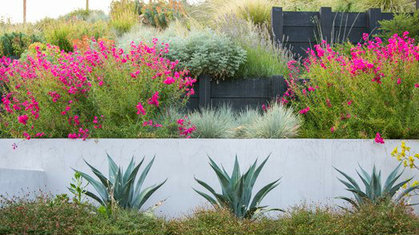
WARMTH IN GARDEN DESIGN: Colin Miller shares tips
on how to achieve a balance between hardscape and plants. "There’s no reason to feel stuck with rigid, architectural plants," he says. "When your plantings have a loose, alive appearance, they bring a sense of playfulness, liveliness, and warmth." Garden Design ❦
______________________________________________
WICKING GARDENS: this is a self-watering system where gardeners use capillary action to pull water upwards from a submerged reservoir. Jay Carpenter uses it for his highly productive vegetable garden, as he demonstrates in this fascinating feature from Central Texas Gardener ❦
THE AUSTIN GARDEN relies on readers for support. Whether annual or monthly, all donations are welcome. At present 7 % of readers fund this newsletter. Many thanks in advance. PayPal link ❦
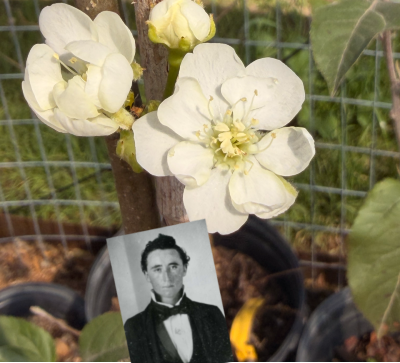 Inset: Walker's great-great-great grandfather Johann Friedrich Leyendecker (J.F.)
The Family Pears
by Walker Pickens
Almost ten years ago, before I ever considered myself a gardener or a plant person, I became fascinated with the concept of grafting. At least initially, the appeal was personal rather than horticultural.
In 2018, my grandparents made the tough but practical decision to sell the ancestral family land outside of Columbus, TX and move to Katy to be closer to family.
They were pushing 80, the maintenance was getting to be too much, and none of their kids had any interest in relocating. The loss stung. It was the center of the universe for my dad’s side of the family, and a huge part of my life growing up.
It was around that time when my mind turned to the heirloom pear trees on the property. They’d always been a fixture at family gatherings — a brown paper bag of pears in the crisper drawer of the spare fridge, a star turn in an autumn salad, or, the best of all possible outcomes, a freshly baked pear pie served with vanilla ice cream.
Not just good eatin’ (as we say in Texas), these trees had a deeper significance: they originated from stock planted over 100 years ago by my great-great-great grandfather, Johann Friedrich (J.F.) Leyendecker. I realized that if I wanted to hold onto this particular piece of family history, I was going to need to learn how to graft.
The NurserymanJ.F. immigrated to Texas from Germany in 1843 as a child, settling in Colorado County near present-day Columbus. Ever the industrious Texas German, he did a little bit of everything — state legislator, county tax assessor, justice of the peace, reluctant Confederate army musician.
But what he’s most remembered for, at least in our family, is his work as a nurseryman.
In 1876, J.F. founded Pearfield Nursery, where he trialed new varieties of pear, persimmon, and pecan sent by the USDA to test their suitability for Texas agriculture.
He won a bronze medal at the 1904 Louisiana Purchase Exposition for his LeConte, Smith, and Kieffer pears, and is believed to have been the first person in Texas to successfully grow Japanese persimmons. His 1908 obituary put it simply: “He loved horticulture intensely.”
Still StandingAfter J.F.’s passing, the nursery continued under his daughter and son-in-law for several more decades. The land was eventually subdivided among family members — one cousin inherited the original nursery site, where several of J.F.’s original trees are still standing and producing fruit today.
In the 1990s, grad students from Texas A&M took cuttings from the Pearfield trees and grafted new saplings from them. Several were planted at my grandparents’ place; others went to family and friends.
Those were the trees that fed us growing up, and the ones that were now sitting on land my immediate family no longer owned.
A Welcome NudgeFlash forward to 2023. I was working for Austin urban forestry nonprofit TreeFolks, and the pears were still on my mind, as they had been for years, to little result or action on my part.
Luckily, they came up in conversation with my colleague Vit Kaspar, TreeFolks’ nursery manager, an experienced grafter and fruit tree fanatic. He immediately pushed me to get some cuttings, promising to teach me to graft if I did. “It’s pretty easy,” he said breezily. We’ll see about that, I thought.
I pushed down my social anxiety and reached out to Terry–my grandmother’s first cousin, who had bought the land–and asked if I could come take some cuttings.
She generously agreed, and suggested I take scions from both properties: the younger grafted trees my grandparents had planted, and the ancient originals across the road at the old nursery site. I gladly took her up on the offer and returned home with an ice chest full of cuttings.
|
|
IT'S ABOUT THYME LEGACY PUBLICATIONS.
CONTACT EDITOR DARREL MAYERS |
|
|