 @LIFEworld @LIFEworld wide wide
|
| NEWSLETTER - June 2025
Welcome to the new LIFE Worldwide quarterly newsletter. We aim to bring you the latest developments in the world of Medical Mycology, including breaking news, diagnostic innovations and literature reviews.
|
|
Rising threat of fungal infections in intravenous drug users |
|
A new comprehensive review published in Open Forum Infectious Diseases warns of a growing public health concern: a sharp rise in severe fungal infections among people who use drugs, especially those who inject them.
According to the United Nations’ 2024 World Drug Report, in 2022, 292 million people worldwide used illicit drugs, 60 million of these were injecting opiates – a 10% increase over the past decade. And this trend is also fuelling the rise of fungal infections in users. MORE
WHO report on fungal diagnostics |
|
The World Health Organization (WHO) has published its first-ever reports addressing the critical lack of medicines and diagnostic tools for invasive fungal diseases, showing the urgent need for innovative research and development (R&D) to close these gaps. MORE
Global guideline for candidiasis The new Global Guideline for the Diagnosis and Management of Candidiasis (Cornely et al., 2025) is a comprehensive review and update on the diagnosis, treatment, and prevention of Candida infections, developed by the European Confederation for Medical Mycology (ECMM) in collaboration with ISHAM and ASM. Candida species, particularly Candida auris and fluconazole-resistant Candida parapsilosis, pose significant global health threats due to antifungal resistance and increasing incidence in hospitalized patients. The guideline provides updated recommendations for both invasive (e.g., candidemia, deep-seated infections) and mucocutaneous (e.g., oral thrush, vulvovaginal candidiasis) infections. MORE
Disseminated histoplasmosis - use of RT-qPCR A 2025 study by Sturny-Leclère et al. has evaluated HIV-positive patients with disseminated histoplasmosis (DH) treated with liposomal amphotericin B in Brazil. Using RT-qPCR to measure fungal DNA in blood, they found 64% tested positive initially, dropping to 15% by day 14, showing better prognostic value than traditional urine antigen tests. The study suggests RT-qPCR can complement diagnostics and predict treatment response. Fungal load declined across treatment regimens, supporting its use for monitoring. Despite promising results, the lack of standardized PCR assays and clinical guidelines limits implementation. The authors urge further research and potential integration into DH management for HIV patients. MORE |
|
Focus on - fungal neglected tropical diseases The new review by Cavanaugh et al. explores the disability and quality of life (QOL) impacts of four fungal neglected tropical diseases (NTDs): sporotrichosis, chromoblastomycosis, eumycetoma, and paracoccidioidomycosis. These diseases can cause disfigurement, long-term functional impairments, and stigmatisation, often impacting patients' mental health and ability to work. The authors highlight a lack of tools used to measure disability and mental health in affected populations. They recommend adapting existing QOL and stigma assessment tools from other NTDs to better understand and quantify the burden. Improving disability data is crucial for guiding health planning, rehabilitation, and funding priorities.
We have also launched a new Fungal NTD section on the LIFE website you can find out more about these diseases.
The WHO have developed a roadmap strategy towards eliminating all NTDs. You can access it HERE.
Review paper - C. parapsilosis infections and antifungal resistance
This 2025 multicenter retrospective study by Vena et al. assessed the clinical impact of fluconazole resistance in Candida parapsilosis bloodstream infections among 457 adult patients across Italy and Spain. Despite 42.9% of cases being fluconazole-resistant, resistance was not independently associated with increased 30-day mortality, provided patients received appropriate antifungal treatment.
However, resistant C. parapsilosis infections were associated with higher one-year recurrence (9.7% vs. 1.1%). Factors linked to increased mortality included older age, solid tumors, septic shock, and prior antifungal use. This study emphasises that fluconazole resistance alone does not worsen short-term survival outcomes when appropriate therapy is used, but it may contribute to recurrent infection risk. These findings underscore the importance of optimised antifungal stewardship and infection control, especially as resistance patterns shift across the globe.
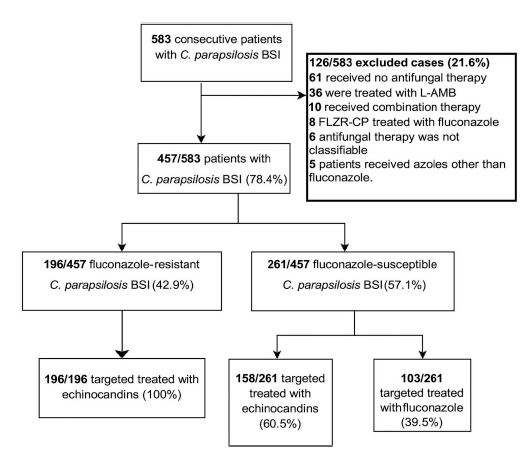 Fig. 1 Study flow chart
|
| www.fungaleducation.org |
