November 2026
Dear
Brethren,
You
will recently have received a communication from the United Grand Lodge
of England announcing a small number of proposed adjustments to the
wording of our ceremonies. These changes have been approved by the MW The
Grand Master and will be put before Grand Lodge for adoption at the
Quarterly Communication in December.
I
wanted to write to you personally, ahead of that meeting, to explain why
I believe these changes are both sensible and important, and why I
wholeheartedly support them.
Our
ceremonies are at the very heart of Freemasonry. They connect us with
generations of Brethren, convey our principles and provide experiences
that stay with us throughout our Masonic lives. I understand how deeply
we value their familiar words, and why any suggestion of changing them
may cause apprehension.
But
it is important to understand what these adjustments are intended to
achieve.
Why are these changes being made?
Earlier
this year, during legal proceedings involving the Metropolitan Police,
passages from our ceremonies were selectively quoted in ways that gave a
misleading impression of Freemasonry and our obligations, with these
misleading representations being accepted at face value by the High
Court. This reinforced an important point: we cannot assume that
those outside Freemasonry will interpret our ceremonies as we do. The
Grand Master therefore authorised a careful review to identify passages
where modest changes could make their meaning clearer and less open to
misrepresentation.
This
is not a rewriting of our ritual. The changes are deliberately limited,
preserving the substance, symbolism and traditions of our ceremonies.
What is actually changing?
The
adjustments fall into three broad areas:
• Clarity about our obligations. No
Masonic obligation overrides our duty to the law, our employer or any
public office we hold. This has always been fundamental to Freemasonry;
the revised wording makes it explicit.
•
Clearer ceremonial language. In
several places, secrets becomes mysteries, a term rooted in the medieval
trades and guilds, better reflecting the traditional knowledge and
symbolism of our ceremonies.
•
Language reflecting our values. Certain
expressions have been updated to remove ambiguity and reinforce
integrity, fairness and respect. References to discretion replace some
references to secrecy, while the familiar injunction to keep within due
bounds now explicitly extends to all mankind.
None
of these changes alters the essential character, meaning or lessons of
our ceremonies. Rather, they make the values and principles that underpin
them clearer and less open to misunderstanding.
Will these changes make people think differently about
Freemasonry?
Some
Brethren have asked whether changing a few words will persuade those who
are hostile to Freemasonry to change their minds.
The
answer is no. We cannot control what others think of us, and some will
remain suspicious whatever we do. But we can ensure that our own words
are less easily taken out of context and used to misrepresent our
principles, particularly where that misrepresentation risks encouraging
discrimination against our members. These changes are not about seeking
approval. They are about removing opportunities for misrepresentation and
standing confidently behind what we believe. They also form part of a
wider effort to explain Freemasonry more openly.
UGLE
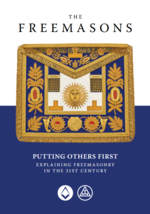
has published a new book, The Freemasons, which explains who we are, what
we do and why Freemasonry remains relevant today, while addressing
longstanding myths and misconceptions. As the Pro Grand Master observes
in his introduction: “An organisation that will not explain itself leaves
the explaining to somebody else.”
For
too long, we have sometimes allowed others to define Freemasonry for us.
The revised ritual helps ensure our ceremonies express our principles
clearly; the book helps us explain those principles to the wider world.
Together, they allow us to take ownership of our own story. I encourage
every Brother to read the book, which is available online free of charge,
and share it with anyone interested in understanding Freemasonry.
Read The
Freemasons online
How should we approach the changes?
I
encourage every Brother, particularly those who deliver our ceremonies,
to familiarise himself with the proposed wording and understand the
thinking behind it.
I
recognise that many Brethren have spent years, even decades, learning our
ritual. Familiar words will take time to adjust, and old habits will
occasionally reassert themselves. That is entirely understandable. What
matters is that we embrace the changes in the spirit intended, support
one another in learning them, and continue to deliver our ceremonies with
the care, dignity and sincerity they deserve.
Subject
to Grand Lodge's approval next month, further guidance on implementation
will be shared with Lodges in due course.
Looking ahead
Freemasonry
has endured for centuries not because every word has remained unchanged,
but because its fundamental principles have remained constant.
Integrity. Friendship. Respect. Service.
These
are the values we seek to practise in our Lodges, our communities and our
everyday lives. We should be proud of them, confident in explaining them,
and equally confident that our ceremonies express them clearly.
Tradition
and thoughtful evolution are not opposites. Our responsibility is to
preserve what matters most while ensuring that Freemasonry remains
meaningful and relevant to future generations.
I
wholeheartedly support the Grand Master's decision, and hope you will
join me in approaching these modest but important changes with
understanding, goodwill and confidence in the Craft we all love. Adrian Marsh
Grand Secretary & Grand Scribe E
|
|
|
|
|
|