| Pure Water Products |
|
April, 2026
|
|
|
Water Treatment Issues and Current Water News |
In this early Spring Occasional you'll find out what WOTUS means, learn about the advantages of installing whole house filters in parallel, hear why you should not drink ultrapure water, find out about Guinea Worms and President Jimmy Carter's connection with water filters, learn about the Safe Drinking Water Act, hear news about PFAS, the serious water shortage in Corpus Christi, the water surplus in San Diego, saltwater intrusion into drinking water along the Mississippi, Michigan's dam crisis, Old Faithful's water output, the ongoing crisis at Lake Powell and Lake Mead, and the finding of canoes older than the Pyramids. And, as always, there is much, much more.
|
Water and Environmental Issues |
More from the Pure Water Gazette Bulging Article Archive
The Pure Water Gazette website has been archiving information about water treatment for about three decades. Since we add regularly and almost never discard, the Gazette website is now bulging with many hundreds of informative and useful articles about water issues and how to deal with them. Best of all, there are no intrusive pop-ups or other distractions from the subject at hand. Even more importantly, information-rich articles don't disappear. You can depend on them to be there for future reference.
The Pure Water Gazette is a non-commercial site. Its function is to provide information, not sell products. The Gazette website is designed to be useful and informative, not beautiful. It is arranged into several broad categories. Below are the main topics from the site's sidebar index. Each of the main categories leads to articles added to the site since 2012.
-
- A few clicks on the links above will give an indication of the extensiveness of the Gazette's content. In this issue of the Occasional we're going to include some miscellaneous articles.
The article below appeared in the Pure Water Gazette in November of 2025. It addresses the timely subject of the ever-changing understanding and application of the concept of "Waters of the United States."
WOTUS Explained
by Gene Franks
When my grandfather built a house on his farm in Oklahoma just before the Great Depression he decided to leave behind the outdoor toilet and washtubs of his family’s previous home and go with modern indoor plumbing. Indoor plumbing was not yet common in farmhouses at the time.
The new house was in the middle of a 160-acre farm and there were no nearby neighbors, so he saw no problem in simply letting the raw sewage and grey water from the home discharge from a pipe into an empty field that sloped down to a small creek. Except on the days when the wind came from the wrong direction, it was easy to forget that raw sewage was collecting just a few feet down the slope. Conveniently, rain washed everything down the hill and eventually into the creek.
My grandfather built his new house about 50 years before the 1972 Clean Water Act when the concept of WOTUS, which stands for “Waters of the United States,” came into being. He followed the prevailing logic that since the land was his, it was no one else’s business where he discharged his sewer water. In 1972 the initial understanding of what the “Waters of the United States” consists of applied mainly to navigable water so my grandfather’s pasture and the tiny creek his sewage eventually washed into were not a great concern.
In 2025, defining WOTUS has become a complicated on-going political dilemma. The scope of WOTUS changes depending on which party is running the EPA. In broad terms, those who value private property ownership over public wellbeing and water quality, most often Republicans, take the view that my grandfather was within his rights to dump his sewage and his leftover farm chemicals and the used crankcase oil from his tractor on the side of his hill and let the rain wash it into “his” little creek. The other side, the radical lefties, take the view that the “Waters of the United States” concept includes the water on a farm in Oklahoma regardless of who owns the land, that all water is part of the Waters of the United States, just as McElligott’s little pool is part of an underground stream which is part of a river which is part of the oceans.
Under President Obama, WOTUS was broadened and more restriction was placed on what could be done on private land and by private businesses. Greater restrictions were placed on private activities that had an effect on the public water supply. The current administration is now working to redefine WOTUS and thus loosen restrictions on private individuals and businesses. Most recently, the new EPA administrator is seeking to remove wetlands, an essential component of nature’s water management system, from control under WOTUS.
Redefining WOTUS according to the way the political winds blow is now expected. Today’s rural homebuilders have accepted that they have to have an approved septic system for disposal of sewage. That’s progress. The battle today has shifted to, do land developers have to be burdened by bothersome WOTUS rules about draining wetlands to build apartments?
This article can be read on the Gazette website. It appeared initially in November of 2025. See WOTUS for Dummies.
Parallel Installation of Water Filters

The illustration above depicts a triple parallel installation that is used to increase the service capacity, the longevity, and the effectiveness of cartridge filters. As an example, if a home needs 15 gallons per minute of service flow for, say, chloramine reduction, the desired flow can be most easily obtained by installing three 5 gallon-per-minute carbon filters in parallel so that the flow splits and each 5-minute unit has to handle only 1/3 of the desired 15 total. Water passes through a single sediment filter on the left. The sediment filter will easy handle the 15-gpm flow,then each of the carbons has to handle only five. This is a practical, relatively inexpensive installation that is easy to maintain.
A Pure Water Gazette article features drawings of six arrangements with compact whole house filters including one that illustrates how to build your own by-pass system for the compact units.
Ultrapure Water Is Not For Drinking
While we believe that water straight from a home reverse osmosis unit is wonderful, water can indeed by too pure for human consumption.
What is commonly referred to as “ultrapure” water goes beyond what is considered pure drinking water. In fact, it is not considered “fit” for human consumption. Ultrapure water is water so clean that it is used as an industrial solvent for cleaning semiconductors, producing pharmaceutical products, and for cooling in power plants.
Typical production of ultrapure water includes use of microfiltration membranes to remove particles from the water, ion exchange and reverse osmosis (RO) membranes to remove ions, UV light to kill bacteria and degassing membranes to remove dissolved oxygen.
We think of reverse osmosis, which can turn sea water into excellent drinking water, as taking “everything” out of water, but when it comes to water needed for many technical processes RO water isn’t nearly clean enough. Ultrapure water requires 12 filtration steps beyond RO with the final filter having pores 20 nanometers in width. (Twenty nanometers is 0.02 microns.)
President Jimmy Carter and Water Filters
President Jimmy Carter died in January of 2025 at the age of 100. After he left office and up until his death he devoted his energies to many worthwhile projects. Perhaps most frequently mentioned is his untiring support for Habitat for Humanity. Less frequently mentioned is his effort to wipe out the infestation of Guinea Worm that plagued millions of the poorest of the planet’s residents.
One of ex-president Jimmy Carter’s great contributions to the world was providing, distributing and popularizing water filters.
The parasite Guinea worm sounds like something out of a horror movie. People become infected by drinking contaminated water or eating undercooked fish, when the worms are very small. Then the worm grows and grows. It sometimes takes a year for the infected person to know that he or she is infected. That’s when the creature breaks through the skin of the legs or feet, causing extremely painful blisters that can be debilitating.
Humans cannot develop resistance to the worms, according to Scientific American’s Charles Schmidt, and the traditional process of removing them is painstaking: gently winding an emerging worm around a stick and pulling it slowly out, usually just an inch or two each day, in a process that can last for weeks. Pulling too fast or too hard might cause the worm to break off in the body, leading to secondary infections. When victims suffer from multiple worms—such as a Nigerian man who had a record-setting 84 in his body at one time—the excruciating recovery work compounds.
In the mid 1980’s, there were about 3.5 million cases of Guinea worm around the world. Now, only about 11 people are known to be infected. President Carter’s goal was to see the total eradication of the guinea worm problem before his death. He got close.
The near eradication of Guinea worm is part of the legacy of Jimmy Carter, whose work with his Carter Center targeted overlooked diseases that most often affect poor people in remote areas. The effort didn’t involve drugs, but relied on public education around disease transmission, and providing safe water supplies like filters.
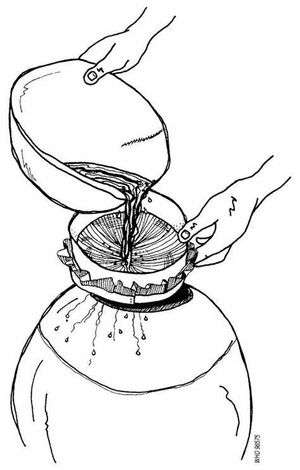
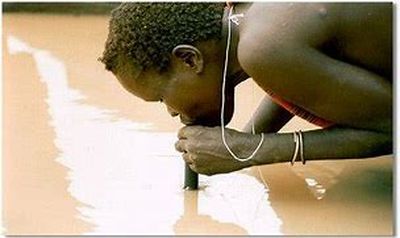
The filters themselves were not high-tech systems developed by massive grants and years of experimentation. They were simple filter straws that strained out worm-producing organisms from unsafe well or river water, or simple, inexpensive cloth filters that filtered unsafe water as it was poured into a water pot.
Simple cloth pour-through filters are very effective at preventing guinea worm infestation.
A typical cloth filter used in Ghana is manufactured by the Swiss company, Vestegaard and it has openings of 100-120 micron pore size.
Drinking water direct from a contaminated river through a simple and inexpensive hand-held filtering device.
The article above is based on a feature in NPR's global health blog that is no longer available.
Safe Drinking Water, Or Is it?
by Professor Victoria Sutton
Living in the United States, we have a great deal of confidence that regulations protect us from health risks. In particular, we trust that our drinking water—overseen by the U.S. EPA and its counterpart state agencies—is reliably safe. However, it is far more variable than many might think. Given that water quality depends on weather, runoff, natural filtration, contaminant and toxin treatment, and the infrastructure that delivers it to each home, it should not be surprising that quality can fluctuate—sometimes to the point of being dangerous—while still operating as a permitted public water supply.
The Safe Drinking Water Act was enacted in 1974, at the height of the environmental movement that followed the first Earth Day on April 22, 1970. A cluster of federal environmental statutes were passed by Congress during that era: the National Environmental Policy Act of 1969 (signed in 1970), the Clean Air Act of 1970, the Clean Water Act of 1972 (a major amendment to the Federal Water Pollution Control Act of 1948), the Endangered Species Act of 1973, and the Safe Drinking Water Act of 1974. President Nixon created the U.S. Environmental Protection Agency through a reorganization plan in 1970, consolidating components from other departments. This structure remains the foundation of the EPA’s authority today.
Returning to the Safe Drinking Water Act: major amendments were adopted in 1986 and 1996. Another significant shift came in 2001, when, in the wake of 9/11, credible threats to the nation’s water supply prompted additional security measures, including physical barriers and monitoring systems—protections arguably as important as the regulation of contaminants and toxins. In 2018, Congress passed further amendments to address cybersecurity risks in water systems. Notably, the first known cyberattack on a water system occurred in 2013.
Compliance with the SDWA (2023) In 2023, 72% of active public water systems (107,559) had no reported violations. Nearly 28% (40,982 systems) violated at least one drinking water standard. More concerning, 4% (6,045 systems) violated a health-based standard, meaning contaminants were detected above allowable limits.
Additionally, 20% of systems (29,703) failed to meet at least one monitoring or reporting requirement, meaning information about contaminants was late, incomplete, or not submitted at all.
That same year, 5,018 systems (3.4%) were designated as enforcement priorities during at least one quarter. The vast majority—93%—were small systems serving 3,300 people or fewer. Federal and state agencies initiated formal enforcement actions at 2,398 systems and informal actions at 27,149 systems. Meanwhile, 24,819 systems corrected violations and returned to compliance.You may want to check your own water system, many of which provide accessible, user-friendly compliance dashboards.
Most public water systems are small; about 80% fall into this category. Under the SDWA, a small public water system serves fewer than 10,000 users, with subcategories for systems serving 3,301–10,000 people, 501–3,300 people, and 500 people or fewer.
The 1996 amendments to the SDWA introduced provisions allowing variances for small systems when they cannot meet certain contaminant standards. This reflects a practical cost-benefit reality: the cost of reducing contaminants rises exponentially, with the final increments of purification accounting for the majority of total expense. In some cases, achieving near-total contaminant removal may be prohibitively expensive, leaving communities to weigh imperfect water against no access at all. This tradeoff helps ensure widespread access to water in the United States—but also explains why it may not be as safe as assumed.
A cost curve illustrating contaminant removal—such as arsenic—typically shows a “hockey-stick” pattern, where the last small percentage of purification requires disproportionately high investment. This pattern holds true for many toxins.
Perceptions of Drinking Water Safety
There appears to be no consistent, year-to-year national study tracking public perception of drinking water safety. However, a composite of multiple research efforts suggests that confidence in the water supply is declining. Across these studies, only about 37% of respondents expressed trust in their drinking water.
High-profile incidents—most notably the Flint, Michigan water crisis beginning in April 2014—have further eroded public trust, particularly when failures disproportionately affect low-income communities.
How We Measure Up Worldwide
Globally, 73% of the population—about 6 billion people—used safely managed drinking water services in 2022. However, 296 million people still rely on unprotected wells and springs, and 115 million collect untreated surface water from lakes, ponds, rivers, and streams.
An estimated 505,000 deaths each year are attributed to microbiologically contaminated drinking water. Diseases such as cholera, dysentery, typhoid, and polio—often spread through parasites, bacteria, and other pathogens—remain major contributors.
Final Thoughts
Ranking nations by drinking water safety is difficult due to varying laws and standards, but the United States generally maintains a high level of safety.
The 1996 amendments to the Safe Drinking Water Act significantly improved transparency by requiring public reporting. The annual Consumer Confidence Report (CCR), which must be delivered by July 1 each year, provides households with detailed information about their local water quality. Transparency is a cornerstone of public trust.
At the same time, increasing enforcement actions may signal either a rise in violations or simply more rigorous oversight. Either way, it underscores the importance of vigilance.
You may find yourself looking at your next glass of water a little differently.
Professor Victoria Sutton (Lumbee) is a law professor on the faculty of Texas Tech University. In 2005, Sutton became a founding member of the National Congress of American Indians, Policy Advisory Board to the NCAI Policy Center, positioning the Native American community to act and lead on policy issues affecting Indigenous communities in the United States.
|
Water News
Water News for April of 2026

Water News For April 2026
Some of the top water news stories of the month
U.S. Tap Water Contamination with PFAS
Recent testing has shown that PFAS contamination of the nation’s waters is more extensive than previously reported.
Nearly half of U.S. tap water samples tested contained “forever chemicals” (PFAS), linked to cancer and other health issues. A new study from the U.S. Geological Survey’s follows the EPA’s proposal to limit six forms of PFAS, which persist in the environment and human bodies for years. Read this article and more in Yahoo.
The Collapse of Corpus Christi’s Water Supply
If Corpus Christi becomes the first modern American city to run out of water, it would take many surrounding communities with it.
That’s why six cities and towns in the Coastal Bend region of Texas have issued disaster declarations in the past two weeks.
National attention has been fastened on Corpus Christi, a city of 317,000, as it grapples with an acute and potentially disastrous water shortage. But the city doesn’t just provide water to its own industries and residents. It supplies a seven-county region, including 20 other municipalities. The entire area’s fate is tied to the Corpus Christi water dilemma. San Antonio Express News
Mississippi River Saltwater Intrusion
Drought upriver has slowed the Mississippi River to the point where saltwater is creeping farther toward New Orleans than usual. The Army Corps of Engineers plans to build a barrier to block it from contaminating drinking water supplies. As flow in the river decreases, saltwater intrusion into groundwater goes up. Yahoo.
Western U.S. Water Surplus to Drought States
San Diego County is offering surplus desalinated seawater to Western states facing severe drought and water shortages, as part of a potential inter-state water-sharing deal. New York Times.
Michigan Dam Crisis
Cheboygan, Michigan, is dealing with a dam in danger of overtopping, part of a “slow-moving disaster” threatening the community. Workers are rushing to shore up the structure. New York Times.
Old Faithful Water Usage Calculated
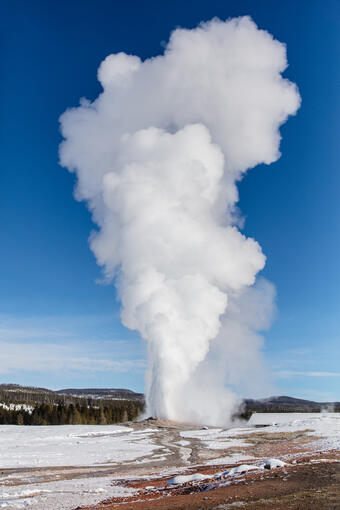
How much water erupts from Old Faithful Geyser? In a recent paper published in the Journal of Volcanology and Geothermal Research, scientists from the USGS, University of California, Davis, University of California, Berkeley, and the National Park Service quantified the total volume of water erupted during 45 Old Faithful Geyser eruptions, as well as the associated heat and mass.
The answer: an average Old Faithful eruption is equivalent to 4 to 5 concrete mixer trucks or about 140 standard household bathtubs! It would take about 90 average Old Faithful eruptions to fill an Olympic-size swimming pool, which typically holds approximately 2,500 cubic meters (660,000 gallons). Now you know. USGS.
River Delta Sink Rates
A global study found that many of the world’s largest river deltas are sinking faster than rising sea levels, putting hundreds of millions of people at risk. ScienceDaily.
Lake Mead and Lake Powell Drought Warnings
California officials have issued emergency water conservation alerts, while Lake Powell’s water levels could break a 24-year record low amid heat waves. Newsweek.
Ancient Canoes Discovered in Lake Mendota
Researchers at the Wisconsin Historical Society have uncovered 16 ancient canoes at the bottom of Lake Mendota, and they believe the oldest was crafted before the Great Pyramid of Giza was built in Egypt. The first of the dugout canoes, which is thought to be 1,200 years old, was found in 2021. Then a 3,000-year-old canoe was found in 2022. Since then, 14 more have been identified in Lake Mendota—six of which were found in the spring of 2025. Why does it matter? The findings indicate that a civilization may have been thriving in the Great Lakes region for thousands of years, and that they had the skills and knowledge to build durable watercraft. The researchers also believe that the canoes were used to gain access to natural resources in the lake—such as fish, as net sinkers were found in some of the canoes—and also for travel. Newsweek.
PFAS Settlement Funds in Ohio
Ohio has begun distributing $65 million in settlement funds to communities affected by PFAS contamination. NewsNow.
Global Water Security Concerns
A drinking water warning has been issued for millions in the U.S. amid fears that the Iran war could threaten water supply stability. Newsweek.
|
|
Places to visit for additional information:
|
|
|
|
|
|