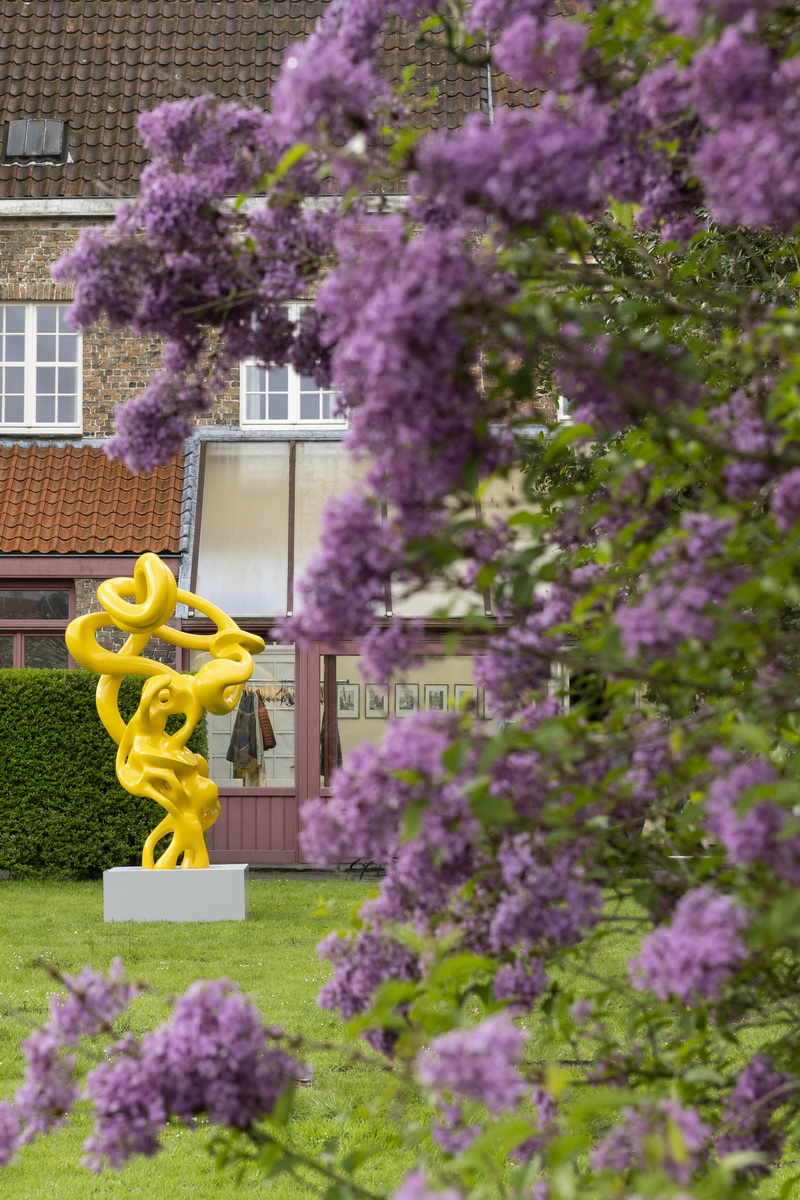
NEWSLETTER JUNE 2021 NEWSLETTER JUNE 2021
|
Dear all!
I'm pleased to invite you to these in- and outdoor exhibitions. Even in these rare times artists have risen to meet the challenges and never stopped to share their creativity, inspiration and strength with the world. Enjoy the season and have a lovely visit.
Let's dream together of the world of tomorrow.
Nick
|
|
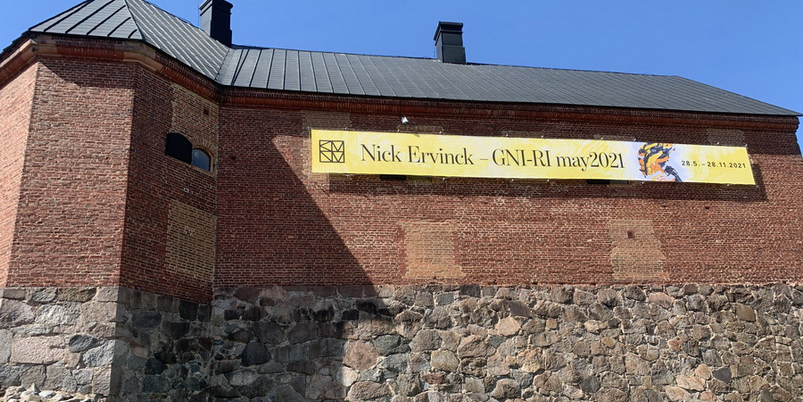
GNI-RI may2021, From knight to cyborg
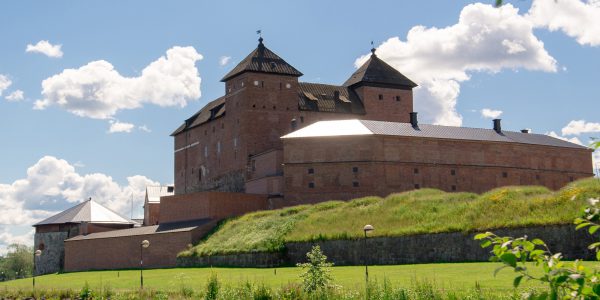
Häme Castle - National Museum of Finland, Hämeenlinna, FI
28/05/2021 - 28/11/2021
The future meets the Middle Ages. Ervinck’s cyrborg-like sculptures combine historical imagery with modern technology. The works engage in dialogue with the historical environs and objects of the castle: for example, the contrast between the sculptures and the castle’s suits of armour challenges visitors to ponder the evolution of technology.
Curated by: Minerva Keltanen
 |
|
 |
Blob architecture fascinated Nick Ervinck from the very beginning of his career, not only because of the welcome opposition it gave to face more classical box structures, but also because of the nearly endless new worlds it opened for rhizomatically streaming energy. Since blob stands for every innovative pouring out of organic softness and roundness, it facilitated a provocative expansion of form and mass in every possible direction. This is the realm where one situates the ecstasy of Dionysus and the unlimited forces at work in all ritual processes of offering. Not by accident APSAADU once belonged to a series of statues of gods, but seen as a macrophotographical snapshot, it also renders the wonderful splashing of water droplets, a powerful illustration of the dynamic interplay at work somewhere between the real and the virtual, nature and technology. Interesting to witness, here in Häme, is the presence of the humblest of all elements, a drop of water, one of the primal forces of nature, against the background of a solid castle, a cultural attempt by excellence to transcend historical time and place.
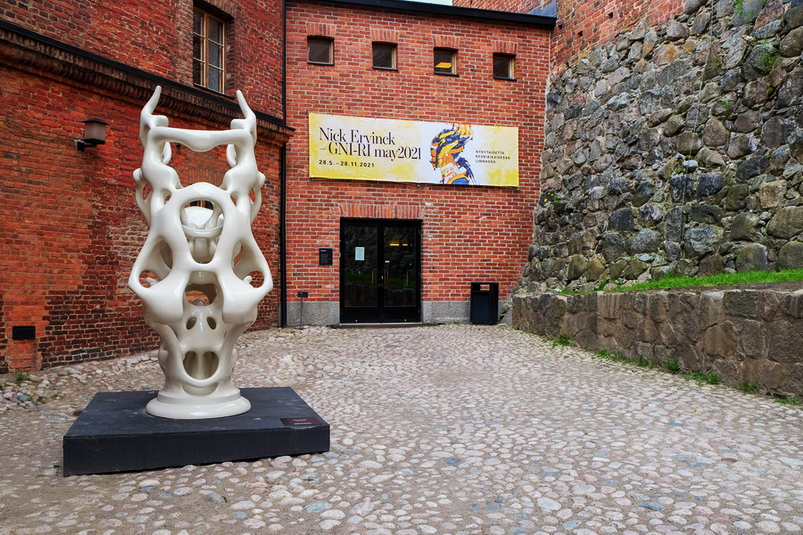 APSAADU APSAADU
2012 - 2013
polyester and polyurethane
300 x 180 x 120 cm
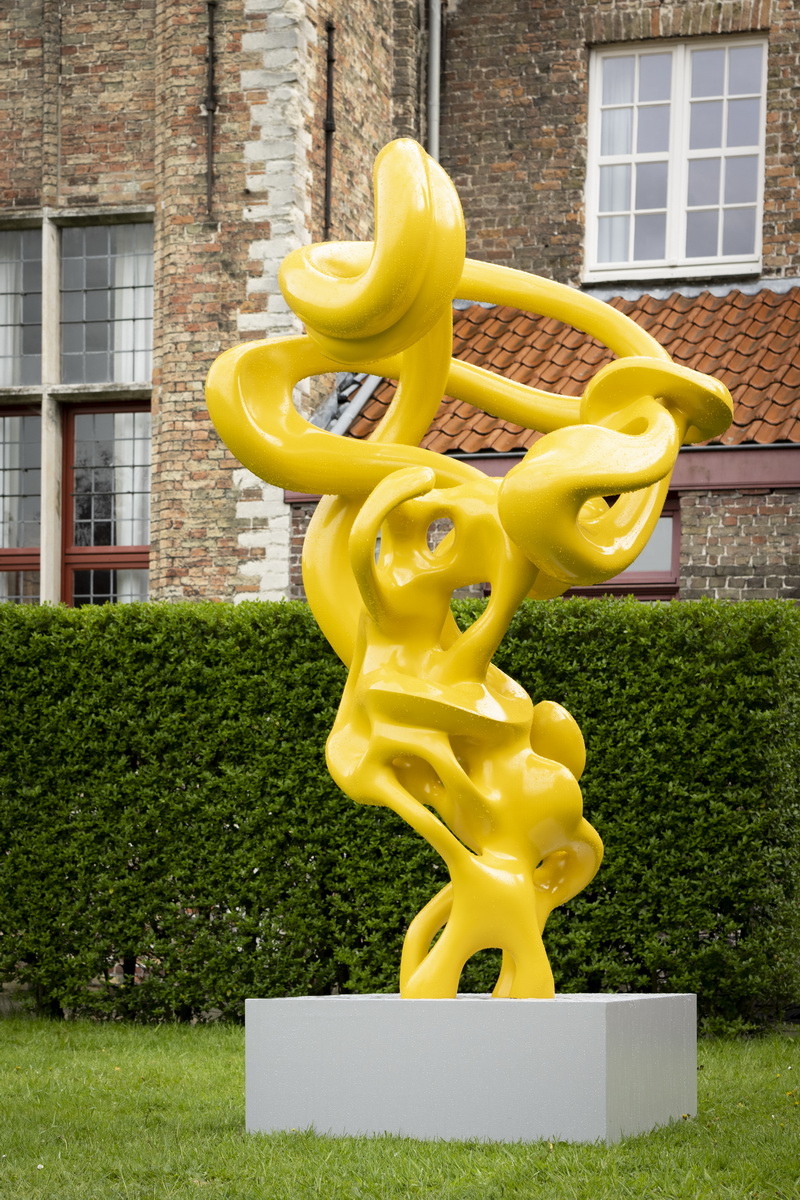
Gracious as a Greek goddess of nature, tender as a flower in the spring, CULMIRIOM testifies of the ungraspable richness that, as a form of free and untamed energy, pervades the whole world, an everlasting present for the artist yearning to depict and enjoy life. Its blob like character suggests an energetic process in full eclosion, twisted vertebrae reaching skyward in an ever lasting swirl. Yet its bright colour and shining surface point at artificial techniques that set other tones than the purely natural ones. A fully designed digital process allows indeed to offer a look deep inside traditional form, giving us a glimpse of what future 3D programmes might be able to achieve in other settings. It takes only a small step to imagine how similar bioprinting devices will function in the visceral depths of our bodies, bringing about the utopian/ dystopian landscape that Harari was so eager to describe. In this sense, Ervinck’s work situates itself in the much larger field of an ‘ecology of form’ that has the urgent task to invent forms that might help the next generations to survive a world in swift transmutation.
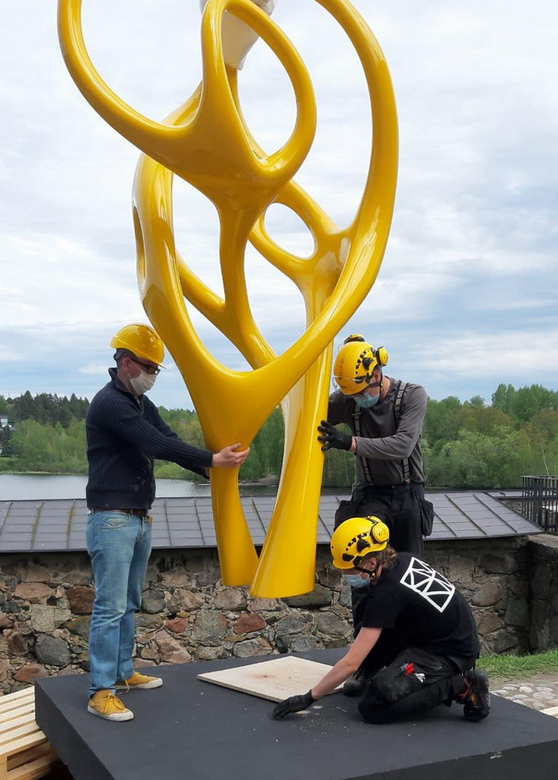
installation at
Häme Castle
Hämeenlinna
|
|
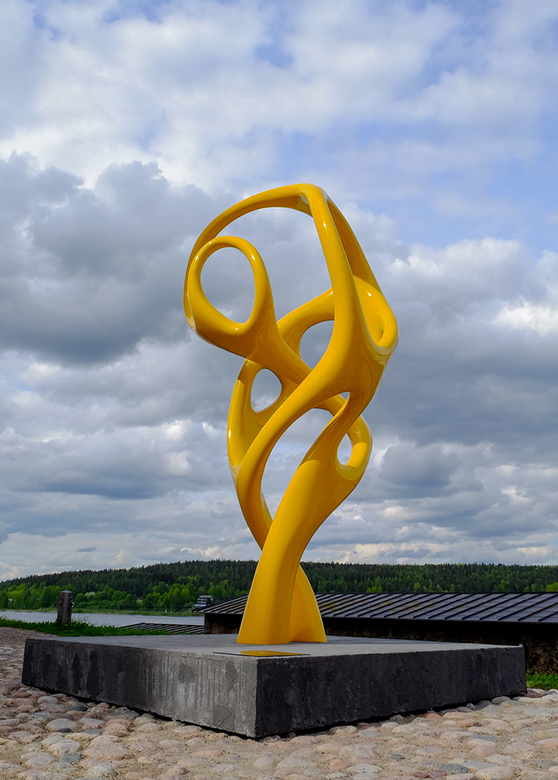
CULMIRIOM, 2019
polyester and polyurethane
285 x 150 x 110 cm
|
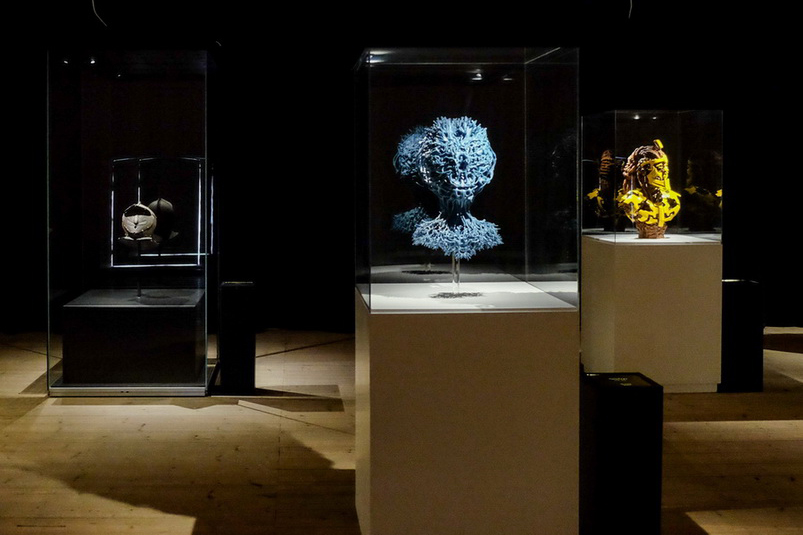
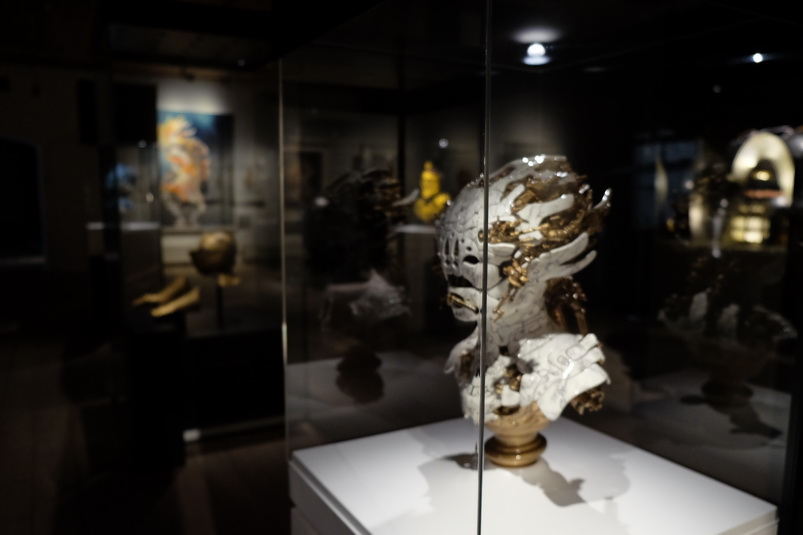
Is it not daring to compete with one of the most famous and influential art forms, the classical portrait bust? The cyborg warriors that Nick Ervinck assembled, products of a thousand hours of computer assisted labour and, at the same time, of subtle artisanal workmanship, are first of all fully historical constructs, as they bring together elements from past, present and future. Clearly, this new synthesis plays a refined game with the mythical heroes, medieval knights and manga figures we know so well. Facing us in a majestic and penetrating way, their dreadlocks and wild hairstyling inspire a deep respect, above all when variously presented in 2D, 3D and lightbox versions. But then again, what do they mean? Do they offer a glance of the new gods of the anthropocene, an upgraded version of ourselves, immersed in dozens of new implants and algorithms, or do they simply remind us of our old lineage as predators and hunters? Definitely, cyborgs of this type belong to an art form where hybridity reigns, rooted as the are in a strange and alienating mental landscape.
 |
|
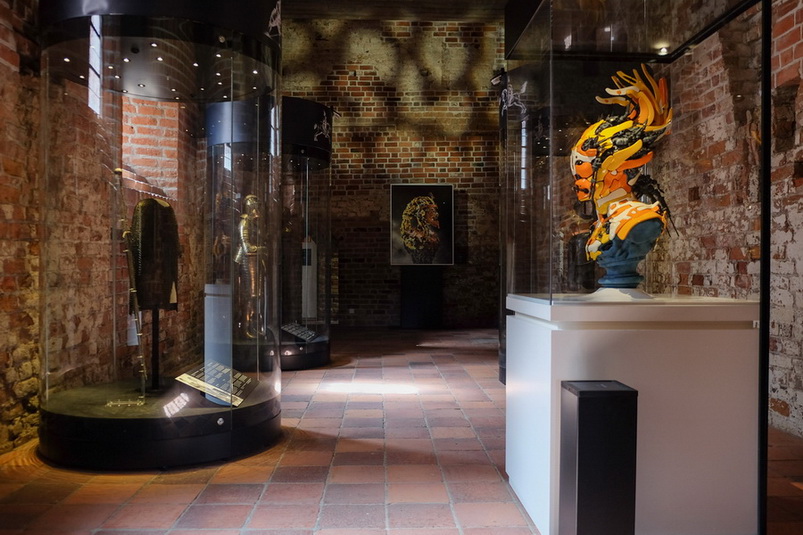 |
Obviously, Ervinck’s cyborgs are not figures that seem to be cut out of prime matter, as Michelangelo or even Henry Moore still had to do. They present themselves as beings that were created in and through negative space, as products of a persisting will to explore the hole in the sculpture. As recent scientific technology allows the scientist to penetrate deeply into the human body, the artist punches through human skull, brain and larynx and lays bare what, for centuries, was closed and recessive. Recent digital developments allow him to design a wildly flowering energetic field of organs, veins and nerves, turning the human head into a place that no longer is guarded by an outer structure, but openly exposes its inner household. Line and form lead a life of their own, purified and cleansed, sometimes perfectly symmetrical, then again wild and chaotical. Here you meet a mixed medium where the organic meets the virtual, a fascinating spectacle that invites us to revise the common ideas we have about reality.
 |
|
 |
A philosophical discussion about reality and the possible future of mankind always has been one of the prime interests of Nick Ervinck. During a visit of the Victoria and Albert Museum in London, he was fascinated by the way the famous Meissen vases were bathing in unnatural colours and a chaotic exuberance. For the artist, they provided a prime example how to illustrate the hybrid and complete ambiguous character of plants and natural landscapes when affected by various processes of mutation. Ever since, slightly surrealistic vases and strawberry sculptures have been in a process of losing the natural colours of leaves, trunk and fruits, suggesting an exposure to diverse forms of radiation and nuclear manipulation. Suddenly, the popular 17th century still life lost its innocence and ceramic stones revealed traces from an unknown disaster. Inevitably, ethical questions arise here, and from now on, our gaze will be encumbered by questions that we rather would have avoided to discuss.
 |
|
 |
In the poetic worlds designed by Nick Ervinck, the spectator is challenged to reinterpret traditional views on nature and self, since a number of other dimensions and parallel worlds seem to be at work as well, ready to disturb our everyday habits and thoughts. Animals in mutation, rendered partly in a frightening, partly in a seducing style, reveal unknown aspects of their energetic nature and remind us of the fully hybrid nature of Greek chimaeras and harpies. Are they aliens from another planet, apocalyptic remains of some major disaster or inevitable results of our human capacity for engineering other forms of life? For sure, beautiful bastard monsters like these easily walk in and out our nightmares, especially when we discover here and there an open mouth that may repeat Munch’s famous scream. The mysterious NOITEM collection, a landscape that exhales a deeply touching Rorschach sensitivity, suggests even further aspects of instability and unconscious movement, paying tribute at the same time to Muybridge’s attempts to render in one and the same image movement, emotion and time.
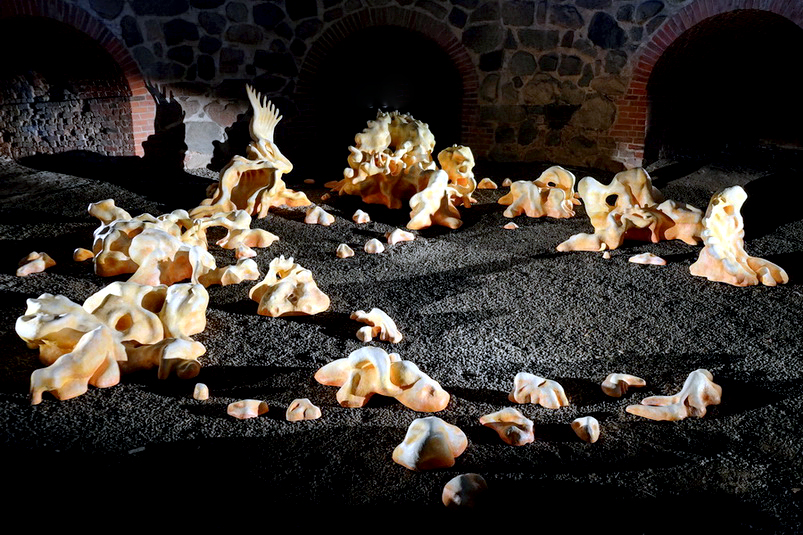
ALSUMVIT, 2019-2020
polyester, polyurethane
154 x 741 x 637 cm
60,6 x 291,7 x 250,8 inches
A hazardous dispersal of parts that once belonged to a sacrificial victim, human or animal? Buried with the greatest respect or just forgotten by history? In any case, its remains are well guarded by the remnants of a historical past, a canon tower. Rather amazing that our scrutinizing eye wants to track down, from the very start, its origin and lineage and solve the mystery. Don’t we recognize an arm, a shoulder or fingers that are reaching out? Why are we lost when no longer able to anthropomorphize? Nick Ervinck’s blob figures, situated between the organic and the digital, create an intermediate world that makes us visit a dreamlike landscape, a potential world that we too easily want to qualify as science fiction. Yet, the challenge is bigger, since the kind of metamorphosis that always is implied in Ervinck’s work raises the epistemological problem of leaving behind our most cherished notions, like truth, meaning and purpose. Where the artist becomes the philosopher, the cut is the deepest.
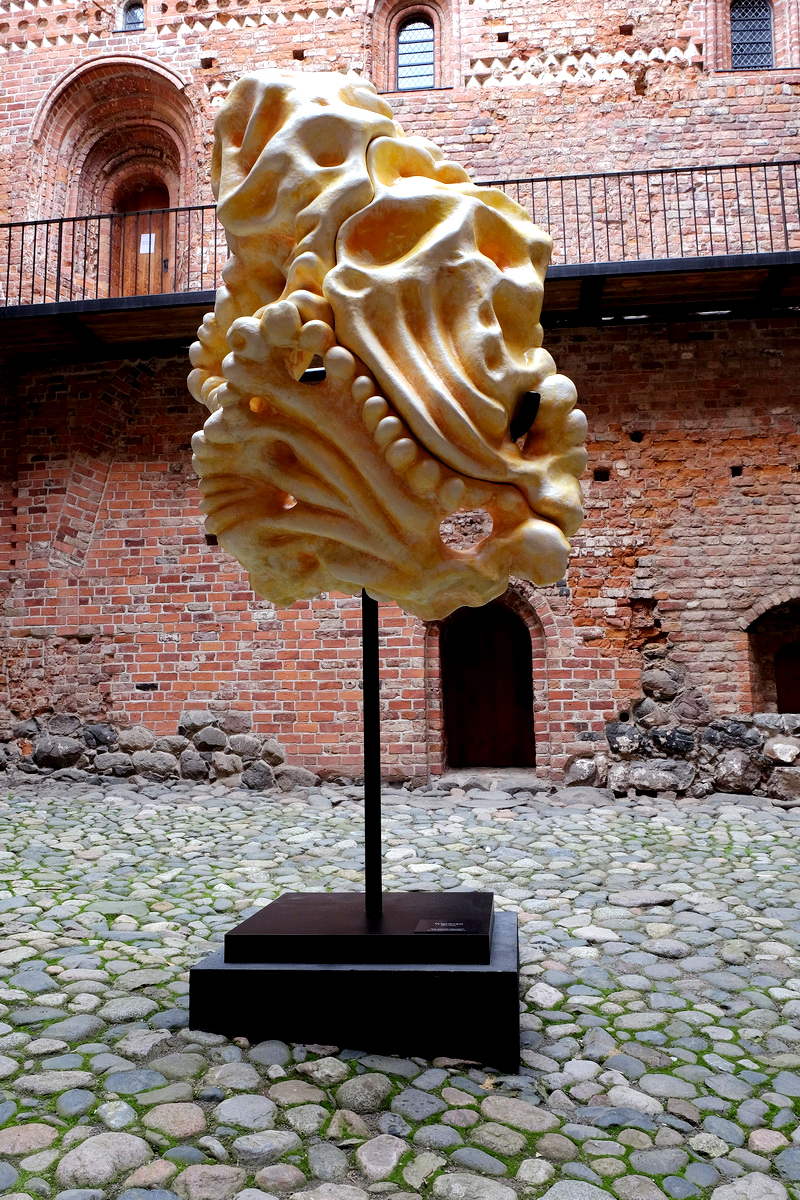
WIGNIROPS, 2019.-.2020
polyurethane and polyester
450 x 234 x 100 cm
177,2 x 92,1 x 39,4 inches
Open appeal to our imagination! Are we confronted here with some rests belonging to human existence, with bones and parts of a prehistorical animal, or is this a cultural relic that was ritually buried by a long forgotten civilisation? Nick Ervinck’s fascination for organic remains led him to rethink and reconstruct in digital settings ways to cover endoskeletons with various forms of skin, coat and pelt. One remembers all too well Henry Moore’s idea regarding ‘the power of the bone beneath the flesh’ and undeniably, one of Ervinck’s central ideas has been the use of bones, joints and vertebrae as constitutive elements in the formation of exoskeletons. In his ongoing quest for the unknown and the inaccessible, he kept on developing techniques that might express, in ever better and more creative versions, how bodies in the future might look like. Therefore, WIGNIROPS, as a statue on a socket, subtle allusion to its possible function as a biomedical prototype, might also refer to the digital tsunami that allowed 3D bioprinting techniques to manufacture all parts of the human body.
|
Correspondenties with Nick Ervinck, Sofie Muller and Renato Nicolodi
Musée Fenaille, Rodez, FR
07/05/2021 - 26/09/2021
(curated by Christa Vyvey)
A world in mutation
Prof. Em. Freddy Decreus
The works that Nick Ervinck presents in this magnificent archaeological museum in Rodez will certainly not go unnoticed. Although they clearly start from a conversation with the past, they mainly problematise the present and the future as aspects of our lives that have lost their natural character. While the museum has always been a place where a consensus was created about our Western tradition and history, this artist questions what is happening today, right before our eyes, in the whole world under the form of profound processes of mutation and transformation. Or to put it more succinctly, all the artistic potential that this artist holds is shaking up essential features of traditional humanity.
On level 3, where the guided tour starts, Nick Ervinck presents ESAVOBOR, a sculpture full of museum and historical references. At first sight, this extraordinary composition refers to broken fragments of a Roman vase that can be put back together again. One wonders, of course, if the vase will ever be seen in a fully restored state, knowing very well that the archaeologist in us feels it is his sacred duty to stage and interpret the past as accurately as possible. Such a situation warns us in any case that for many moments of our lives we are doomed to live with worlds of incompleteness in a state of constant reconstruction, a world that the artist immediately recognises as his own. But at the same time it is clear that behind the shards a robot or a transformer can appear, waiting for the right moment to metamorphose and strike unexpectedly. What we are confronted with here is a phase of liminal consciousness, of a possible and therefore always threatening transition, i.e. an uninterrupted presence and tension of the new and the unexpected. Does a transformer like this simply represent the eternal transitions that we as humans are experiencing, or should we rather ask ourselves how many unknown worlds and undiscovered energy fields we as upgraded hominids will one day travel to?
photocredits: Pierre Soissons / Studio Nick Ervinck
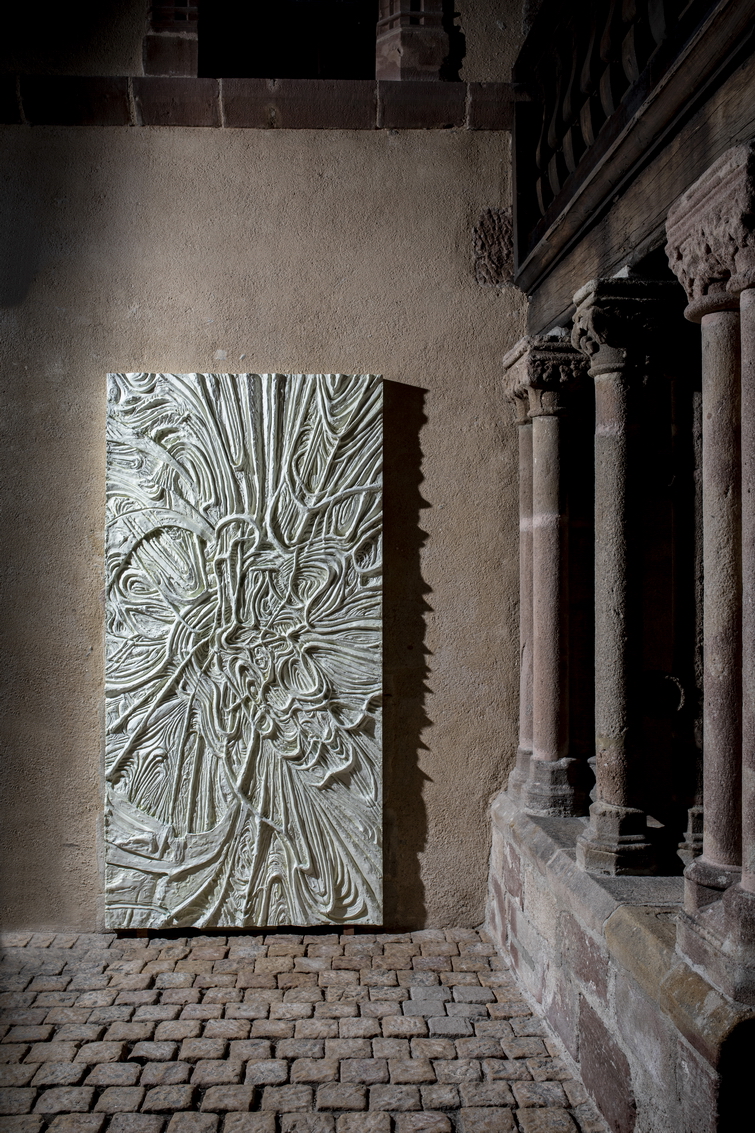
GARZGRIOLEJIF, 2020 - 2021
Polyester, wood and iron
120 x 240 x 9 cm
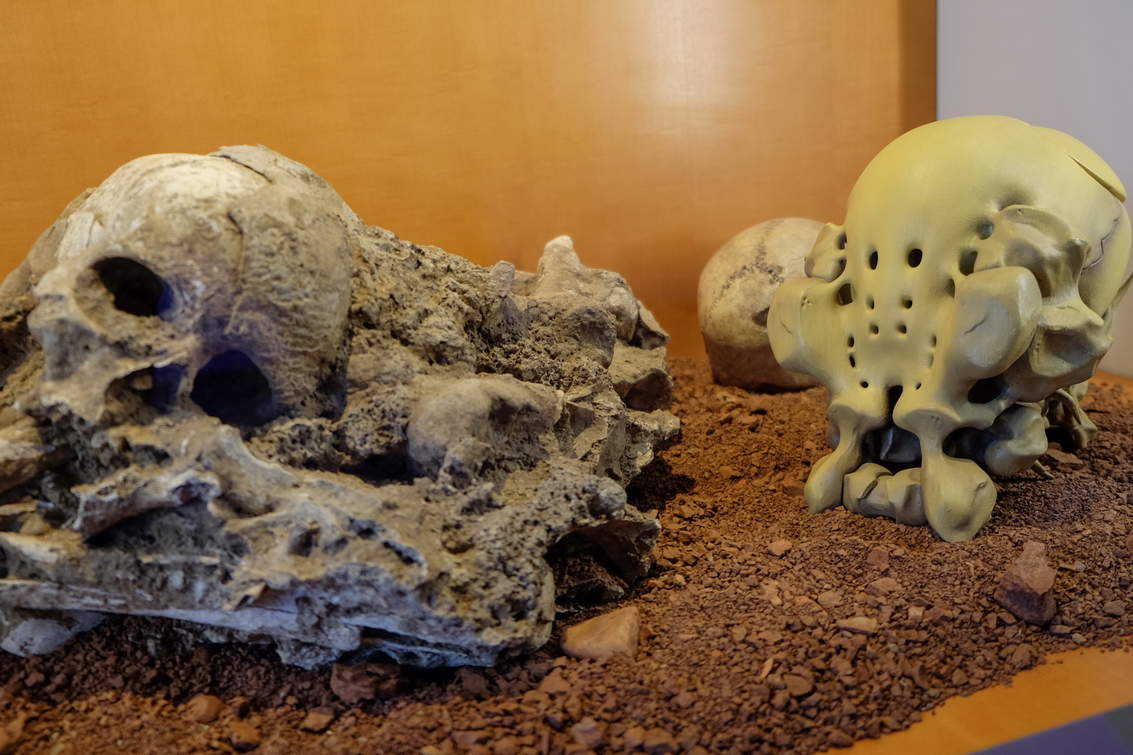 EDHOLP, 2013 EDHOLP, 2013
SLS 3D print
20 x 23 x 17 cm
7.9 x 9.1 x 6.7 inches |
|
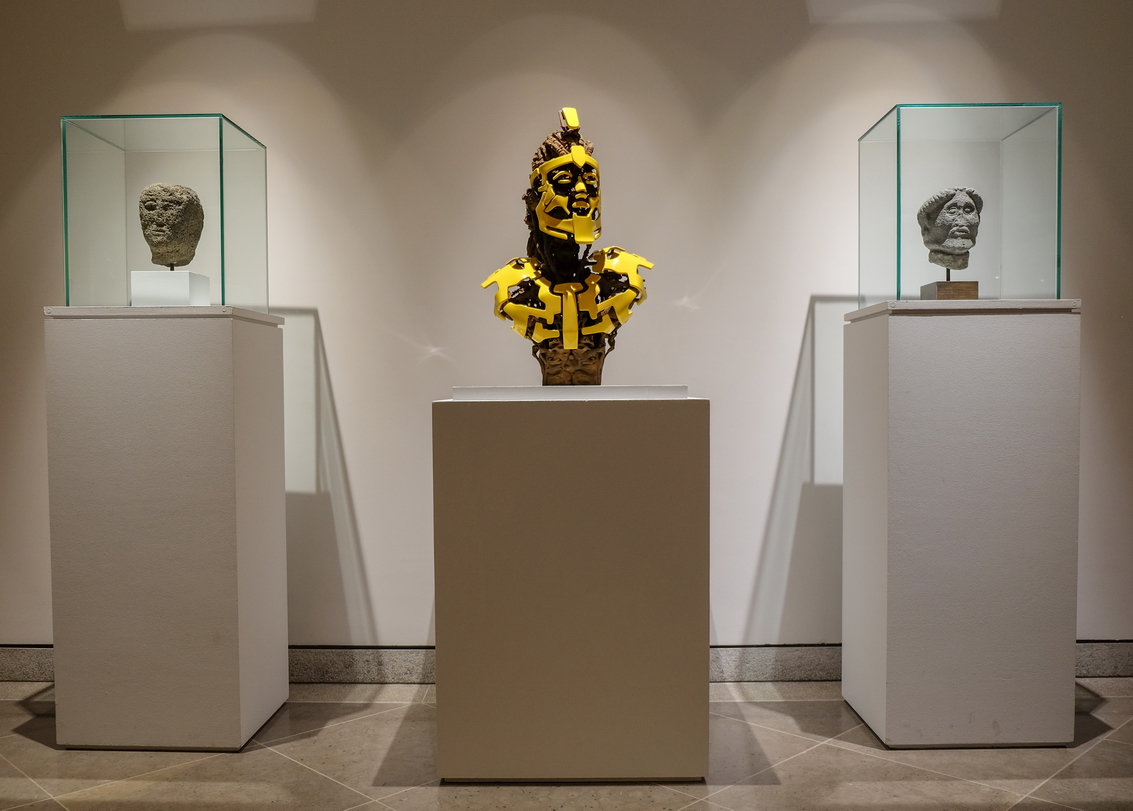 LAPIRSUB, 2015 - 2016 LAPIRSUB, 2015 - 2016
SLS 3D print
68 x 35 x 43 cm
26.8 x 13.8 x 16.9 inches |
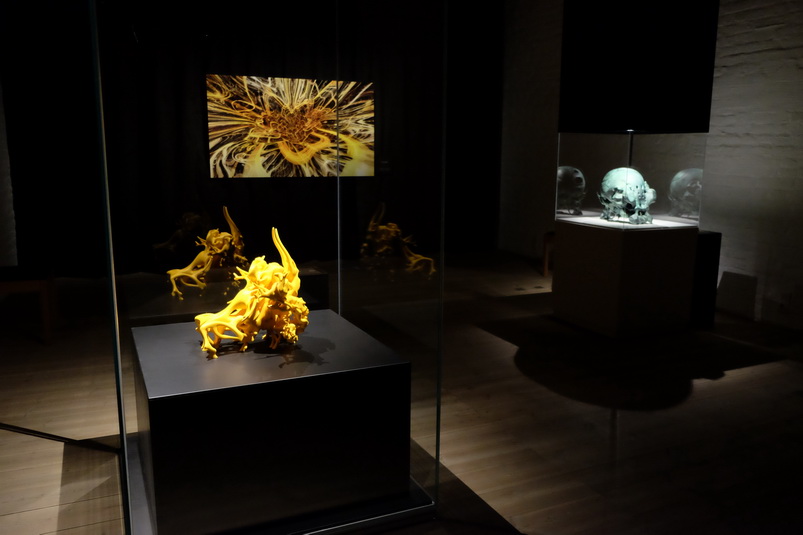
A consequence of such a contradiction can be seen further on in EDHOLP, a skull that might as well be part of a cabinet of curiosities. This ambiguous skull is illuminated by an internal fire, but is heavily damaged on the underside. Here too, the question arises as to the possible origin of this relic: is EDHOLP an archaeological find, the result of an archaic ritual murder, a form from a parallel world or the remains of a mutant? In any case, EDHOLP is a radical challenge to our desire to understand everything and yet be able to place this disorienting artefact in a taxonomically ordered world. We can now think of this bizarre head as a hybrid, demonic or grotesque outgrowth, but these designations do not really solve the problem. The infinite possibilities of 3D printing in the new bioprinting technology already show that organ printing can work as a means of improving the species, making the human condition less vulnerable and thus surviving the kind of life we did not ask for. The question, of course, is to what extent Eros will ever allow us to disrupt our old desire for fusion with others and to what extent Thanatos will continue to be kind to the autonomous individual in his new isolation. How long will we even continue to think and philosophise in such terms, concepts that have shaped our thinking itself? In the near future, will our bio-printed bodies make our old status as human beings happier or more depressed, emotionless or, on the contrary, always cheerful and boosted? And how soon will we be able to go through life with a techno-version of the amygdala, temporal lobe or prefrontal cortex?
One floor down, the viewer will find the triptych ANONIVES, ANONOVES and ANONAVES, a refined brickwork that is experienced as an architecture of moving lines, framed here as if they were paintings. They are reminiscent of the imagination that the artist fed in the early 2000s with building games such as Simcity, with the puzzle pieces of the Tetris game and the games with pixels. These dynamic lines show how the old Roman mosaic tiles in Room 6 are pulled into a new exchange of building blocks, as smooth as the waves of the sea. While bricks are normally seen as part of a rigid, robust and reliable world, here you experience an alienating form of life that completely changes our view of the world. A brick sculpture sets itself in motion, what has always been experienced as solid takes on a dynamic impulse, what has always been a 'box' now becomes a 'blob'.
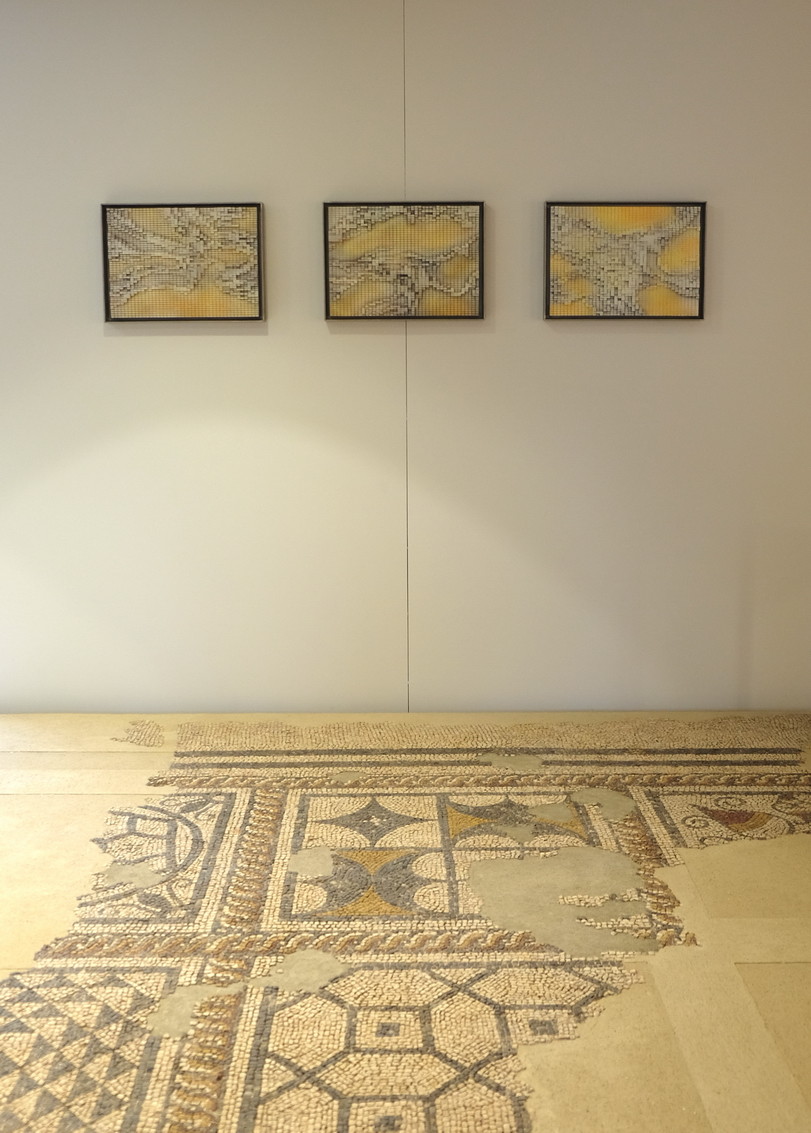
ANONIVES, ANONOVES and ANONAVES, 2019 - 2021
polyurethaan, wood, stainless steel
35,8 x 49,5 x 3,7 cm, framed 39 x 53,5 x 5 cm
14 x 19.5 x 1.5 inches, framed 15.4 x 21 x 1.9 inches |
|
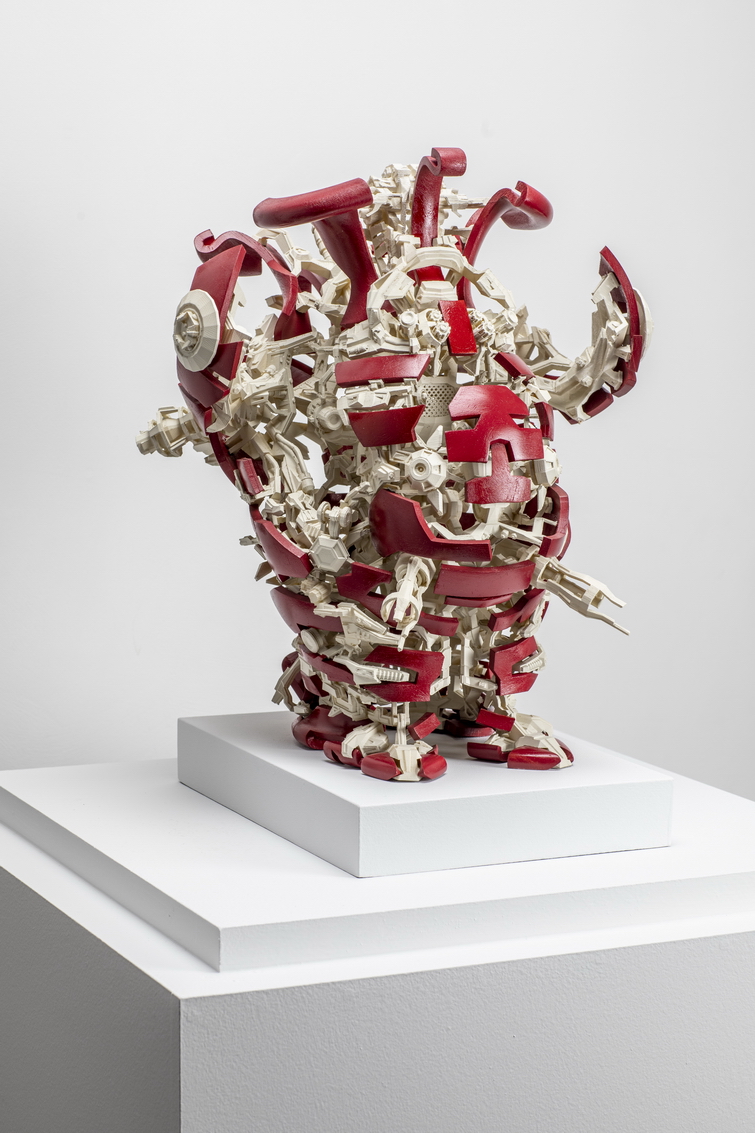
ESAVOBOR, 2011 - 2012
3D print
45 x 61 x 53 cm
17.7 x 24 x 20.9 inches |
The delicate drawing processes from LINE MUTATION, an artistic project close to the artist's heart, are now also evoked in all their finesse in order to form a flowing landscape. However, these experiments with the dynamic line in this kind of brick drawing should not make us forget that the mosaic stones of classical antiquity were also the subject of a long artistic research into innovative materials and techniques.
The dynamic triptych has also found its place between two more anthropomorphic figures, RACHT and LAPIRSUB, a reference to the delicate bust of Julius Caesar in room 6 and the fascinating iron helmet in room 10.
The sight of RACHT is an enigma, for it is not clear whether this is a new god, hero or knight. Does this character fit particularly well into a Gallo-Roman context, or is it rather reminiscent of Viking culture? Distortion of the past in the hands of the artist who manipulates time and place at will, a tradition in full mutation? Maybe RACHT is also the guardian of an ineffable religious experience or the guardian of forbidden rituals? Certainly he falls prey to emptiness and silence, because essential parts of the image remain unfinished. So, a dream image, or a transitional figure guarding thresholds, between past and present, body and mind, artist and scientist?
LAPIRSUB, a sculpture a few metres away, further heightens this ambiguity. Like one of the many cyborg warriors created by Ervinck, this sculpture assumes the imposing and problematic character of many of his new busts. Often inspired by the imagination of science fiction and modern manga, these cyborgs still emanate aspects of robots, aliens and monsters, a sweet reminder and also homage to an artist like H.R. Giger. But also forms borrowed from Inca and Mayan masks and jewels can be found on the hundred or so fragments that make up this sculpture, each of which has been printed and sanded by hand. LAPIRSUB consists of a mutated mechanical skeleton held together by rusty steel veins, protected by a shiny yellow armour, one of many complex compositions resulting from the use of the latest computer software and 3D printing techniques. Again, a confused and alienating human image that casts deep doubt on our everyday experiences?
Finally, you will also meet the artist in the museum courtyard, where GARZGRIOLEJIF, a large relief (120 x 240 cm) plays a stunning game with the ornamental lines of the many stone artefacts that adorn the beautiful Jouéry courtyard. Abstract as this work is, one can certainly recognise a drawing in it, a visualisation that exudes movement and reminds one of the Big Bang. Lines emerge and decay, in search of a path that, no matter what, leads to our earthly existence. Thus, they draw attention to the absolute changeability of the line as a geometric and epistemological process, and thus also to absolute uncertainty and indeterminacy as an existential trajectory. Such lines undeniably belong to an artist who from the beginning of his career has wanted to create intermediate worlds, interfaces between craft and technology, between digital design and physical presence. Lines mutate, just like the smallest cell structures and man's greatest dreams and desires. What remains to be discovered and revealed are the principles at work, here and elsewhere, in all these energy fields, in all these nano- and macro-dimensions!
Does the art of Nick Ervinck therefore speak of the birth of a new type of human being who wants to become transhuman and live the mutation to the full? In any case, the current pandemic has made it clear that the old man will have a hard time surviving on his own, as disaster after disaster comes upon him. EDHOLP shows that Nick Ervinck's sculptures on the themes SKIN MUTATION, PLANT MUTATION and HUMAN MUTATION do not exclude a scientific future.
|
|
OXYMORON
Nick Ervinck, GNI-RI may2021, Adornes, Brugge - BE
15/05/2021 - 25/09/2021
'To know one thing you must know the opposite' (Henry Moore)
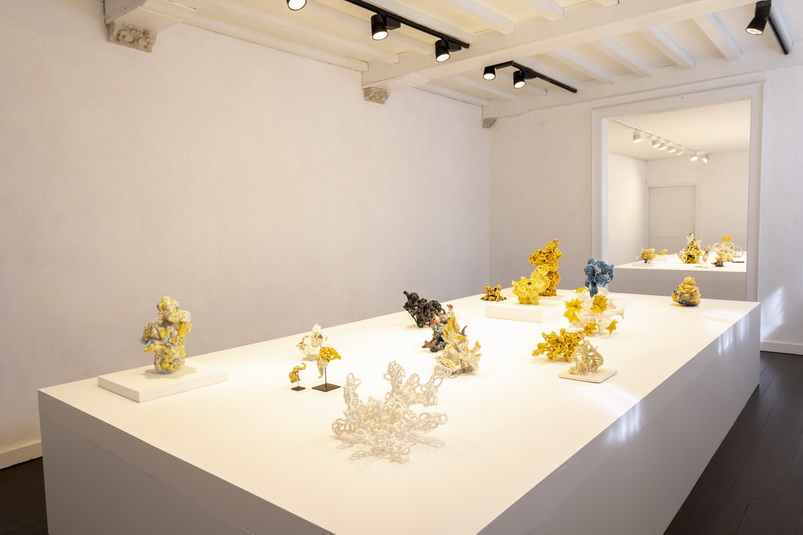
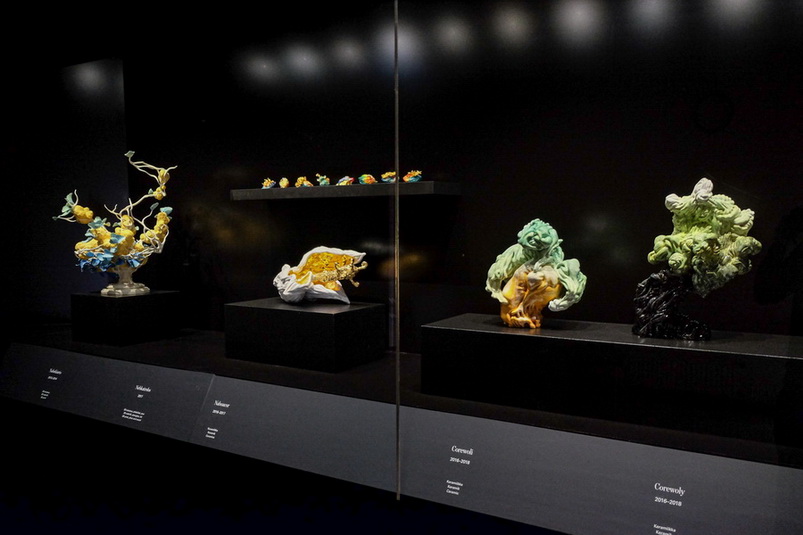
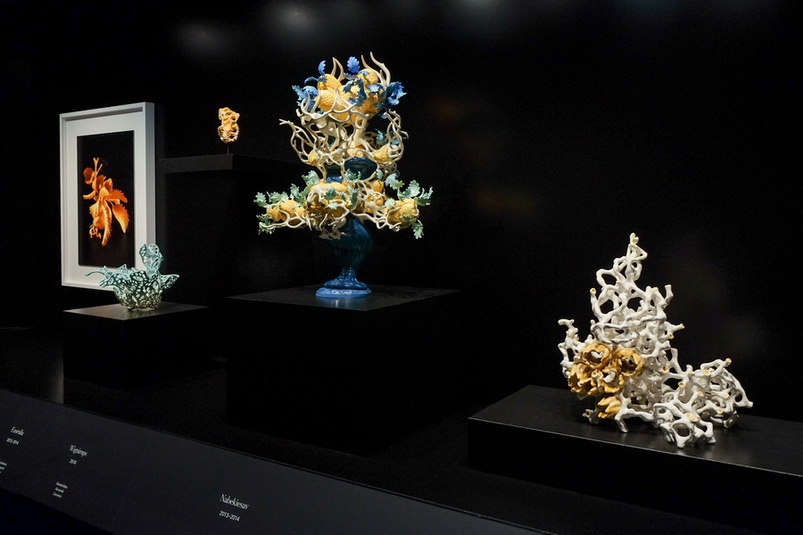
In the Oxymoron exhibition, Nick Ervinck confronts contradictory worlds, fictional or real, magnificent or monstrous, based on thirty ceramic works. The uncertainty and tension that emerge are both tragic and hopeful. Ervinck talks about the big bang and evolution, reminding us that all equilibrium is inherently unstable and everything is always in motion.
The contemporary and sometimes futuristic world of Nick Ervinck finds a beautiful 'contrary' resonance in the authentic medieval architecture of the Adornes domain.
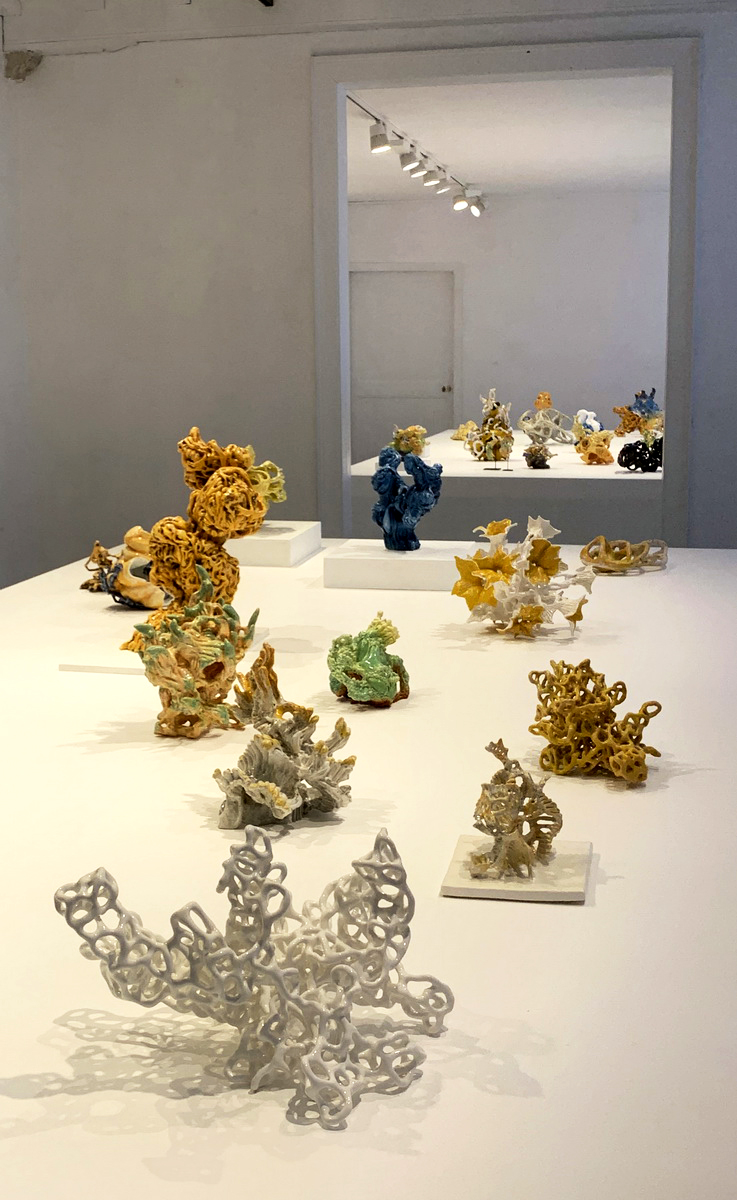
Nick Ervinck’s ceramic imagination in the Adornes Estate in Bruges
Prof. Em. Freddy Decreus
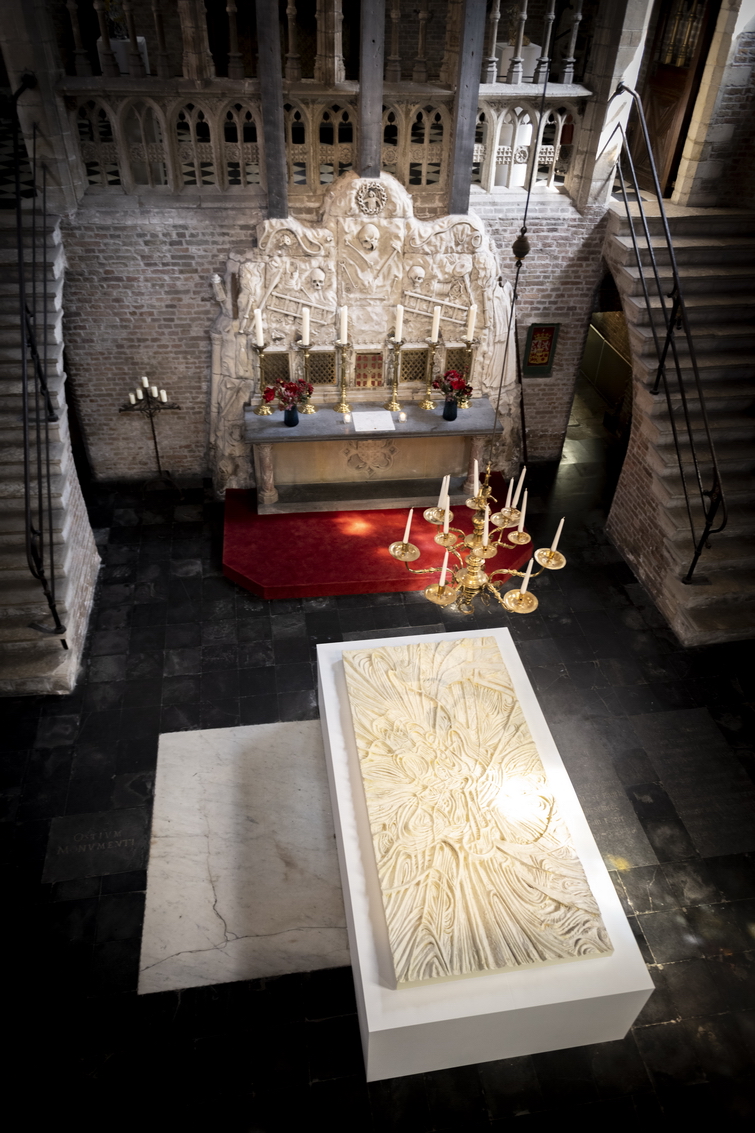
The Adornes Estate with its Jerusalem Chapel, an unsuspected pearl in the heart of Bruges, somehow still a sacred centre in Europe. It is exactly here that Nick Ervinck exhibits his ceramics for the first time as a perfect complement and challenge to this historical heritage. A meeting between a 14th century Genoese family with a perspective larger than their European contemporaries on the one hand and an artist exploring today’s world in a modern fashion, mainly through 3D printing. Now that the recumbent statues of forefather Anselm Adornes and his wife Margareta vander Banck have temporarily had to leave their tomb due to restoration work, the power of imagination has for a while been entrusted to an artist who thoroughly questions our traditional view of reality. Indeed, the title of the exhibition Oxymoron fits perfectly with what is on display here. Just as in the theme of the Bruges Triennial TraumA which brings unspoken tensions back to the surface, Ervinck’s ceramics reveal strains that have been hiding at the bottom of human existence for centuries. Is his art not commonly qualified as ‘virtual reality’, ‘organized chaos’ and testifiying to ‘unnatural naturalness’, three perfect examples of an oxymoron? An oxymoron contains paradoxical knowledge, but above all it testifies to a creativity that is deeply rooted somewhere in our poetic sense of language and imagination. The experience of the oxymoron is crucial to Ervinck’s art concept, you gladly go along with him to experience paradoxes and hybrid meanings next to and on top of each other. Going through life with Nick as a companion therefore means feeling like Heraclitus, the Greek philosopher who believed that “Everything flows”(Panta Rhei). When you take a moment to let his ceramics and drawings sink in, you will feel that his imagination calls on you to interpret reality in terms of a constant BECOMING and never to accept a definitive BEING. The presentation and intermingling of the exhibited ceramic gems let them interact in form and colour, a surprising outcome also for the artist who creates his own glazes. Here you can see the result of his experiments, for like a chemist he has ventured into unknown territory, never knowing whether his types of processed clay might explode or decompose in the kiln. These art objects are not always the smoothly polished ceramics we are familiar with,
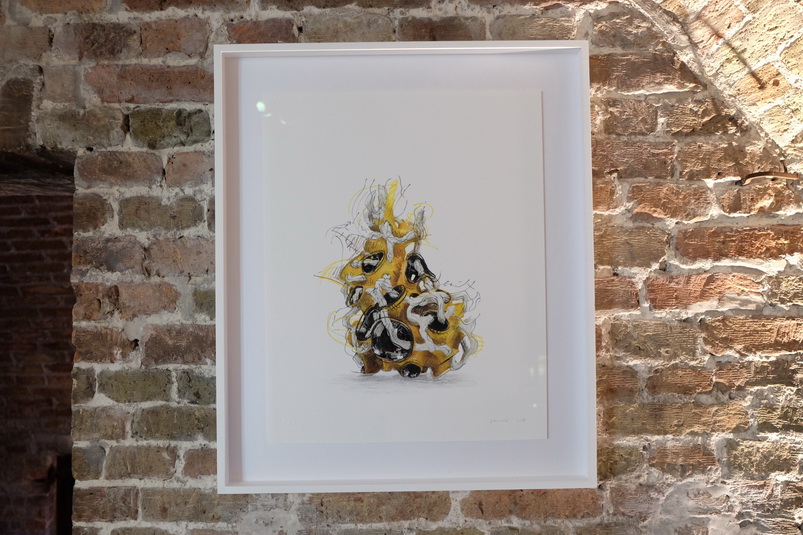
little imperfections often reminding you of the ingenious creation process. That is exactly why these ceramics float back and forth between worlds of dream and reality and why you can feel the fever of your imagination and fantasy coming on. Sometimes the ceramics will remind you of a prehistoric skeleton, a coral reef or floating algae, and then again they appear threatening and chaotic and seem to challenge any form of order. Even the beautiful shining colours are hard to interpret, as their absolute beauty appears to pass into sickly shades suggesting traces of rot or radiation. Plant becomes animal becomes man becomes bone becomes plant, or everything in Ervinck’s ceramics is in motion, without rest or end. Cosmos temporarily replaces chaos, fullness embraces emptiness and then becomes dynamic matter again. The large relief GARZGRIOLEJIF replacing the recumbent statues on the emptied tomb visualizes movements reminiscent of the Big Bang. A beautiful central place in the middle of the Jerusalem Chapel, the true navel of creation in the manner of ancient mandalas, the origin of many undulating movements towards the works of art exhibited around. Lines appear and fall apart, the start of a movement into the visitors’ eye and heart. In passing they will meet Nick Ervinck’s drawings and prints, enlarged and mutating remains of primal life, paradoxically fertilizing the proliferating womb of nature? Here is a multidimensional invitation in this Jerusalem Chapel to return for a moment to our primitive origins as human beings, with primal life undifferentiated yet, when the sea still covered the earth and elementary beings were created from moist slime. Nick Ervinck’s ceramics contain a grand creation story, a human adventure of metamorphosis and transformation finding a brief rest in the seclusion of a paradisiac garden, a hortus conclusus in which the mystery of cosmic energy can be felt hovering.
photocredits: Ann-Sophie Deldycke / Studio Nick Ervinck
BOBLARAK, 2017
marker, pastel pencil, print
50 x 40 cm, framed 63 x 53 cm
19,7 x 15,7 inches, framed 24,8 x 20,9 inches
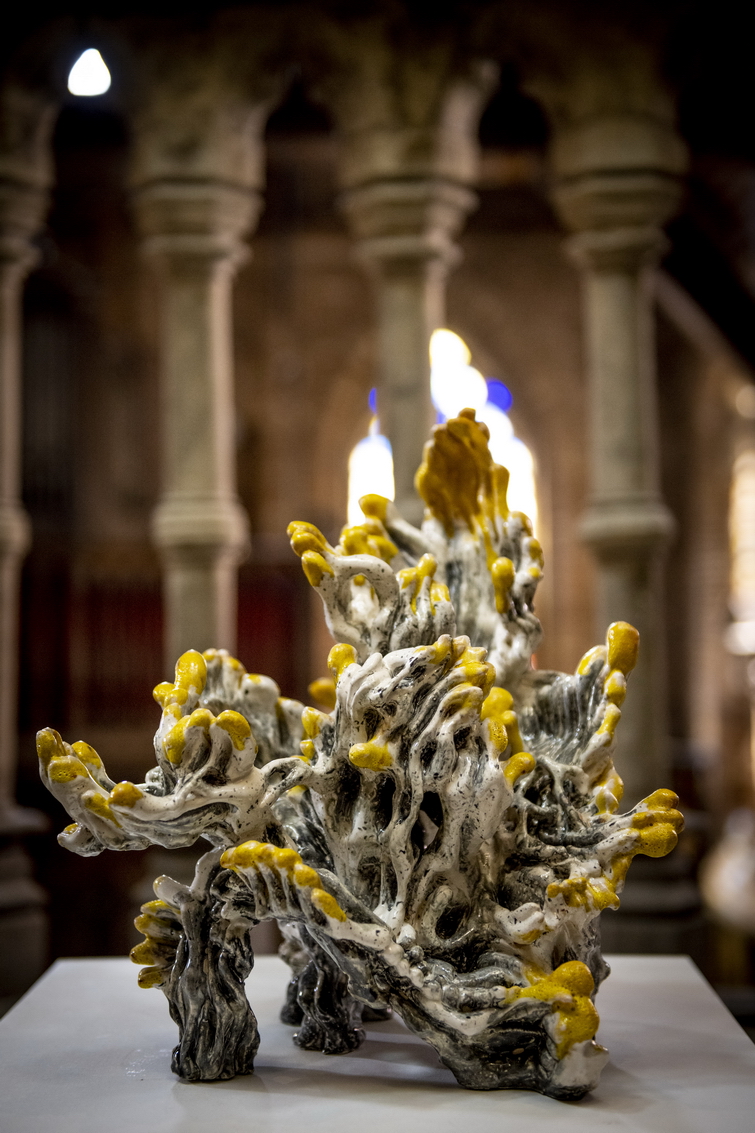 BRUNTISKO, 2017.-.2018 BRUNTISKO, 2017.-.2018
ceramic
33 x 30 x 30 cm
13 x 11,8 x 11,8 inches
|
|
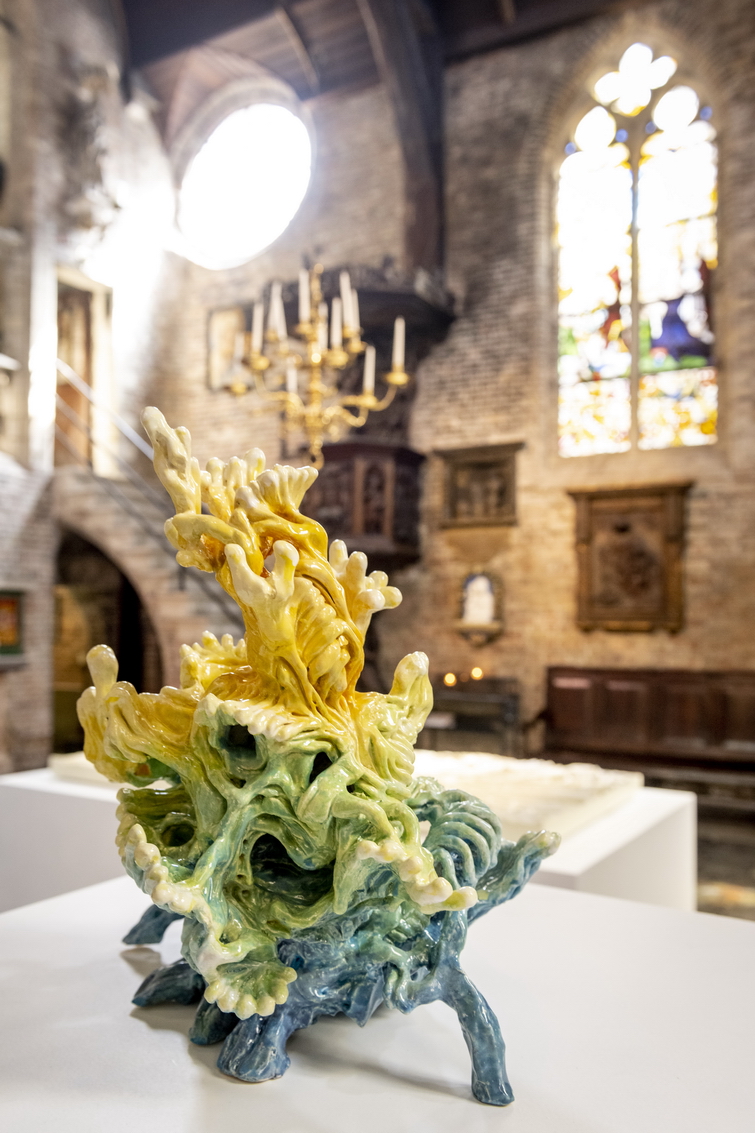
BRUNTISFA, 2017 - 2018
ceramic
38 x 38 x 33 cm
15 x 15 x 13 inches |
NARTUAT, 2020
iron, polyester and polyurethane
236 x 150 x 105 cm
92,9 x 59,1 x 41,3 inches
|
GNI-RI jul2021, UnNatural Selection
and
Wundertower #1 private collection Nick Ervinck
K.E.R.K., Middelkerke, BE
01/07/2021 - 28/08/2021
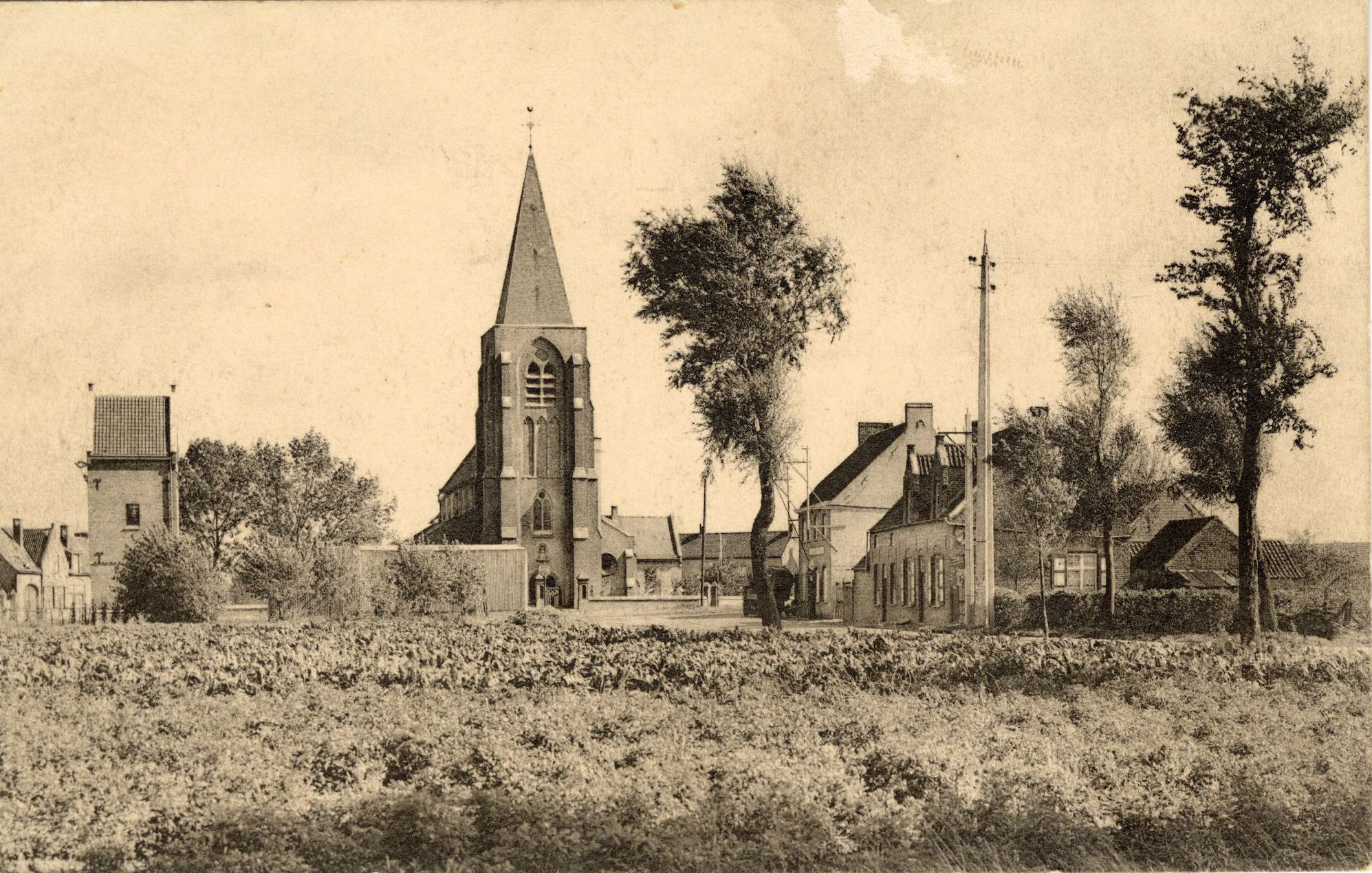
Kunsthalle ERvincK or simply K.E.R.K. was founded in summer 2021 by artist Nick Ervinck in collaboration with the municipality of Middelkerke. K.E.R.K wants to search for new formulas in the ever-changing (art) landscape. A new cultural temple where visual arts are central and can be varied with activities that can attract a large audience. It is a presentation and meeting place with a focus on contemporary art. But where there is also room for cross-fertilization with other disciplines such as theatre, music and dance. There is an annual framework with lectures, guided tours, debriefings, studio visits, workshops, network events, coaching and meetings with artists. K.E.R.K. wants to bring visitors together to generate enthusiasm and wonder through contemporary art and art experience.
Artists: Anne Marie Laureys, Caroline Coolen, Conrad Willems, Daniel Arsham, Danny Mathys, Folkert De Jong, Frank & Robbert, Frederic Plateus, Henry Moore,
Johan Laethem, Joke Raes, Katleen Vinck, Koen Van Mechelen, Luk van Soom, Nel Bonte,
Nick Ervinck, Pieter Vermeersch, Renato Nicolodi, Robin Vermeersch, Sofie Muller, Stefan Peters, Stephan Balleux, Stephanie Leblon, Studio Job,
Sven Boel, Tamara Van San, Thomas Huyghe, Unfold, Warre Mulder, Xavier Mary, Yves Velter
|
|
|
GNI-RI may2021 - From knight to cyborg
Häme Castle - National Museum Finland,
Hämeenlinna, FI
28/05/2021 - 28/11/2021 new date

|
|
Beeldenroute Zeist 2020-2022 - VAN SLOT TOT CENTRUM
Zeist, NL
16/07/2020 - 15/07/2022
(curated by Henk van den Bosch)
|
GNI-RI may2021 - OXYMORON
Adornes, Brugge, BE
15/05/2021 - 26/09/2021
|
|
Correspondances: Nick Ervinck, Sofie Muller and Renato Nicolodi
Musée Fenaille, Rodez, FR
07/05/2021 - 26/09/2021
(curated by Christa Vyvey)
|
Art Zuid: IMAGINE: Amsterdam Sculpture Biennal
Amsterdam, NL
01/07/2021 - 17/10/2021 new date
|
|
Art Oisterwijk
De Lind, NL
postponed
|
GNI-RI jul2021, UnNatural Selection
K.E.R.K., Middelkerke, BE
01/07/2021 - 28/08/2021
|
|
THILAP
private commission, Gent, BE
fall 2022
|
Wundertower#1 Private collection Nick Ervinck
K.E.R.K., Middelkerke, BE
01/07/2021 - 28/08/2021
|
|
LIABLOY
World Convention & Exhibition Center, Shenzhen, CH
Summer 2021
|
Plymouth contemporary 2021,
The Levinsky Gallery, University of Plymouth and The Art Institue KARST, Plymouth , UK
07/07/2021 - 05/09/2021
|
|
ANLUNIK
World Convention & Exhibition Center, Shenzhen, CH
Summer 2021
|
GNI-RI 2021 - Wunderkammer
date to be confirmed
|
|
New monograph GNI-RI 2022
Hannibal Publishers
|
For the Love of the Master, 25 artists fascinated by Piranesi
the Coach House Gallery, Dublin Castle and the Casino, Dublin, IE
(curated by Hélène Bremer, Mary Heffernan and prof. Matt J. Smith)
postponed
|
|
Muzekat
Ypres Museum, Ieper, BE
02/05/2021 - 16/01/2022
|
|
|
|
|