| Pure Water Products |
|
November, 2025
|
|
|
Water Treatment Issues and Current Water News |
In this Autumn Occasional you'll hear about (un)truth in advertising, a lot about WOTUS and a lot about PFAS, the basics of backwashing water filters, the long history and success of activated carbon filters, the problems of river dolphins, why water mains are popping all over the country, the important water features known as "the kidneys of the landscape," the new EPA director's promise to "fix everything," a big and expensive study of countertop water filters, and, as always, there is much, much more.
|
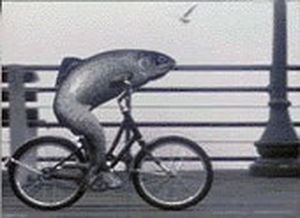
Fish are better than bicycles. Read on to find out why.
(Un) Truth in Advertising
As far as I know, there's no law against making outrageously stupid statements, although there probably should be if only to protect advertisers from making fools of themselves.
There are certain water treatment myths and exaggerations that have been repeated so many times that people who say them actually believe them. Like, "Reverse osmosis does not remove chlorine," or "Carbon filters don't remove chloramines."
Here's a clip from a website touting a drinking water filter that contains the popular and very useful filter medium KDF55. The ad is in bold type and my comments are in italics.
Independent laboratory tests confirm that KDF®55 is one of the best media for improving drinking and bathing water naturally and economically. That is why we incorporate it into our technology.
-
Compared to carbon-only units, KDF®55 lasts far longer, doesn't’t permit bacterial growth, and removes a much wider range of inorganic matter (e.g. heavy metals).
While this is all true to a degree, you could also say:
-
Compared with carbon filters, KDF55 does not improve taste and odor appreciably,does not treat most organic chemicals, does not work well at all if not accompanied by carbon, does not treat VOCs, does not remove chloramines, etc. for pages and pages.
-
Compared to reverse osmosis, KDF®55 is less expensive, wastes no water, does not require membrane replacement, works at most water temperatures and pressures, and removes chlorine.
-
Compared with reverse osmosis, KDF does not remove fluoride, does not remove nitrates, does not reduce dissolved solids, does not remove sodium, does not remove chlorides, cannot desalinate sea water, does not remove hardness, etc., etc. for about forty pages.
-
Compared to ultraviolet lights, KDF®55 works in cloudy water, doesn’t require bulb replacement or electricity, and removes inorganics.
-
Compared with ultraviolet light, KDF does not keep water safe from e. Coli, does not kill viruses, does not kill cryptosporidium or Guardia, etc. etc. for many pages.
-
Compared to ozone, KDF®55 provides a residual effect to keep bacteria from growing in water, does not require electricity, and costs far less to buy and maintain.
-
Compared with ozone, KDF does not oxidize significant amounts of iron or hydrogen sulfide, does not make non-potable water safe for drinking, does not act as a disinfectant, etc.
KDF 55 is a very good product. It can prolong the life and enhance the performance of carbon filters, and it's the main ingredient in most shower filters sold today. But to try to compare a KDF filter to a reverse osmosis unit is like the proverbial comparison of a fish to a bicycle. Compared to a fish, a bicycle cannot swim into deep river channels, has to have air in its tires, and is difficult to peddle uphill. That's fine, but does it really prove that fish are superior to bicycles? It isn't any sillier than the attempt to compare KDF, a granular filter medium made of copper and zinc, to ultraviolet light. Doesn't require bulb replacement, indeed!
A fish is better than a bicycle because you don't have to oil the chain.
By Riley Kleemeier
The U.S. EPA has proposed new guidelines regarding what counts as a “water of the United States,” a controversial announcement that has been met with backlash.
While Administrator Lee Zeldin maintained that the new rules would provide “a balance between protecting the environment and economic development,” environmental advocates aren’t so sure.
“The Trump administration’s Polluted Water Rule is another blatant giveaway to big corporate polluters that will jeopardize the waters that our families and communities rely on for drinking, recreation, and fueling our local economies,” said Madeleine Foote, healthy communities program director at the League of Conservation Voters, per The Hill.
Under the new rule, the scope of federal jurisdiction over waters and wetlands in the U.S. would be limited. The rule would reverse the Biden administration’s definition of waters of the U.S. (WOTUS) and would impose stricter guidelines on what kind of water is protected by the Clean Water Act.
Among the excluded waters would be wetlands. “The wetlands now at risk of being bulldozed filter our water supplies and protect us from floods,” said Jim Murphy, senior director for legal advocacy for the National Wildlife Federation, per Bloomberg Law.
Wetlands, which have been called “ the kidneys of the landscape,” remove and detoxify contaminants in water. Without federal protection, “people will no longer need a permit to fill the wetlands,” Mark Ryan, a former Clean Water Act litigation specialist at the EPA, told The Hill. Added Curtis Richardson, director of the Duke University Wetland Center: “Every place we remove them, we’ve ended up having to spend millions of dollars on treatment plants or have polluted water.”
WOTUS Explained
by Gene Franks
When my grandfather built a house on his farm in Oklahoma just before the Great Depression he decided to leave behind the outdoor toilet and washtubs of his family’s previous home and go with modern indoor plumbing. Indoor plumbing was not yet common in farmhouses at the time.
The new house was in the middle of a 160-acre farm and there were no nearby neighbors, so he saw no problem in simply letting the raw sewage and grey water from the home discharge from a pipe into an empty field that sloped down to a small creek. Except on the days when the wind came from the wrong direction, it was easy to forget that raw sewage was collecting just a few feet down the slope. Conveniently, rain washed everything down the hill and eventually into the creek.
My grandfather built his new house about 50 years before the 1972 enactment of the Clean Water Act when the concept of WOTUS, which stands for “Waters of the United States,” came into being. He followed the prevailing logic that since the land was his, it was no one else’s business where he discharged his sewer water. In 1972 the initial understanding of what the “Waters of the United States” consists of applied mainly to navigable water, so my grandfather’s pasture and the tiny creek his sewage eventually washed into were not a great concern.
In 2025, defining WOTUS has become a complicated on-going political dilemma. The scope of WOTUS changes depending on which party is running the EPA. In broad terms, those who value private property ownership over public wellbeing and water quality, most often Republicans, take the view that my grandfather was within his rights to dump his sewage and his leftover farm chemicals and the used crankcase oil from his tractor on the side of his hill and let the rain wash it into “his” little creek. The other side, the radical lefties, take the view that the “Waters of the United States” concept includes the water on a farm in Oklahoma regardless of who owns the land, that all water is part of the Waters of the United States, just as McElligott’s little pool is part of an underground stream which is part of a river which is part of the oceans. Under President Obama, WOTUS was broadened and more restriction was placed on what could be done on private land and by private businesses. Greater restrictions were placed on private activities that had an effect on the public water supply. The current administration is now working to redefine WOTUS and thus loosen restrictions on private individuals and businesses. Most recently, the new EPA administrator is seeking to remove wetlands, an essential component of nature’s water management system, from control under WOTUS.
Redefining WOTUS according to the way the political winds blow is now expected. But lasting progress has been made since my grandfather's day. Today’s rural homebuilders have accepted that they have to have an approved septic system for disposal of sewage. That’s progress. The battle today has shifted to "Do land developers have to be burdened by bothersome WOTUS rules about draining wetlands to build apartments?"
The Basics for Backwashing Water Filters for Residential Applications
A backwashing filter is a water filter that cleans itself
periodically by rinsing away impurities it has filtered from water. An
equally important purpose of the backwash is to resettle the filter’s
media bed.
Although a backwashing filter may look like a water softener and be
the same size, it’s a different animal. Softeners are “ion exchangers,”
not filters.
A backwashing filter is a simple device that consists of a large tank
called a “mineral tank” that is filled with a filtering substance
called a filter medium. (The plural is media.) Water enters the top of
the tank through a special control valve and passes downward through the
medium, which removes impurities and holds them. Some media do not hold
impurities, but cause a change to occur. Calcite, for example,
dissolves and in the process increases the pH of acidic water. The
treated water then enters a tube at the bottom of the mineral tank,
passes upward through the tube (called a riser), and exits the filter
via the control valve.
When the filter medium is saturated with contaminants, the control
valve initiates a backwash. The backwash is an operation in which water
passes backward through the filter at a rapid rate. It enters the tank
at the bottom via the riser tube, then passes upward through the filter
medium, exiting at the top, via the control valve. The rapid upward
flow, in addition to washing away stored impurities, fluffs and
resettles the media bed, preparing it for another filtering cycle.
Media
Filter media are selected according to purpose. Some of the most
common are Katalox (iron removal), Zeolite (sediment removal), Calcite
(increase pH of acidic water), and KDF55 (chlorine and lead removal),
KDF85 (iron and hydrogen sulfide reduction). Older favorites that are
still around but not as widely used as before are Manganese Greensand
(iron and sulfide removal), Birm (iron removal), and Filter Ag (sediment
reduction).
Some media have numerous applications, like the very useful and
widely used GAC, or Granular Activated Carbon, which is used to remove
chlorine, the by-products of chlorination, pesticides, herbicides, and
chemicals in general. GAC, following proper pretreatment, also removes
iron and hydrogen sulfide. It comes in various formulations made from a
variety of materials (bituminous coal, coconut shells, wood, etc.), each
with its own special properties. Catalytic carbon, a specially
processed version of GAC, is aimed at special problems like chloramines
in city tap water and iron and hydrogen sulfide in well water. GAC is
proving to be an effective treatment for new contaminants like PFAS as
well.
How To Choose
Choosing a backwashing filter can be a simple or a complex issue. You
should not expect a backwashing filter to be a magic, one-step solution
to any problem. Often, in fact, it is the final stage of a more complex
treatment system.Below is a brief problem-oriented suggestion list. It will give you a place to start.
City Water Problems
-
Chlorine/Chloramines and Taste/Odor
The standard medium for removal of chlorine, both free and combined,
and for the enhancement of taste and odor in city tap water is granular
activated carbon (GAC). Catalytic carbon, sold under such brand names
as Centaur® and Aquasorb,, is a specially processed carbon designed for
effective removal of chloramine. KDF55,
an excellent long-term remover of free chlorine, is not effective
against chloramine or combined chlorine. It is often mixed in small
quantities with GAC to enhance its performance.
-
Fluoride Reduction
Unfortunately, there isn’t a practical way to get significant,
dependable fluoride reduction with a residential backwashing filter.
Activated Alumina, the most commonly used medium for fluoride removal,
requires very low flow rates and must be used in large quantities. These
problems make it impractical for use in standard “whole house”
filters.Although reduction of fluoride by standard GAC is not claimed by
manufacturers, the reality is that carbon often reduces fluoride.
Although fluoride reduction by carbon filtration may depend on many
variables (pH, mineral content of the water, etc.) that make performance
uncertain, a good carbon filter is probably your best bet for fluoride
reduction in city water. We can’t promise it, but it often works. A
specialty carbon called “bone char” (made from animal bones) is often
sold as a fluoride treatment. We have not seen evidence that it removes
fluoride better than standard GAC.
-
Chemical Reduction
For general chemical reduction — removal of pesticides, herbicides,
etc.— carbon (GAC) is the standard. Filter carbon is made from a variety
of substances, the most common being bituminous coal. Carbon made from
coconut shells is generally regarded as the medium of choice for the
removal of chlorinated solvents or Volatile Organics. Catalytic carbon
is superior for treatment of chloramine. Catalytic carbon is made from either bituminous coal or coconut shells.
-
Hard Water
“Hardness” is an overabundance of calcium and magnesium. It is
removed by a water softener, which is an ion exchanger, not a filter. Go here to see water softeners.
Well Water Problems
-
Iron Removal
You should not simply purchase a filter with “iron removal” media and
expect it to solve your iron problems. Although a simple Katalox filter
is sometimes all that’s needed, iron removal often requires
pretreatment by chlorination or aeration or some other oxidization
strategy. In many cases, a common water softener is a great iron removal
tool. A free-standing Katalox filter will usually work quite well to
remove a reasonably small amount of iron if your water has a pH of 7.0
or higher and there is sufficient dissolved oxygen in the water to be
treated. If pH is low, an ordinary water softener may be your best
choice for removal of small amounts of iron.
-
pH Increase
Backwashing filters with calcite can increase the pH of acidic water
to neutral. They can also remove sediment and, if the water is properly
oxidized, they can remove iron. Increasing pH is often necessary as a
pretreatment for iron removal with a backwashing filter.
-
Hydrogen Sulfide Removal
Small amounts of hydrogen sulfide, the noxious gas that produces the
“rotten egg” smell that wells are sometimes plagued with, can be removed
by carbon filters and KDF/carbon combinations. If the problem is
significant, you’ll get best results by treating with aeration or chlorination before filtering with carbon. This is a case where catalytic carbon works better than standard GAC.
-
Hard Water
“Hardness” is an overabundance of calcium and magnesium. It is removed by a softener, not a filter. Go here to see water softeners. Hardness can also be “sequestered” by
filtration through poly-phosphate, though this is not commonly done with
backwashing filters.
Links to Backwashing Filter Information
For years, the U.S. EPA has recognized
granular activated carbon (GAC) as a best available technology for a
wide range of organic contaminants. GAC is proven to be a highly
effective solution for removing multiple contaminants from drinking
water, including total organic carbon (TOC), disinfection byproducts
(DBPs), per- and polyfluoroalkyl substances (PFAS),
1,2,3-tricholoropropane (1,2,3-TCP), taste and odor (T&O), volatile
organic compounds (VOCs), and algal toxins.
Historical Use Of GAC
Initially used to tackle taste and odor,
GAC filtration has been a part of drinking water treatment since the
1930s in the United States. With the passage of the Safe Drinking Water
Act (SDWA) 50 years ago, GAC treatment has evolved to encompass
additional target contaminants such as VOCs, TOC, DBPs, and more. Today,
GAC filters are the treatment of choice for difficult new challenges
like PFAS.
Why is GAC filtration the treatment of choice for such a vast variety of contaminants?
Simply put, unlike other treatment technologies, GAC media is not
manufactured to target one specific contaminant. Instead, GAC media
removes organic contaminants in the water stream, regardless of type,
through the process of adsorption. Adsorption is governed by
the kinetics of diffusion and is powered by electrostatic forces, called
Van der Waals forces, which cause the organic contaminant to stick to
the surface of the GAC media, thereby removing it from the water stream.
Diffusion is governed by both media properties and contaminant
properties and describes the time required for the contaminant in the
water to be adsorbed onto the media. Several organic contaminants share
similar diffusion characteristics, thereby making it possible to remove
multiple contaminants simultaneously in one GAC filter, provided there
is enough contact time and media capacity. For whole house residential
carbon filters, sizing to allow sufficient contact time is important, as
is renewing the media before it is exhausted. A filter will remove
chlorine for years after it loses its ability to remove VOCs or PFAS.
Using GAC For Multiple Contaminants
For residential city water treatment, either for the whole house or
for drinking water only, carbon filtration is the unchallenged first
choice. Sometimes other media may be added, like ion exchange resin
added to some carbon block filters to add lead removal properties to the
filter, or KDF, added to increase the longevity of the carbon. In all cases, however, carbon itself is the workhorse ingredient.
Practical Advise for Residential City Water Applications
Carbon filtration is a valuable resource for providing all around
good tasting, aesthetically pleasing water for the whole home or for
drinking. Be sure the product you select is adequately sized, then renew
the carbon media is replaced before it is spent.
The article above is adapted, very freely, from a Calgon Corporation article. See original at Water Online.
Check Valve / Air Gap Adapter
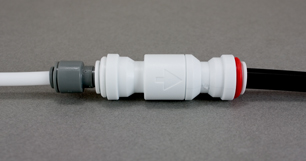
If you have an "air gap" faucet on your undersink reverse osmosis unit and you want to get rid of the gurgling and occasional dumping of drain water onto your countertop, there's a simple and inexpensive way to convert your airgap faucet to a standard faucet.
The simple device (at right) allows you to bypass the drain feature of your air gap faucet if you want to. It's a check valve—it allows drain water to flow away from your unit but not toward it.
The white tube is the drain coming from your RO unit. The black tube connects to the drain saddle on your drain pipe. Fittings are John Guest-style Quick Connect.
The only tool you'll need to install this adapter on your RO unit is a pair of scissors.
Get more information here.
|
Water News
Water News for November of 2025

Water News for November 2025
Salisbury, MD vs. Perdue Agribusiness
In spite of promised action from a powerful soybean processor, Salisbury, MD finds that that PFAS contamination of its drinking water is only getting worse. New Lede.
Lead Pipe Replacement
At this point, no state has gotten rid of all of its toxic lead service lines which pipe drinking water to homes and businesses. But some cities like Chicago, New York City, and Detroit have more lead plumbing than others, and replacing it can cost tens of thousands of dollars.
Water Infrastructure Finance
EPA’s water-infrastructure financing program has moved at a sluggish pace since President Donald Trump took office, approving only three loans so far this year, compared with 18 in 2024 and 24 in 2023.Water utility trade groups sounded the alarm about the Water Infrastructure Finance and Innovation Act (WIFIA) program’s slowdown in a letter to Administrator Lee Zeldin late last month, asking that EPA resume “the previous pace” of loan closings. There are 38 pending water and wastewater projects that have applied for loans, according to the program webpage. E&E News.
River Dolphins Dying of Rising Water Temperatures
More than 200 river dolphins died in Brazil’s Lake Tefé in the fall of 2023, with water temperatures soaring as high as 105.8 degrees Fahrenheit, according to a new study. Surface water temperatures in the region have increased by an average of around 1 degree Fahrenheit every decade since 1990, the researchers find. “The climate emergency is here, there is no doubt about it,” Fleischmann tells the Agence France-Presse.More broadly, the findings highlight the need to investigate how global warming is affecting historically overlooked tropical regions. The researchers call for long-term monitoring of the Amazon’s lakes and climate solutions that involve the region’s inhabitants.“Climate models project increasing air and sea surface temperatures across the globe, yet the impact of climate change on tropical fresh waters remains largely unknown,” the researchers write. Smithsonian
NIH Studies the Effectiveness of Countertop Filters against Waterborne Diseases
A team led by Virginia Tech’s Alasdair Cohen is launching the first major U.S. study to test whether simple countertop water filters can reduce illness in households that rely on private wells and springs for drinking water.The study, supported by a $3.7 million National Institutes of Health (NIH) grant, includes faculty members from four universities and will focus on rural Appalachia in Southwest Virginia and northeast Tennessee. Findings from Cohen and colleagues’ prior studies indicate that lower-income families in that region face higher risks of waterborne diseases because of contaminated private water sources that are not monitored and regulated like public water systems. Virginia Tech News.
Drought is quietly pushing American cities toward a fiscal cliff
Drought, hurricanes, floods and fires are bankrupting cities across America. After flames ripped through Paradise, California in 2018, the town’s redevelopment agency defaulted on some of its obligations. Naples, Florida resorted to selling $11 million in bond to rebuild its pier after Hurricane Ian in 2022. Earlier this year, the Los Angeles Department of Water and Power had a harder time raising money after massive fires swept the city. Kerr County, Texas is in the midst of raising taxes after devastating floods in July. And the city of Clyde in north Texas missed two debt payments last year during a prolonged dry spell. Full article in Grist.
PFAS Manufacturing Status Questioned
A leading environmental group has challenged the EPA’s assertion as totally false and misleading that a hazardous PFAS product is no longer being made or imported, New Lede.
New EPA Administrator’s Goal: “To Fix Everything”
Since getting confirmed by the United States Senate on January 29, 2025, U.S. Environmental Protection Agency (EPA) Administrator Lee Zeldin has now traveled to all fifty states across the country to hear directly from the American people about the challenges facing their communities and to better inform policy decisions to be made at EPA. Throughout his travels, Administrator Zeldin shared one goal with everyone he met, and that is to fix everything. (EPA Press Release.)
Pitt researchers reveal hidden impacts of drinking-water treatment on urban streams
Aging lead-pipe drinking water systems, along with the public health measures implemented to reduce their risks, are reshaping the chemistry and health of nearby urban streams. New research from University of Pittsburgh biogeochemists, hydrologists, and environmental engineers uncovered previously overlooked environmental impacts of a common water treatment practice: adding orthophosphate to drinking water systems to prevent lead pipe corrosion. The study reveals that phosphate used in drinking water treatment can leak into urban streams, altering their chemistry and potentially accelerating eutrophication, the process where such nutrients lead to excessive growth of algae and aquatic plants..And such lead-pipe networks are widespread throughout the Northeast, Great Lakes region and Midwest — meaning as many as 20 million Americans and their nearby streams may face similar challenges. Eurekalert
Popping Water Mains
As infrastructure ages, crippling water main breaks are becoming more frequent and more difficult to fix. Xylem
Forever Chemicals used with pesticides
The Guardian has revealed the alarming news that PFAS “forever chemicals” are applied in generous amounts in the form of pesticides on staple crops in some areas. The chemicals are added to pesticides that are sprayed on crops such as almonds, pistachios, wine grapes, alfalfa and tomatoes, the review of California department of pesticide regulation data found. The Environmental Working Group non-profit put together the report.
The risk for uptake of PFAS is likely higher in water-rich fruits and vegetables, because water attracts the chemicals, and research has shown PFAS may concentrate at dangerous levels in some produce. The chemicals also pollute water supplies and present a higher risk to the often low-income and Latino farm workers. The Guardian.
More Coastal Flooding Due to Rising Sea Levels
More than 5,500 toxic sites nationwide could face coastal flooding by 2100 due to rising sea levels, according to new research.
The study, published in Nature Communications and led by scientists at the University of California, warns that if heat-trapping pollution continues unabated, rising seas will flood a wide range of hazardous facilities including those handling sewage, toxic waste, oil and gas, as well as other industrial pollutants. The Guardian
“The Kidneys of the Landscape”
In what could be a move that is devastating for water quality in the United States, Lee Zeldin, current head of the EPA, has proposed a redefining of “waters of the United States” to exclude wetlands. Here’s a good article that explains the problem on the Pure Water Gazette website.
|
|
Places to visit for additional information:
|
|
|
|
|
|